


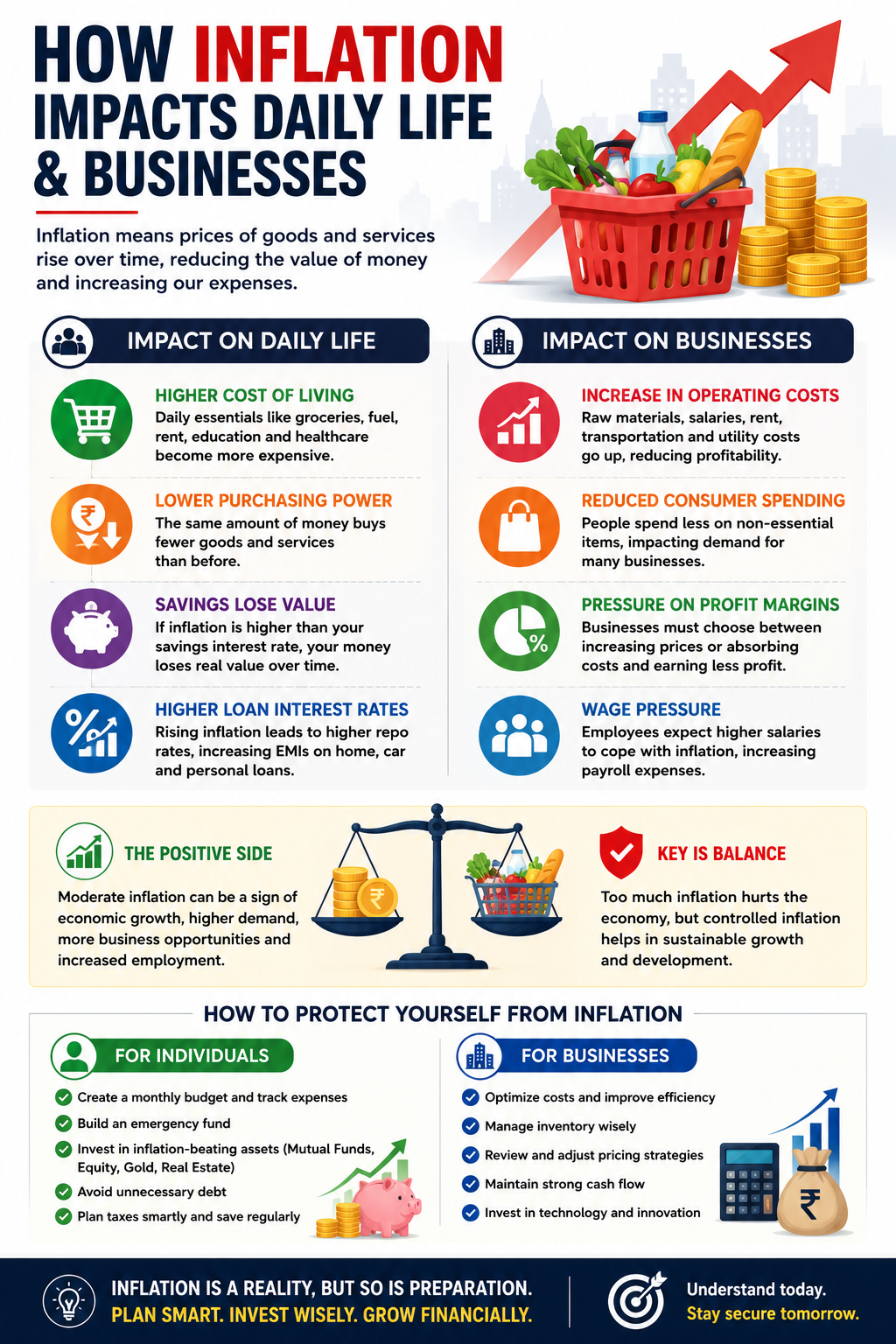
Inflation is one of the most talked-about economic factors affecting households, businesses, and the overall economy. Whether you’re buying groceries, paying rent, managing business expenses, or planning investments, inflation directly impacts your financial decisions. But what exactly is inflation, and how does it affect your daily life, purchasing power, business costs, and financial planning? Let’s understand in simple terms.
What Is Inflation?
Inflation refers to the increase in prices of goods and services over time, which reduces the purchasing power of money.
In simple words, when inflation rises, the same amount of money buys fewer products and services than before.
For example:
- Petrol prices increase
- Grocery bills become expensive
- House rent rises
- Business operating costs go up
This means your monthly expenses increase, even if your income remains the same.
How Inflation Impacts Daily Life
1. Higher Cost of Living
One of the biggest effects of inflation is the increase in daily household expenses.
Essential expenses such as:
- Food and groceries
- Electricity bills
- Transportation costs
- Fuel prices
- School fees
- Healthcare expenses
become more expensive over time.
For salaried individuals and middle-class families, rising inflation can make monthly budgeting difficult.
Keyword Focus: cost of living in India, rising inflation impact, household expenses in India
2. Reduced Purchasing Power
Inflation decreases the value of money.
For example:
If ₹1,000 could buy groceries for a week last year, the same amount may only cover 4–5 days of groceries today.
This is called loss of purchasing power, where money becomes less valuable due to rising prices.
Keyword Focus: purchasing power meaning, inflation and purchasing power
3. Savings Lose Value
Keeping money idle in a savings account may not always be beneficial during inflation.
If inflation is growing faster than your bank interest rate, your money effectively loses value over time.
For example:
- Savings account return = 3–4%
- Inflation rate = 6–7%
This means your money’s real value decreases.
This is why many financial experts recommend inflation-beating investments such as:
- Mutual funds
- Equity investments
- Gold
- Fixed assets
- Tax-saving investments
Keyword Focus: best investment during inflation, inflation-proof investments India
4. Higher Loan Interest Rates
To control inflation, the Reserve Bank of India (RBI) may increase the repo rate, leading to:
- Higher home loan EMIs
- Increased business loan interest
- Costlier car loans
- More expensive personal loans
This directly impacts borrowers and businesses dependent on financing.
Keyword Focus: inflation and loan interest rates, repo rate impact on EMI
How Inflation Affects Businesses
1. Increase in Operational Costs
Businesses often face rising expenses due to inflation, including:
- Raw material costs
- Employee salaries
- Transportation charges
- Electricity and utility bills
- Rent and office expenses
This reduces profitability unless businesses increase prices.
For SMEs and startups, managing rising costs becomes challenging.
Keyword Focus: inflation impact on business, rising business costs India
2. Reduced Consumer Spending
When inflation rises, customers tend to spend less on non-essential items.
Consumers prioritize necessities like:
✔ Food
✔ Utilities
✔ Healthcare
while reducing spending on luxury goods, travel, and entertainment.
This affects industries such as:
- Real estate
- Luxury products
- Hospitality
- Automobile sector
3. Pressure on Profit Margins
Businesses face a difficult choice:
- Increase prices and risk losing customers
OR - Maintain prices and reduce profit margins
This becomes especially difficult in competitive markets.
Small businesses are often more vulnerable to inflation shocks.
Keyword Focus: business profit margin during inflation, inflation challenges for SMEs
4. Wage Pressure on Employers
As the cost of living rises, employees expect:
- Salary hikes
- Better benefits
- Inflation-adjusted compensation
This increases payroll expenses for businesses.
Companies may need stronger financial planning and cash flow management to sustain operations.
Positive Effects of Moderate Inflation
Not all inflation is bad.
Moderate inflation can indicate:
✔ Economic growth
✔ Higher demand for goods and services
✔ Increased business opportunities
✔ Better employment generation
A controlled inflation rate often supports a growing economy.
How to Protect Yourself From Inflation
For Individuals:
- Create a monthly budget
- Invest in inflation-beating assets
- Build an emergency fund
- Avoid unnecessary debt
- Focus on tax-efficient investments
For Businesses:
- Optimize operational costs
- Improve inventory management
- Revise pricing strategies
- Maintain healthy cash flow
- Invest in technology for efficiency
Final Thoughts
Inflation affects everyone — from salaried employees and families to business owners and investors. While rising prices can strain finances, proper financial planning, smart investments, tax planning, and business cost management can help reduce its impact.
Understanding inflation is the first step toward making better money decisions and protecting your financial future.
FAQs
1. How does inflation affect common people?
Inflation increases the cost of living, making everyday expenses such as food, fuel, and rent more expensive.
2. Why is inflation bad for businesses?
Inflation increases raw material, labor, and operational costs, reducing profit margins.
3. Does inflation affect loans?
Yes. Higher inflation often leads to higher interest rates, increasing EMIs on loans.
4. What investments are good during inflation?
Equity investments, mutual funds, gold, and real estate are often considered better during inflationary periods.