


Understanding the latest income tax slab rates is essential for effective tax planning and financial management. With changes in tax regulations and the continued focus on simplifying taxation, taxpayers must stay updated on the applicable tax slabs for FY 2026-27 (Assessment Year 2027-28). In this comprehensive guide, we'll explain the new income tax slab rates, compare tax regimes, discuss tax-saving opportunities, and help you determine which option may be suitable for your financial situation.
Income Tax Slab Rates for FY 2026-27 Under the New Tax Regime
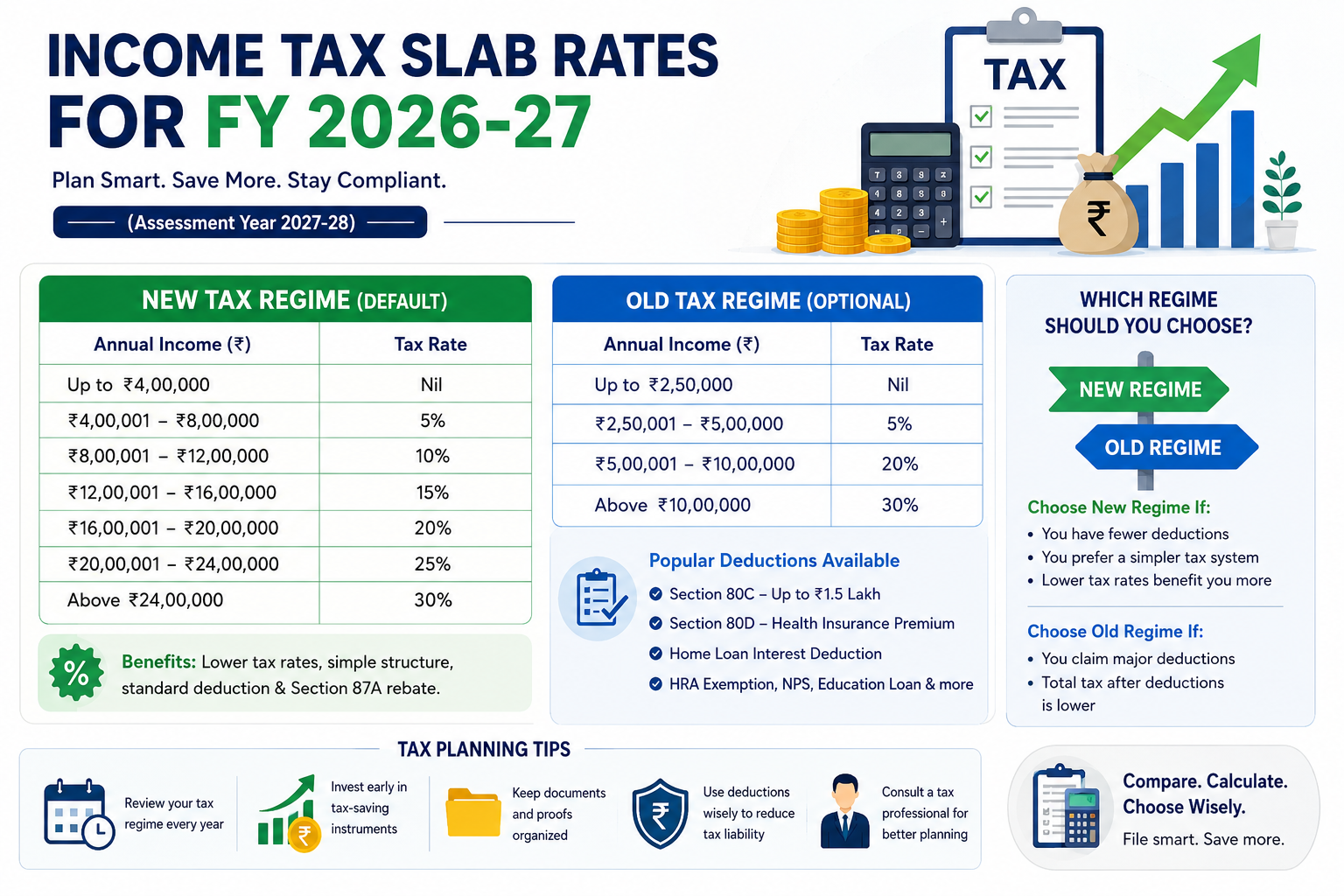
The New Tax Regime continues to be the default tax regime for individual taxpayers.
| Annual Income | Tax Rate |
|---|---|
| Up to ₹4,00,000 | Nil |
| ₹4,00,001 – ₹8,00,000 | 5% |
| ₹8,00,001 – ₹12,00,000 | 10% |
| ₹12,00,001 – ₹16,00,000 | 15% |
| ₹16,00,001 – ₹20,00,000 | 20% |
| ₹20,00,001 – ₹24,00,000 | 25% |
| Above ₹24,00,000 | 30% |
Additional Benefits
- Rebate under Section 87A available for eligible taxpayers.
- Standard deduction available for salaried employees and pensioners.
- Lower tax rates compared to the traditional tax regime.
- Simplified tax filing process.
Income Tax Slab Rates Under the Old Tax Regime
Taxpayers can still opt for the old tax regime if it provides greater tax savings through deductions and exemptions.
| Annual Income | Tax Rate |
| Up to ₹2.5 lakh | Nil |
| ₹2.5 lakh – ₹5 lakh | 5% |
| ₹5 lakh – ₹10 lakh | 20% |
| Above ₹10 lakh | 30% |
Major Deductions Available
- Section 80C (up to ₹1.5 lakh)
- Section 80D (Health Insurance Premium)
- Home Loan Interest Deduction
- HRA Exemption
- NPS Contributions
- Education Loan Interest
New Tax Regime vs Old Tax Regime: Which Is Better?
The answer depends on your income level and available deductions.
Choose the New Tax Regime If:
✔ You have limited investments eligible for deductions.
✔ You prefer a simpler tax structure.
✔ You want lower tax rates without maintaining extensive documentation.
Choose the Old Tax Regime If:
✔ You claim substantial deductions under Sections 80C, 80D, and home loan benefits.
✔ You receive HRA and other exempt allowances.
✔ Your overall tax liability becomes lower after deductions.
Example of Income Tax Calculation
Example:
Annual Income: ₹15,00,000
Under the New Tax Regime:
- Tax calculated according to slab rates.
- Standard deduction available.
- Reduced compliance burden.
Under the Old Tax Regime:
- Taxpayer may claim deductions such as:
- Section 80C: ₹1.5 lakh
- Section 80D: ₹25,000
- Home Loan Interest: As applicable
A comparison should be made before filing the Income Tax Return (ITR).
Tax Planning Tips for FY 2026-27
1. Review Your Tax Regime Annually
Evaluate both regimes before filing your return.
2. Invest Early
Avoid last-minute investments for tax savings.
3. Maintain Proper Documentation
Keep records of investments, insurance premiums, and other deductions.
4. Use Tax-Saving Instruments
Consider:
- ELSS Mutual Funds
- Public Provident Fund (PPF)
- National Pension System (NPS)
- Tax-Saving Fixed Deposits
5. Consult a Tax Professional
Professional guidance can help optimize tax liability while ensuring compliance.
Frequently Asked Questions (FAQs)
What is the default tax regime for FY 2026-27?
The New Tax Regime remains the default option for individual taxpayers.
Can I switch between old and new tax regimes?
Salaried individuals generally have flexibility to choose while filing their returns, subject to applicable rules.
Is the standard deduction available under the new tax regime?
Yes, eligible salaried employees and pensioners can claim the standard deduction.
Which tax regime results in lower taxes?
It depends on your income and deductions. A personalized comparison should be conducted.
Conclusion
The Income Tax Slab Rates for FY 2026-27 offer taxpayers greater flexibility and simplified compliance under the New Tax Regime. However, choosing between the old and new tax regimes requires careful analysis of your deductions, investments, and overall tax liability.
Before filing your Income Tax Return, compare both regimes and select the option that helps you maximize savings while remaining compliant with tax laws.
Need assistance with tax planning, ITR filing, or choosing the right tax regime? Consult a qualified tax professional to make informed financial decisions.