
Many business owners believe that if their company has no profit, they don't need to file a corporate tax return. However, this is one of the most common misconceptions among startups and business owners. In India, having no profit does not always mean you are exempt from filing your company's Income Tax Return (ITR). Depending on your business structure and legal requirements, filing may still be mandatory. This guide explains when businesses with no profit must file tax returns, why it matters, and the consequences of not filing.
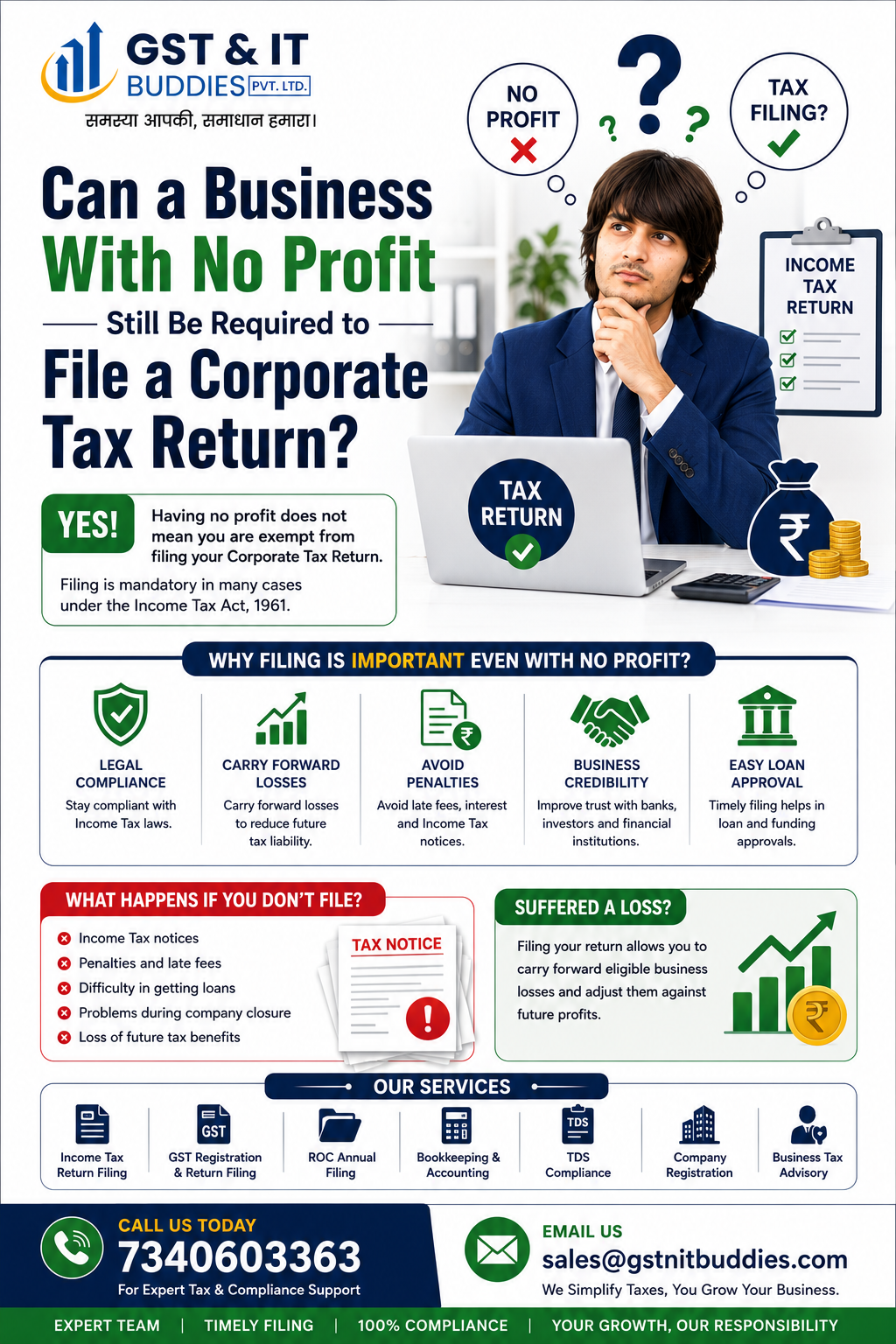
Is Filing Mandatory Even If There Is No Profit?
Yes, in many cases.
Companies registered under the Companies Act and many LLPs are required to file their Income Tax Returns regardless of whether they earned profits during the financial year.
The filing requirement depends on factors such as:
- Business structure
- Legal registration
- Annual compliance obligations
- Tax laws applicable to your entity
Which Businesses Must File Even Without Profit?
The following entities generally need to comply with annual tax filing requirements:
- Private Limited Companies
- Public Limited Companies
- One Person Companies (OPC)
- Limited Liability Partnerships (LLPs)
- Section 8 Companies
- Producer Companies
Even if:
- Revenue is zero
- Business operations did not start
- The company remained inactive
- There was a financial loss
Annual filing obligations may still apply.
Why Filing a Corporate Tax Return Is Important
1. It Maintains Legal Compliance
Filing returns keeps your company compliant with the Income Tax Act and other statutory requirements.
2. Carry Forward Business Losses
If your business incurred losses instead of profits, filing your return allows you to carry forward eligible losses, subject to applicable tax provisions.
This can reduce tax liability in future profitable years.
3. Avoid Heavy Penalties
Failure to file may result in:
- Late filing fees
- Interest on outstanding taxes
- Notices from the Income Tax Department
- Additional compliance issues
4. Improves Business Credibility
Banks, investors, and government authorities often request:
- Income Tax Returns
- Financial statements
- Compliance records
Regular filing improves your company's credibility.
5. Easier Loan Approval
Financial institutions usually verify tax compliance before approving:
- Business loans
- Working capital finance
- Overdraft facilities
Timely filing strengthens your financial profile.
What Happens If You Don't File?
Ignoring annual tax filing requirements can lead to:
- Income Tax notices
- Penalties and late fees
- Difficulty obtaining loans
- Problems during company closure
- Loss of certain tax benefits
- Compliance complications with regulatory authorities
Difference Between No Profit and No Filing Requirement
Many people confuse these two concepts.
| Situation | Tax Return Required? |
|---|---|
| Company earned no profit | Usually Yes |
| Company incurred losses | Yes |
| Newly incorporated company with no business | Usually Yes |
| Dormant company | Compliance may still be required |
| Active company with zero income | Usually Yes |
Best Practices for Businesses
Even if your business has not generated profits:
- Maintain proper books of accounts.
- File Income Tax Returns on time.
- Complete annual ROC compliance (where applicable).
- File GST returns if required.
- Preserve financial records.
- Consult a qualified tax professional for entity-specific advice.
Frequently Asked Questions (FAQs)
Can a private limited company file a nil income tax return?
Yes. A private limited company can file a nil return if there is no taxable income, while still meeting its filing obligations.
Is tax payable if there is no profit?
Generally, no income tax is payable if there is no taxable profit. However, filing requirements may still apply.
Can business losses be carried forward?
Yes. Subject to applicable tax rules, eligible business losses may be carried forward when returns are filed within the prescribed timelines.
What if my company has never started operations?
Even if business operations have not commenced, annual compliance and filing obligations may still exist depending on the entity type.
Does an LLP need to file tax returns without profit?
Yes. LLPs are generally required to file annual Income Tax Returns even if they have no profit.
Why Choose GST & IT Buddies?
At GST & IT Buddies, we help businesses stay fully compliant with Indian tax and corporate laws.
Our services include:
- Company Income Tax Return Filing
- LLP Tax Return Filing
- ROC Annual Filing
- GST Registration & Return Filing
- Accounting & Bookkeeping
- TDS Compliance
- Company Registration
- Startup Compliance
- Business Tax Advisory
Our experienced professionals ensure timely filing, accurate documentation, and complete compliance.
Conclusion
Is Filing Mandatory Even If There Is No Profit?
Yes, in many cases.
Companies registered under the Companies Act and many LLPs are required to file their Income Tax Returns regardless of whether they earned profits during the financial year.
The filing requirement depends on factors such as:
- Business structure
- Legal registration
- Annual compliance obligations
- Tax laws applicable to your entity
Which Businesses Must File Even Without Profit?
The following entities generally need to comply with annual tax filing requirements:
- Private Limited Companies
- Public Limited Companies
- One Person Companies (OPC)
- Limited Liability Partnerships (LLPs)
- Section 8 Companies
- Producer Companies
Even if:
- Revenue is zero
- Business operations did not start
- The company remained inactive
- There was a financial loss
Annual filing obligations may still apply.
Why Filing a Corporate Tax Return Is Important
1. It Maintains Legal Compliance
Filing returns keeps your company compliant with the Income Tax Act and other statutory requirements.
2. Carry Forward Business Losses
If your business incurred losses instead of profits, filing your return allows you to carry forward eligible losses, subject to applicable tax provisions.
This can reduce tax liability in future profitable years.
3. Avoid Heavy Penalties
Failure to file may result in:
- Late filing fees
- Interest on outstanding taxes
- Notices from the Income Tax Department
- Additional compliance issues
4. Improves Business Credibility
Banks, investors, and government authorities often request:
- Income Tax Returns
- Financial statements
- Compliance records
Regular filing improves your company's credibility.
5. Easier Loan Approval
Financial institutions usually verify tax compliance before approving:
- Business loans
- Working capital finance
- Overdraft facilities
Timely filing strengthens your financial profile.
What Happens If You Don't File?
Ignoring annual tax filing requirements can lead to:
- Income Tax notices
- Penalties and late fees
- Difficulty obtaining loans
- Problems during company closure
- Loss of certain tax benefits
- Compliance complications with regulatory authorities
Difference Between No Profit and No Filing Requirement
Many people confuse these two concepts.
| Situation | Tax Return Required? |
|---|---|
| Company earned no profit | Usually Yes |
| Company incurred losses | Yes |
| Newly incorporated company with no business | Usually Yes |
| Dormant company | Compliance may still be required |
| Active company with zero income | Usually Yes |
Best Practices for Businesses
Even if your business has not generated profits:
- Maintain proper books of accounts.
- File Income Tax Returns on time.
- Complete annual ROC compliance (where applicable).
- File GST returns if required.
- Preserve financial records.
- Consult a qualified tax professional for entity-specific advice.
Frequently Asked Questions (FAQs)
Can a private limited company file a nil income tax return?
Yes. A private limited company can file a nil return if there is no taxable income, while still meeting its filing obligations.
Is tax payable if there is no profit?
Generally, no income tax is payable if there is no taxable profit. However, filing requirements may still apply.
Can business losses be carried forward?
Yes. Subject to applicable tax rules, eligible business losses may be carried forward when returns are filed within the prescribed timelines.
What if my company has never started operations?
Even if business operations have not commenced, annual compliance and filing obligations may still exist depending on the entity type.
Does an LLP need to file tax returns without profit?
Yes. LLPs are generally required to file annual Income Tax Returns even if they have no profit.
Why Choose GST & IT Buddies?
At GST & IT Buddies, we help businesses stay fully compliant with Indian tax and corporate laws.
Our services include:
- Company Income Tax Return Filing
- LLP Tax Return Filing
- ROC Annual Filing
- GST Registration & Return Filing
- Accounting & Bookkeeping
- TDS Compliance
- Company Registration
- Startup Compliance
- Business Tax Advisory
Our experienced professionals ensure timely filing, accurate documentation, and complete compliance.
Conclusion
A business does not need to be profitable to have tax filing obligations. In many cases, companies and LLPs are legally required to file annual corporate tax returns even when they have no income or have incurred losses.
Filing on time helps avoid penalties, preserves future tax benefits, enhances business credibility, and ensures compliance with statutory requirements. If you're unsure about your filing obligations, consulting a qualified tax professional can help ensure you meet all applicable requirements.