


How Often Should a Business Update Its Books of Accounts? Accurate bookkeeping is the foundation of every successful business. Whether you're a startup, freelancer, retailer, or established company, maintaining updated books of accounts helps you stay compliant, make informed decisions, and avoid costly financial mistakes. But one of the most common questions business owners ask is: "How often should a business update its books of accounts?" The answer depends on your business size, transaction volume, and legal requirements. However, updating your books at least once every month is considered the minimum best practice, while businesses with frequent transactions should update them daily or weekly.
Why Is Regular Bookkeeping Important?
Keeping your financial records updated provides several benefits:
- Accurate financial reporting
- Better cash flow management
- Easy GST and Income Tax compliance
- Faster business decision-making
- Error detection before they become costly
- Improved profitability tracking
- Smooth audit preparation
- Better chances of obtaining loans and investments
Businesses that delay bookkeeping often struggle with missing invoices, incorrect GST returns, and financial confusion.
How Frequently Should You Update Your Books?
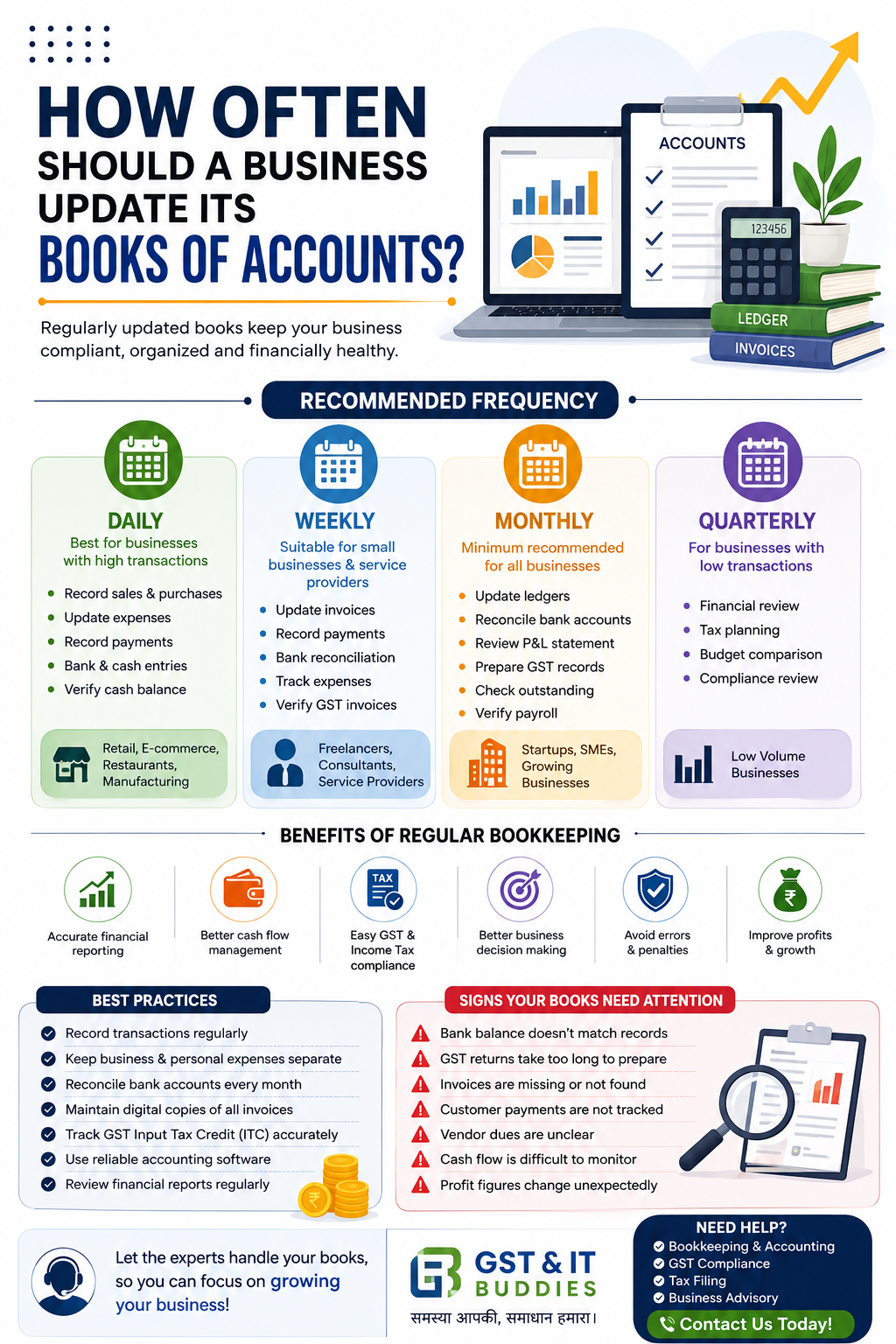
Daily Bookkeeping (Recommended for High-Transaction Businesses)
Daily bookkeeping is ideal for:
- Retail stores
- Restaurants
- E-commerce businesses
- Manufacturers
- Wholesalers
- Businesses with high cash transactions
Daily tasks include:
- Recording sales
- Recording purchases
- Updating expenses
- Recording customer payments
- Bank transaction entries
- Cash balance verification
Daily updates reduce mistakes and keep financial records accurate.
Weekly Bookkeeping
Weekly bookkeeping is suitable for:
- Small businesses
- Service providers
- Freelancers
- Consultants
Weekly tasks include:
- Updating invoices
- Recording vendor payments
- Bank reconciliation
- Expense categorization
- GST invoice verification
This schedule provides a good balance between accuracy and time management.
Monthly Bookkeeping (Minimum Recommended)
Most small and medium-sized businesses should complete bookkeeping every month.
Monthly activities include:
- Updating ledgers
- Reconciling bank accounts
- Reviewing profit and loss
- Preparing GST records
- Recording depreciation
- Checking outstanding receivables
- Reviewing payables
- Payroll verification
Monthly bookkeeping ensures your financial statements remain accurate and ready for tax filing.
Quarterly Bookkeeping
Quarterly bookkeeping is generally suitable only for businesses with very few transactions.
Quarterly reviews usually include:
- Financial statement analysis
- Tax planning
- Budget comparison
- Compliance review
Waiting until the end of the quarter to update records can increase the risk of errors.
Annual Bookkeeping: Why It's Not Enough
Some businesses only update their books before filing Income Tax Returns or GST returns.
This approach often leads to:
- Missing invoices
- Incorrect GST Input Tax Credit (ITC)
- Late compliance
- Cash flow issues
- Tax penalties
- Audit complications
Annual bookkeeping should only be used for final review—not day-to-day accounting.
Bookkeeping Schedule by Business Type
| Business Type | Recommended Frequency |
|---|---|
| Freelancer | Weekly |
| Consultant | Weekly |
| Retail Shop | Daily |
| Restaurant | Daily |
| E-commerce Business | Daily |
| Startup | Weekly or Monthly |
| Small Business | Monthly |
| Medium Business | Weekly |
| Manufacturing Company | Daily |
| Service Company | Weekly or Monthly |
Signs Your Books of Accounts Need Immediate Updating
You should update your records immediately if:
- Bank balances don't match accounting records.
- GST returns take too long to prepare.
- You can't find invoices.
- Customer payments are not tracked.
- Vendor dues are unclear.
- Cash flow is difficult to monitor.
- Profit figures change unexpectedly.
These are clear indicators that bookkeeping has been neglected.
Best Practices for Maintaining Books of Accounts
Follow these simple practices to keep your records organized:
- Record transactions regularly.
- Separate business and personal expenses.
- Keep digital copies of invoices.
- Reconcile bank accounts every month.
- Track GST Input Tax Credit accurately.
- Review financial reports regularly.
- Back up accounting data securely.
- Use reliable accounting software.
- Consult a professional accountant when needed.
Should You Outsource Bookkeeping?
Many businesses choose professional bookkeeping services because they offer:
- Greater accuracy
- Time savings
- GST compliance support
- Expert financial guidance
- Reduced risk of penalties
- Timely financial reports
Outsourcing allows business owners to focus on growth while professionals handle accounting responsibilities.
Final Thoughts
Updating your books of accounts regularly is not just a compliance requirement—it's a smart business practice.
For most businesses, monthly bookkeeping is the minimum recommendation, while businesses with frequent transactions should update their books daily or weekly. Consistent bookkeeping enhances financial visibility, supports tax compliance, and enables businesses to make informed decisions.
If maintaining accurate financial records feels overwhelming, working with experienced bookkeeping professionals can save time, reduce errors, and keep your business compliant year-round.
Frequently Asked Questions (FAQs)
1. How often should small businesses update their books?
Small businesses should update their books at least once every month. Businesses with frequent transactions should do so weekly or daily.
2. Is daily bookkeeping necessary?
Daily bookkeeping is recommended for businesses with a high volume of sales or transactions, such as retailers, restaurants, and e-commerce companies.
3. Can I update my books once a year?
Updating your books only once a year is not recommended, as it increases the risk of errors, missed compliance deadlines, and financial inaccuracies.
4. Why is bookkeeping important for GST compliance?
Regular bookkeeping ensures accurate GST records, helps claim eligible Input Tax Credit (ITC), and makes GST return filing easier.
5. Should I hire a professional bookkeeper?
If you have limited time or complex financial transactions, hiring a professional bookkeeper can improve accuracy, ensure compliance, and support better financial management.