

Taxes are an important part of India’s financial and economic system. Two of the most commonly discussed taxes are Goods and Services Tax (GST) and Income Tax. Although both are taxes, they apply to different activities and follow different rules. Understanding the difference between GST and Income Tax can help individuals, business owners, and professionals manage their tax responsibilities more effectively.
What Is GST?
Goods and Services Tax (GST) is a destination-based tax on the consumption of goods and services. It is generally collected through the supply chain, with input tax credit helping prevent the cascading of taxes. The final burden is generally borne by the consumer.
GST can involve:
- CGST – Central Goods and Services Tax
- SGST/UTGST – State or Union Territory GST
- IGST – Integrated Goods and Services Tax, generally applicable to inter-State supplies
Businesses registered under GST generally need to maintain appropriate records, issue tax invoices where applicable, collect GST, and comply with applicable return-filing requirements.
What Is Income Tax?
Income Tax is a direct tax imposed on taxable income. Depending on the taxpayer and applicable provisions, income can include salary, business or professional income, capital gains, house property income, and other sources.
Individuals and businesses may need to calculate their taxable income and file an appropriate Income Tax Return (ITR).
The Income Tax Department provides different ITR forms depending on factors such as the taxpayer’s income sources and circumstances.
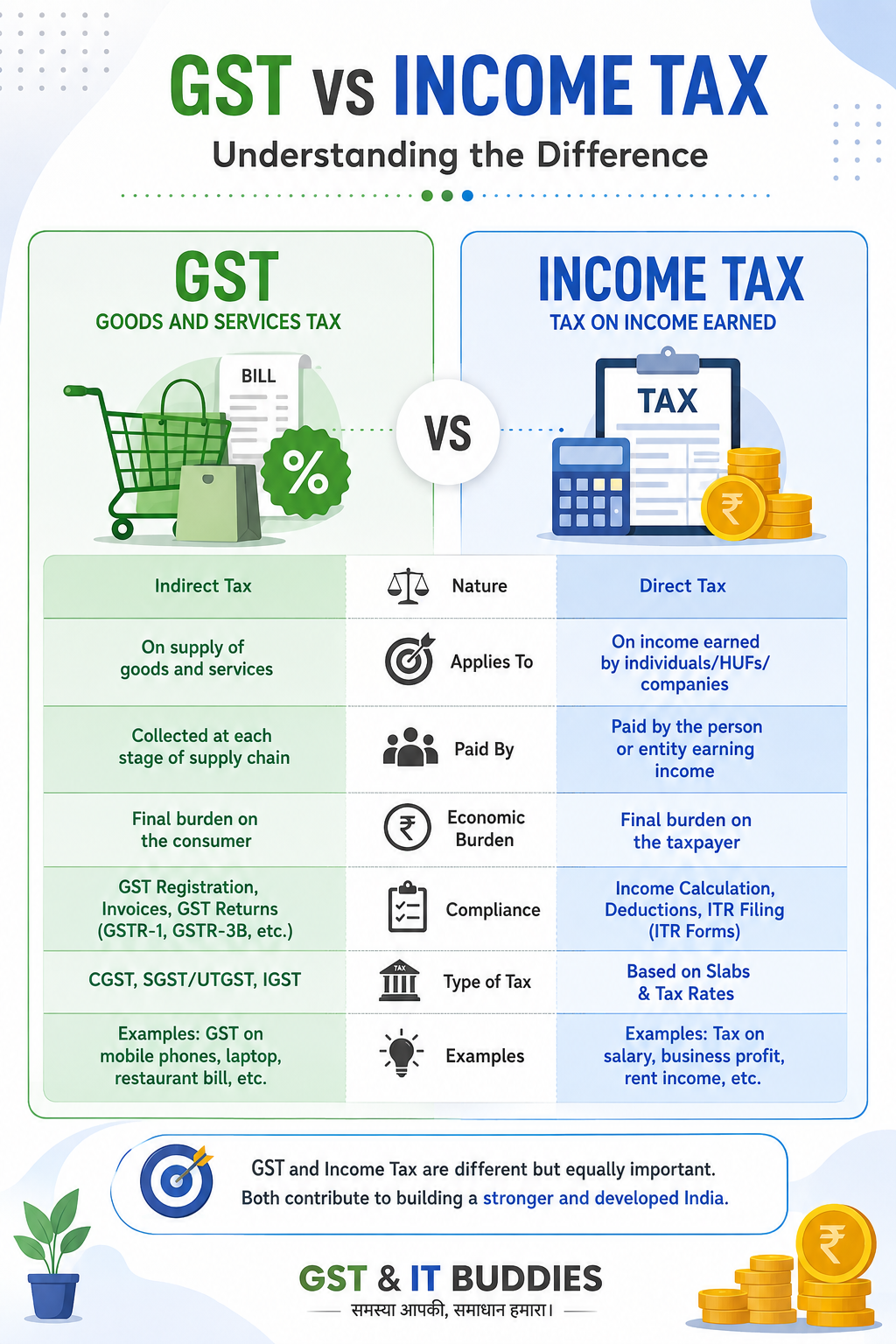
GST vs Income Tax: Key Differences
| Basis | GST | Income Tax |
|---|---|---|
| Full Form | Goods and Services Tax | Income Tax |
| Nature | Indirect tax | Direct tax |
| Mainly applies to | Supply of goods and services | Taxable income |
| Tax burden | Generally borne by the final consumer | Generally borne by the person/entity earning taxable income |
| Main focus | Transactions and supplies | Income and taxable earnings |
| Common compliance | GST registration, invoices and GST returns, where applicable | Income computation and ITR filing, where applicable |
| Examples | GST charged on a taxable supply | Tax on taxable salary or business income |
How Does GST Work?
Suppose a registered business sells taxable goods or services to a customer. GST may be charged on the taxable supply at the applicable rate.
For example:
Selling price: ₹1,00,000
Applicable GST: Depends on the classification and notified rate
Customer pays: Value of supply + applicable GST
The business collects the GST and accounts for it according to GST rules. Eligible input tax credit may be available for GST paid on qualifying business purchases.
GST rates differ according to the goods or services involved, so businesses should verify the applicable rate rather than assuming a standard percentage.
How Does Income Tax Work?
Income Tax works differently because it is based on taxable income rather than the sale of a particular product or service.
For example, an individual may receive income from:
- Salary
- Business or profession
- House property
- Capital gains
- Other sources
After considering applicable deductions, exemptions, adjustments, and other provisions, taxable income is determined according to the relevant tax rules.
For AY 2026–27, the Income Tax Department lists different slab structures under the old and new tax regimes for eligible individual taxpayers.
Can a Business Have Both GST and Income Tax?
Yes. A business can have responsibilities under both systems.
For example, a business may:
- Sell taxable goods or services and have GST compliance obligations.
- Earn business profits that may be subject to Income Tax.
- Maintain accounting records that support both GST and Income Tax reporting.
- Reconcile financial records with tax filings to reduce the risk of discrepancies.
However, GST and Income Tax are not the same tax. Compliance under one does not automatically replace compliance under the other.
GST and Income Tax: Why Businesses Should Keep Them Separate
A common mistake is treating GST collected from customers as business income. In general, GST collected on behalf of the government is accounted for separately from the business's own revenue, subject to applicable accounting and tax rules.
Similarly, Income Tax focuses on taxable income and is calculated under the Income Tax Act and related provisions.
Maintaining accurate books and reconciling sales, purchases, GST records, and income-tax information can make compliance easier.
GST vs Income Tax: Which One Applies to You?
It depends on your circumstances.
GST may be relevant if:
You are involved in supplying goods or services and meet the applicable GST registration and compliance requirements.
Income Tax may be relevant if:
You earn taxable income and are required to pay tax or file an Income Tax Return under the applicable provisions.
A taxpayer or business may therefore need to comply with both GST and Income Tax laws.
Final Takeaway
GST and Income Tax serve different purposes:
GST → Tax connected with the supply and consumption of goods and services.
Income Tax → Tax connected with taxable income.
Understanding this distinction can help businesses maintain better records, avoid confusion, and plan their tax compliance more effectively.
Need help with GST or Income Tax compliance? Professional guidance can help you understand your applicable requirements and keep your records organized.
This article is for general educational purposes. Tax rules, rates, exemptions, and compliance requirements can change, so applicable provisions should be checked for the relevant tax period.