


Introduction An e-Way Bill is an important GST compliance document used for the movement of goods. Businesses need to ensure that the information reported in the e-Way Bill matches the actual movement of goods and that the bill remains valid during transportation. In 2026, the e-Way Bill system introduced a proposed EWB Closure functionality, intended to allow taxpayers to voluntarily close certain e-Way Bills in specified situations. However, businesses should note an important current update: according to the official e-Way Bill system release notes dated 30 July 2026, the EWB Closure functionality has been kept on hold.
Therefore, businesses should understand the concept but should not treat the proposed closure functionality as an active compliance requirement until the authorities officially activate it.
What Is GST E-Way Bill Closure?
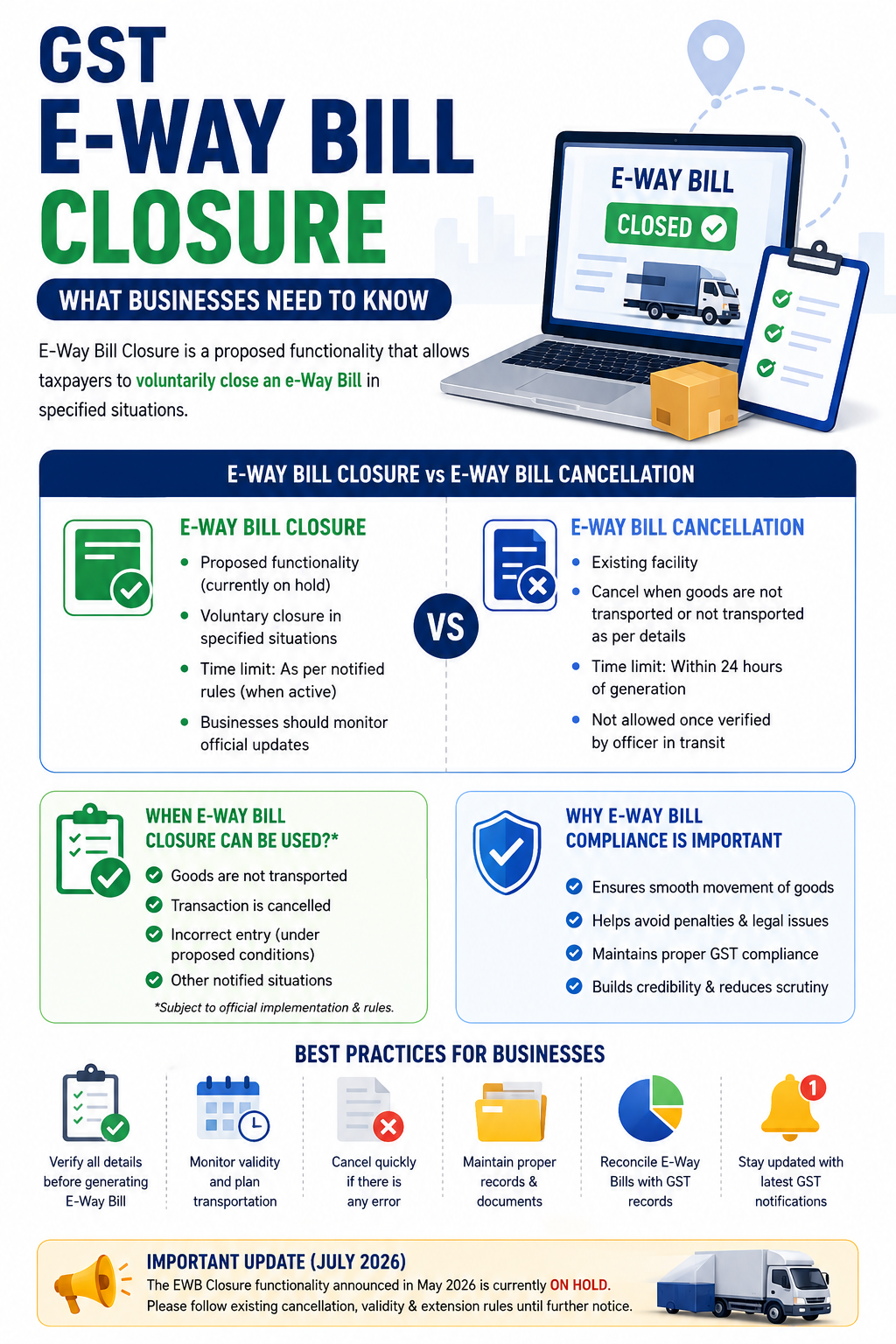
E-Way Bill Closure refers to a proposed functionality designed to allow taxpayers to voluntarily close an e-Way Bill in specified situations.
The functionality was announced as part of e-Way Bill system enhancements in May 2026. The proposed system included an EWB Closure feature and related API functionality.
However, the official system update dated 30 July 2026 states that recent changes related to EWB Closure have been kept on hold.
This means businesses should distinguish between:
- E-Way Bill Closure – proposed functionality currently on hold.
- E-Way Bill Cancellation – an existing facility available in specified circumstances.
- E-Way Bill Expiry – occurs when the validity period ends without the required movement being completed.
E-Way Bill Closure vs Cancellation
These terms should not be treated as interchangeable.
| Point | E-Way Bill Closure | E-Way Bill Cancellation |
|---|---|---|
| Status | Functionality currently on hold | Existing facility |
| Purpose | Proposed voluntary closure in specified scenarios | Cancel an E-Way Bill when goods are not transported or are not transported as reported |
| Time limit | Depends on the notified functionality | Generally within 24 hours of generation |
| Can it be used after officer verification? | Subject to applicable functionality/rules | No, if the EWB has been verified in transit |
| Current action for businesses | Monitor official updates | Follow existing cancellation rules |
Under the existing rules, an E-Way Bill can be cancelled electronically within 24 hours of generation when the goods are not transported or are not transported according to the details furnished. An E-Way Bill cannot be cancelled if it has already been verified in transit.
What Happens If an E-Way Bill Is Incorrect?
An E-Way Bill cannot simply be edited after generation.
According to the official E-Way Bill FAQ, if incorrect information has been submitted, the existing E-Way Bill generally needs to be cancelled and a new one generated with the correct details. The cancellation must be completed within the applicable 24-hour period.
Businesses should therefore carefully check:
- Supplier and recipient details
- Invoice number and date
- Product information
- Taxable value
- GST details
- Vehicle information
- Transportation mode
- Approximate distance
- Delivery location
Maintaining accurate invoice and transportation data can reduce unnecessary compliance issues.
What If the E-Way Bill Expires?
An E-Way Bill has a validity period based on the distance involved and applicable rules.
The official E-Way Bill FAQ explains that, under the standard rule framework, validity is calculated based on the distance to be transported. For regular transportation, the traditional rule provides one day for up to 100 km and an additional day for every additional 100 km or part thereof.
If goods cannot reach the destination within the validity period because of exceptional circumstances, the transporter may use the validity-extension facility subject to the applicable conditions.
Examples of circumstances can include:
- Natural calamities
- Accidents
- Law-and-order problems
- Trans-shipment delays
- Vehicle breakdowns
- Other exceptional transportation circumstances
The system requires relevant reasons and transportation details when an extension is requested.
Why Is E-Way Bill Compliance Important?
E-Way Bill compliance helps businesses maintain consistency between their:
Invoice → E-Way Bill → Goods Movement → GST Records
Errors or inconsistencies can create questions during GST verification or departmental checks.
Businesses should therefore avoid treating E-Way Bills as merely transportation documents. They form part of the broader GST compliance trail.
Regular reconciliation can help identify:
- Incorrect invoice details
- Wrong vehicle numbers
- Duplicate E-Way Bills
- Cancelled transactions
- Expired E-Way Bills
- Differences between accounting records and transportation documents
Best Practices for Businesses
Businesses can strengthen their E-Way Bill compliance by following a few simple practices:
1. Verify Details Before Generation
Check the invoice and transportation information carefully before generating the E-Way Bill.
2. Monitor E-Way Bill Validity
Keep track of validity periods, especially for long-distance shipments and delayed consignments.
3. Act Quickly on Errors
If an E-Way Bill contains incorrect information, follow the applicable cancellation and fresh-generation process within the permitted time.
4. Maintain Transportation Records
Keep invoices, delivery challans, vehicle details and other relevant documents properly organized.
5. Reconcile E-Way Bills With GST Records
Regular reconciliation can help identify discrepancies before they become larger compliance problems.
6. Monitor Official GST Updates
GSTN periodically introduces changes to the E-Way Bill system. Businesses should verify new functionality and compliance requirements through official updates before changing their internal processes.
Latest 2026 Update on E-Way Bill Closure
The most important point for businesses is that the EWB Closure functionality announced in May 2026 is currently on hold.
The official E-Way Bill system release notes updated on 30 July 2026 specifically state that recent changes relating to E-Way Bill Closure and mandatory Ship-to GSTIN have been kept on hold.
Therefore, businesses should not assume that E-Way Bill Closure is currently an active mandatory process. Instead, they should continue following the existing E-Way Bill cancellation, validity-extension and transportation compliance procedures unless a subsequent official notification changes the position.
Conclusion
GST E-Way Bill Closure is an important development to understand, but businesses need to distinguish between the proposed closure functionality and the existing E-Way Bill compliance mechanisms.
As of the latest official E-Way Bill system update available in July 2026, the EWB Closure functionality is on hold.
For now, businesses should focus on accurate E-Way Bill generation, timely cancellation where applicable, validity monitoring, proper extension in eligible exceptional circumstances, and regular reconciliation with their GST and accounting records.
Staying up to date with official GSTN announcements can help businesses adapt quickly when new E-Way Bill functionality becomes operational.