
For every business and taxpayer, managing taxes involves more than simply paying tax when it becomes due. Two important concepts—tax compliance and tax planning—play different roles in effective financial management. Tax compliance focuses on following applicable tax laws, filing returns correctly, maintaining records, and meeting deadlines. Tax planning, on the other hand, involves making informed financial decisions within the law to manage tax liability efficiently.Understanding the difference between these two concepts can help individuals and businesses stay compliant while making better financial decisions.
What Is Tax Compliance?
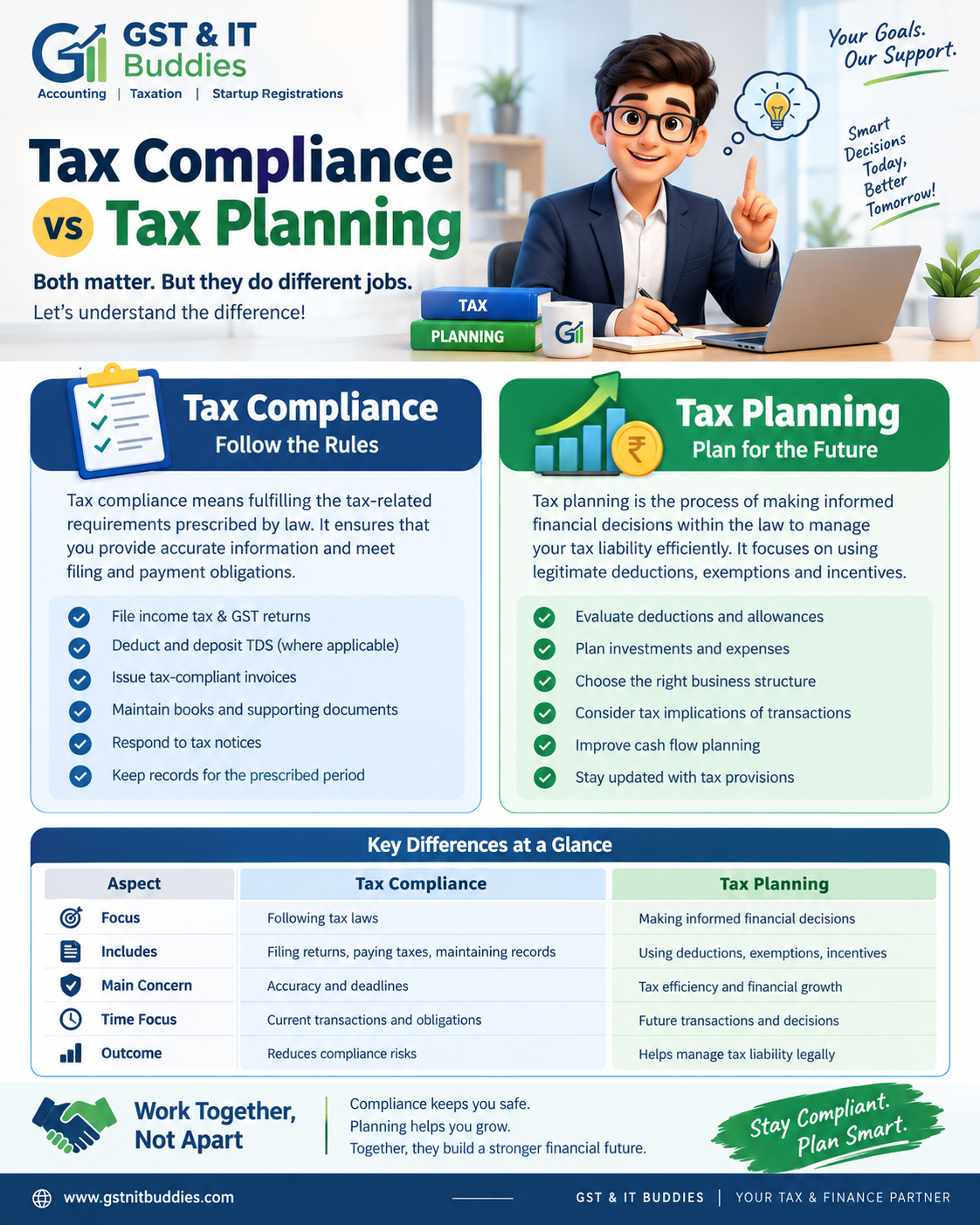
Tax compliance means fulfilling the tax-related requirements prescribed by law. It ensures that a taxpayer provides accurate information to the relevant authorities and meets applicable filing and payment obligations.
For a business in India, tax compliance may include:
- Filing applicable Income Tax Returns
- Filing GST returns within the prescribed timelines
- Deducting and depositing TDS where applicable
- Issuing tax-compliant invoices
- Maintaining books and supporting documents
- Reconciling tax records and financial records
- Responding to tax notices when required
- Keeping relevant records for the prescribed period
The exact compliance requirements depend on factors such as the nature of the business, turnover, transactions, registration status, and applicable tax laws.
What Is Tax Planning?
Tax planning is the process of organizing financial activities and making legitimate decisions with an understanding of their tax consequences.
The objective is not to avoid taxes illegally. Instead, tax planning involves using available deductions, exemptions, incentives, structures, and legally permitted provisions appropriately.
For example, a business may consider:
- The timing of certain business expenses
- Applicable deductions and allowances
- Available tax incentives
- Appropriate business structure
- Investment decisions and their tax implications
- Cash-flow requirements related to tax payments
- Applicable tax provisions for a particular transaction
Tax planning should always be based on the law applicable to the taxpayer and the relevant financial year.
Tax Compliance vs Tax Planning
Although they are related, tax compliance and tax planning are not the same.
| Tax Compliance | Tax Planning |
|---|---|
| Focuses on following tax laws | Focuses on making informed tax-related financial decisions |
| Includes filing returns and paying applicable taxes | Includes evaluating legitimate tax-saving opportunities |
| Primarily concerned with accuracy and deadlines | Primarily concerned with financial planning and tax efficiency |
| Usually deals with existing transactions and obligations | Often considers future transactions and decisions |
| Helps reduce compliance risks | Helps manage tax liability within the law |
| Requires proper documentation and records | Requires advance analysis and financial planning |
Why Is Tax Compliance Important?
Failing to meet tax obligations can create unnecessary financial and administrative problems.
Proper tax compliance helps businesses:
1. Avoid Late Filing Issues
Tax returns and other statements may have specific filing deadlines. Missing deadlines can result in applicable interest, late fees, or other consequences.
2. Maintain Accurate Records
Good compliance requires businesses to maintain appropriate financial and tax records. These records can also help management understand the financial position of the business.
3. Reduce Errors
Regular reconciliation and review can help identify differences between accounting records, invoices, tax returns, and other records.
4. Handle Tax Notices More Effectively
Well-maintained records make it easier to understand and respond to queries or notices from tax authorities.
5. Support Business Operations
Tax compliance is an important part of maintaining an organized financial system, especially as a business grows.
Why Is Tax Planning Important?
Tax planning can help taxpayers make financial decisions with a better understanding of their potential tax impact.
1. Better Financial Decisions
Before entering into a transaction, businesses can consider its possible tax implications along with its commercial benefits.
2. Improved Cash Flow Planning
Understanding expected tax liabilities can help businesses plan their cash requirements more effectively.
3. Use of Legitimate Tax Benefits
Depending on eligibility, taxpayers may be able to use deductions, exemptions, incentives, or other provisions available under applicable tax laws.
4. Better Business Structure Decisions
The choice of business structure can have accounting, legal, operational, and tax implications. Tax considerations can therefore form one part of the decision-making process.
5. Reduced Last-Minute Decisions
Planning throughout the year can be more effective than trying to make tax-related decisions immediately before a filing deadline.
Tax Planning Is Not Tax Evasion
This distinction is important.
Tax planning involves using legally available provisions and making legitimate financial decisions.
Tax evasion involves deliberately concealing income, falsifying records, making fraudulent claims, or otherwise attempting to illegally avoid tax.
Businesses and individuals should maintain proper documentation and seek professional advice when the tax treatment of a transaction is unclear.
How Tax Compliance and Tax Planning Work Together
Compliance and planning should not be treated as completely separate activities.
For example, a business may plan its finances during the year while simultaneously maintaining accurate accounting records. When tax filing time arrives, those records can support accurate return preparation.
A practical approach can be:
Plan → Record → Reconcile → Review → File → Monitor
This approach helps connect financial planning with day-to-day compliance.
Common Mistakes Businesses Should Avoid
Businesses can face unnecessary tax and financial difficulties when they:
- Wait until the last moment to review tax obligations
- Ignore filing deadlines
- Mix personal and business transactions
- Maintain incomplete financial records
- Claim deductions or credits without checking eligibility
- Fail to reconcile accounting and tax records
- Make business decisions without considering their tax implications
- Treat tax planning as a year-end activity only
Regular accounting and periodic tax reviews can help identify potential issues earlier.
When Should Tax Planning Begin?
Tax planning should ideally be considered throughout the financial year, rather than only when the tax return is due.
Early planning gives businesses more time to evaluate different options, understand the tax impact of planned transactions, maintain supporting documentation, and prepare for expected tax payments.
The specific approach should depend on the taxpayer's income, business activities, transactions, applicable tax regime, and current tax rules.
Role of Professional Tax and Accounting Support
Tax laws and compliance requirements can be detailed and may change over time. Professional accounting and tax support can help businesses understand their obligations and maintain appropriate records.
A professional can assist with areas such as:
- Tax return preparation
- GST compliance
- TDS compliance
- Accounting and bookkeeping
- Tax planning
- Reconciliation
- Financial record maintenance
- Tax-related documentation
However, taxpayers should ensure that any tax planning strategy is based on applicable law and supported by proper documentation.
Conclusion
Tax compliance and tax planning serve different purposes, but both are important for effective financial management.
Tax compliance is about meeting legal obligations accurately and on time. Tax planning is about making informed financial decisions while using legitimate provisions available under the law.
For individuals and businesses, the goal should not simply be to calculate tax at the end of the year. A better approach is to maintain accurate records, monitor tax obligations regularly, understand the tax impact of financial decisions, and plan ahead.
When compliance and planning work together, taxpayers can build a more organized approach to managing their financial and tax responsibilities.
Disclaimer: Tax laws, rates, thresholds, deductions, and compliance requirements may change. Tax treatment also depends on individual facts and circumstances. Always verify the provisions applicable to the relevant financial year and seek professional advice where appropriate.