


For Assessment Year (AY) 2026–27, taxpayers and tax professionals should pay close attention to the updated reporting requirements, particularly the changes introduced through the Finance Act, 2026, and the updated tax-audit guidance issued by the Income Tax Department.
What Is Form 3CD?
Form 3CD is the statement of particulars required to be furnished under Section 44AB in connection with a tax audit.
Where the assessee's accounts are audited under another law, the tax audit report is generally furnished in Form 3CA along with Form 3CD. In other cases, Form 3CB along with Form 3CD is used.
Form 3CD contains information relating to areas such as:
- Nature of business or profession
- Books of account maintained
- Accounting methods
- Depreciation
- Payments and expenses
- Loans and deposits
- GST and other indirect-tax details
- Deductions and disallowances
- Related-party transactions
- Tax-related disclosures
The purpose is to provide the tax authorities with structured information about the taxpayer's financial and tax-compliance position.
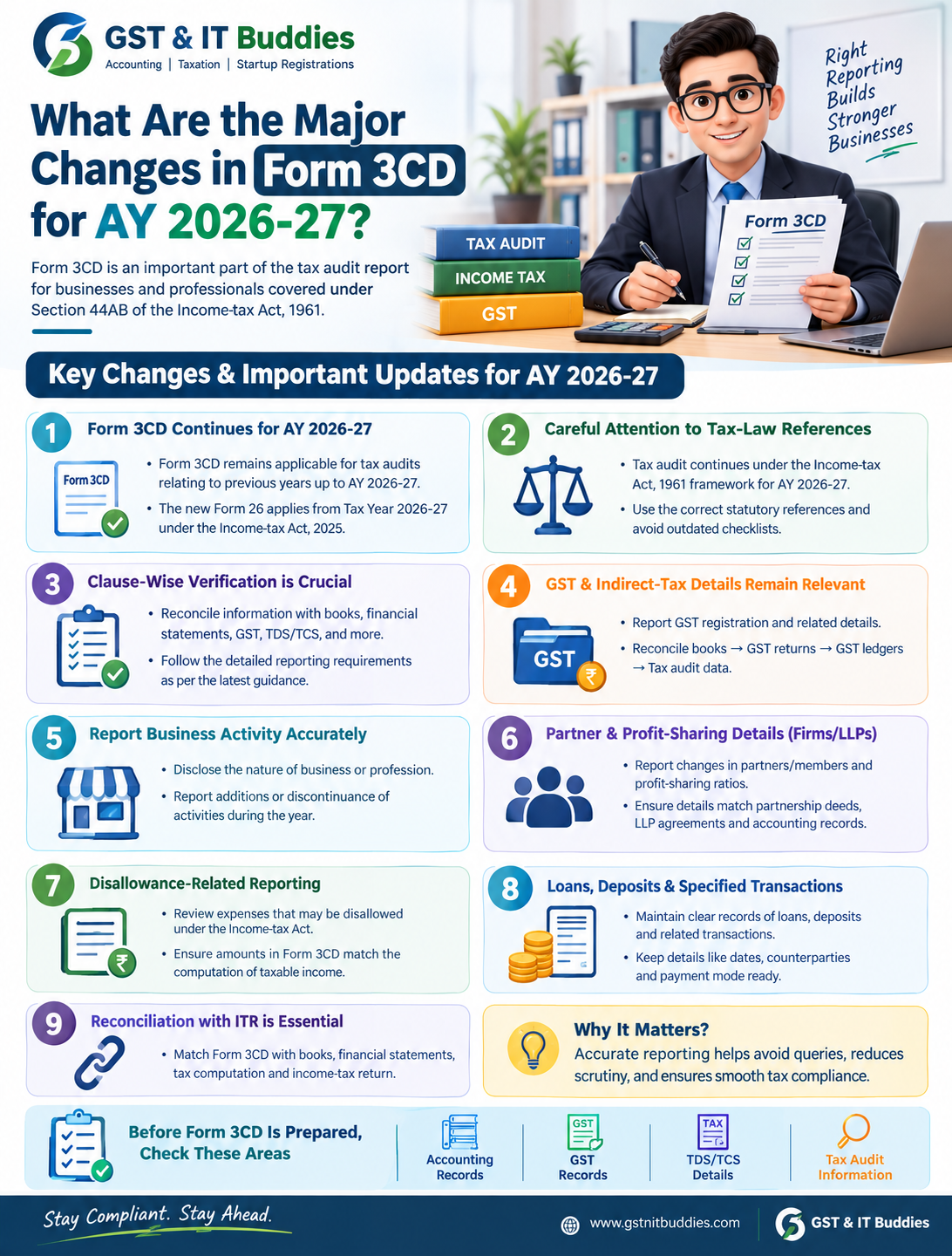
Major Changes and Important Updates for AY 2026–27
1. Reporting Continues Under the Existing Form 3CD Framework
A key point for AY 2026–27 is that Form 3CD remains applicable for tax audits relating to previous years relevant to assessment years up to AY 2026–27.
The Income Tax Department has specifically clarified that Forms 3CA, 3CB and 3CD continue for previous years relevant to AY 2026–27. The transition to the new Form 26 is relevant from Tax Year 2026–27 under the Income-tax Act, 2025.
Therefore, taxpayers should not confuse the AY 2026–27 Form 3CD requirements with the new reporting framework applicable under the Income-tax Act, 2025.
2. Changes in Tax-Law References Need Careful Attention
For AY 2026–27, the tax audit continues under the Income-tax Act, 1961 framework.
The Income Tax Department's current guidance confirms that the Form 3CD reporting requirements remain linked to the provisions applicable to the relevant assessment year. This makes it important for auditors to use the correct statutory references while preparing the report.
Businesses should therefore avoid relying on old checklists without verifying whether the relevant provision or reporting requirement has changed.
3. Greater Importance of Clause-Wise Verification
Form 3CD contains numerous clauses, and each clause has a specific reporting purpose.
For AY 2026–27, taxpayers should ensure that information reported in the audit report is properly reconciled with:
- Books of accounts
- Financial statements
- GST returns
- TDS/TCS records
- Income-tax returns
- Fixed-asset records
- Loan and advance records
- Expense ledgers
- Statutory registers and supporting documents
The Income Tax Department's guidance on tax-audit reporting emphasizes clause-wise reporting of the particulars required under Form 3CD.
4. GST and Indirect-Tax Information Remains Relevant
Form 3CD requires reporting of certain indirect-tax registrations and related information.
For example, the tax auditor is required to report whether the assessee is liable to indirect taxes such as GST and, where applicable, provide the relevant registration or identification number.
Businesses should therefore reconcile their:
Books → GST Returns → GST Ledgers → Tax Audit Data
before the tax audit report is finalized.
Differences between accounting records and GST returns can result in additional questions during the audit and may require appropriate reconciliation or explanation.
5. Business or Professional Activity Must Be Reported Accurately
Form 3CD requires reporting of the nature of business or profession.
Clause 10 also considers whether there has been an addition or discontinuance of a business or professional activity during the relevant year.
Businesses that started a new activity, discontinued an existing activity or changed their business operations should ensure that the information reported in Form 3CD agrees with their books and other statutory records.
6. Partner and Profit-Sharing Details Need Attention
For firms, LLPs, AOPs and BOIs, Form 3CD requires information relating to partners or members and their profit-sharing arrangements.
Changes during the year should be properly documented and reported, including changes in:
- Partners or members
- Profit-sharing ratios
- Relevant remuneration or related payments, wherever applicable
The auditor should ensure that the information agrees with partnership deeds, LLP agreements and accounting records.
7. Disallowance-Related Reporting Should Be Carefully Reconciled
One of the most important areas of Form 3CD is reporting relating to expenses that may be disallowed under the Income-tax Act.
Businesses should review items such as:
- Expenses involving statutory non-compliance
- Payments covered by specific disallowance provisions
- Certain cash payments
- Employee-related statutory dues
- Interest and other specified expenses
- Expenses requiring supporting documentation
The objective is not simply to complete the clause, but to ensure that the amounts reported in Form 3CD are consistent with the computation of taxable income.
8. Loans, Deposits and Specified Transactions Require Documentation
Tax audit reporting also covers specified transactions involving loans, deposits and other financial arrangements.
Businesses should maintain clear records of:
- Loans received
- Loans repaid
- Deposits received
- Deposits repaid
- Mode of payment
- Relevant transaction dates
- Counterparty details
Proper bank reconciliation and transaction-level documentation can make this verification considerably easier.
9. Reconciliation Between Tax Audit Data and ITR Becomes Even More Important
Form 3CD should not be prepared in isolation.
The figures reported in Form 3CD should be reviewed against the taxpayer's income-tax return and financial statements.
A practical reconciliation should cover:
Books of Accounts
↓
Financial Statements
↓
Form 3CD
↓
Tax Computation
↓
Income-Tax Return
Any significant mismatch should be identified and resolved before filing.
What Should Businesses Do Before Form 3CD Is Prepared?
Businesses undergoing tax audit for AY 2026–27 should ideally complete the following checklist:
Accounting Records
- Finalize books of accounts.
- Reconcile bank accounts.
- Review receivables and payables.
- Verify fixed-asset records.
- Review expense ledgers.
GST Records
- Reconcile sales with GST returns.
- Reconcile purchase and ITC records.
- Verify GSTIN details.
- Review differences between books and GST returns.
TDS/TCS
- Reconcile TDS/TCS ledgers.
- Verify applicable deductions.
- Check payment and return records.
- Review outstanding statutory dues.
Tax Audit Information
- Verify business activities.
- Check partner/member details where applicable.
- Review loans and deposits.
- Identify potential disallowances.
- Check related-party transactions.
- Review deductions and other tax-sensitive items.
Why Accurate Form 3CD Reporting Matters
Form 3CD is more than a compliance form. It provides detailed information about the taxpayer's financial and tax position.
Incorrect, incomplete or inconsistent reporting can lead to:
- Additional clarification requirements
- Tax-compliance issues
- Differences between audit report and ITR
- Additional scrutiny
- Possible reporting or penalty-related consequences, depending on the circumstances
This is why businesses should begin preparing their supporting information well before the tax-audit filing deadline.
Form 3CD vs New Form 26: Don't Confuse the Two
A significant development in India's income-tax reporting framework is the introduction of Form 26 under the Income-tax Act, 2025.
However, this should not be confused with Form 3CD for AY 2026–27.
The Income Tax Department has clarified that Forms 3CA, 3CB and 3CD continue for previous years relevant to assessment years up to AY 2026–27. From Tax Year 2026–27, tax audits are furnished through Form 26 under the new law.
This transition means taxpayers and professionals should identify the correct applicable law and reporting form based on the relevant tax year.
Key Takeaway
For AY 2026–27, Form 3CD continues to play an important role in tax-audit compliance. The focus should be on accurate clause-wise reporting, proper reconciliation of accounting and tax records, GST and TDS verification, and complete supporting documentation.
Businesses should not wait until the audit-report filing deadline to start preparing Form 3CD information. Early reconciliation can help identify discrepancies and provide sufficient time to correct or explain them.
As India's income-tax reporting framework transitions toward the Income-tax Act, 2025, taxpayers and professionals should also stay alert to the distinction between the existing Form 3CD framework for AY 2026–27 and the new Form 26 framework applicable from Tax Year 2026–27.
Frequently Asked Questions
1. Is Form 3CD applicable for AY 2026–27?
Yes. Form 3CD continues to apply for tax audits relating to previous years relevant to AY 2026–27.
2. Is Form 3CD the same as the tax audit report?
Form 3CD contains the statement of particulars required for the tax audit. Depending on the case, it is furnished along with Form 3CA or Form 3CB.
3. Is Form 26 applicable to AY 2026–27?
The Income Tax Department has clarified that Form 26 applies from Tax Year 2026–27 under the Income-tax Act, 2025, while Forms 3CA, 3CB and 3CD continue for previous years relevant to AY 2026–27.
4. What is the biggest practical issue for businesses preparing Form 3CD?
One of the most important practical requirements is ensuring that the information reported in Form 3CD is properly reconciled with the books of account, GST records, TDS/TCS records, financial statements and income-tax computation.
5. Should businesses prepare Form 3CD information in advance?
Yes. Early preparation allows businesses and auditors to identify mismatches, collect supporting documents and resolve compliance issues before the report is finalized.