


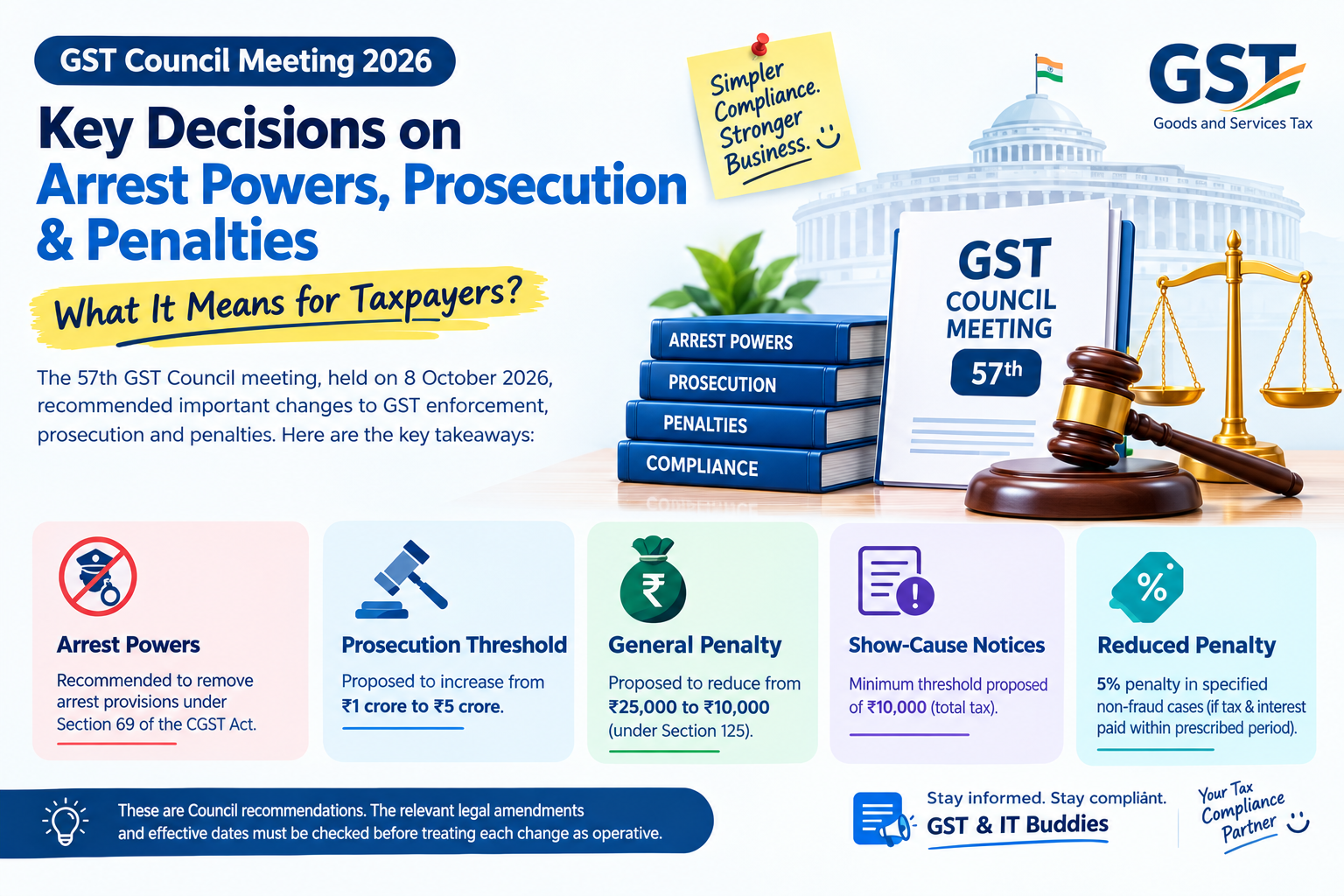
The 57th GST Council meeting, held on 8 October 2026 in New Delhi, recommended significant changes to GST enforcement and penalty provisions. The key proposals include removing arrest powers under the Central Goods and Services Tax (CGST) Act, increasing the prosecution threshold from ₹1 crore to ₹5 crore, and reducing the maximum general penalty from ₹25,000 to ₹10,000. These recommendations aim to simplify tax administration, reduce unnecessary litigation, and establish a more proportionate approach to GST compliance. Businesses should understand the proposed changes while continuing to meet their existing tax obligations.
1. Removal of Arrest Powers Under GST
One of the most significant recommendations from the 57th GST Council meeting concerns the power to arrest taxpayers under GST law.
The Council recommended completely withdrawing GST arrest powers by omitting Section 69 of the CGST Act, 2017.
What does this mean for taxpayers?
- The proposal aims to remove the statutory arrest powers GST authorities currently exercise under Section 69.
- GST disputes involving tax liabilities may increasingly be addressed through recovery of tax, interest and proportionate penalties.
- The proposed reforms seek to reduce the risk of criminal proceedings in cases that can appropriately be dealt with through civil tax consequences.
Important: This is a recommendation for legislative change, not a blanket immunity from criminal liability under every applicable law. Businesses must verify the relevant amendments and commencement date before relying on it.
2. Prosecution Threshold Increased from ₹1 Crore to ₹5 Crore
The GST Council recommended raising the monetary threshold for prosecution from ₹1 crore to ₹5 crore.
| Particulars | Existing threshold | Recommended threshold |
|---|---|---|
| Monetary threshold for prosecution | ₹1 crore | ₹5 crore |
Why is this important?
The proposed increase is intended to reduce criminal prosecution in lower-value cases while retaining enforcement measures against serious tax fraud and evasion.
The Council also recommended rationalising the offences covered under Section 132 of the CGST Act and revising the punishment provisions.
For example, the proposed amendments would narrow certain offence provisions relating to fraudulent availment of input tax credit (ITC).
Note: The threshold change should not be interpreted as permission to evade tax or disregard GST filing and payment requirements.
3. General Penalty Proposed to Reduce from ₹25,000 to ₹10,000
The Council recommended reducing the maximum general penalty under Section 125 of the CGST Act, 2017, from ₹25,000 to ₹10,000.
Section 125 concerns contraventions for which no separate penalty is specifically provided under the law.
Key points
- Existing maximum general penalty: ₹25,000.
- Recommended maximum general penalty: ₹10,000.
- The proposed reduction is intended to make penalties more proportionate for relevant compliance violations.
This recommendation does not mean that every GST penalty will be capped at ₹10,000. Where a specific penalty applies under another provision, the applicable rules must be examined separately.
4. Minimum Threshold for GST Show-Cause Notices
The Council recommended introducing a minimum monetary threshold of ₹10,000 for issuing GST show-cause notices.
Under the proposal, notices would not be issued where the total amount involved across CGST, SGST/UTGST, IGST and cess is below ₹10,000.
The Council also recommended a provision addressing qualifying pending notices and appeals below this threshold.
How could this help businesses?
The proposal aims to reduce low-value disputes, limit unnecessary litigation and allow taxpayers and tax authorities to focus on more substantial cases.
However, businesses should not assume that every minor discrepancy will automatically be ignored. The legal provisions, applicable threshold and implementation date will determine how the change operates.
5. Reduced Penalty of 5% in Specified Non-Fraud Cases
Another important recommendation relates to a reduced penalty for specified non-fraud cases.
Under the proposed framework, a penalty of 5% may apply where the taxpayer pays the applicable tax and interest within the prescribed period after the adjudication order.
The recommended time limits are:
- Section 73 cases: Within 30 days of the adjudication order.
- Section 74A cases: Within 60 days of the adjudication order.
These are proposed conditions, and taxpayers should verify the final statutory wording and eligibility requirements before calculating or paying any reduced penalty.
The objective is to encourage timely settlement of eligible non-fraud cases and reduce prolonged disputes.
6. Cap on Appeal Pre-Deposits in Penalty-Only Cases
The Council also recommended an upper limit of ₹40 crore on the pre-deposit payable for appeals in cases involving only a penalty and no tax demand.
The proposed cap is divided as follows:
- CGST: Up to ₹20 crore.
- SGST/UTGST: Up to ₹20 crore.
This recommendation is intended to reduce the financial burden on taxpayers seeking to challenge penalty-only orders before the appropriate appellate authority or tribunal.
The applicable requirements will depend on the relevant appeal provision and the final amendments.
7. What Should Businesses Do Now?
Businesses should continue following existing GST requirements until the relevant changes become legally effective.
Recommended compliance steps include:
- Review GST returns: Ensure GSTR-1 and GSTR-3B are accurate and filed within the applicable deadlines.
- Reconcile ITC: Match purchase records with GSTR-2B and maintain supporting invoices.
- Respond to notices promptly: Do not ignore an existing GST notice simply because a new threshold has been recommended.
- Maintain documentation: Keep tax invoices, payment records, reconciliations and supporting documents organised.
- Track official notifications: Check the CGST Act amendments, rules and commencement dates before applying any proposed relief.
- Seek professional guidance: Obtain advice before responding to significant tax demands, alleged fraud or prosecution-related matters.
Frequently Asked Questions
Has the GST Council removed arrest powers?
The Council recommended withdrawing the arrest powers under Section 69 of the CGST Act. Taxpayers should check the relevant legislative amendment and its effective date to determine when the change applies.
What is the new GST prosecution threshold?
The Council recommended increasing the monetary threshold for prosecution from ₹1 crore to ₹5 crore.
Has the maximum general penalty been reduced to ₹10,000?
The Council recommended reducing the maximum general penalty under Section 125 from ₹25,000 to ₹10,000. This is not a universal cap on all GST penalties.
Will GST notices below ₹10,000 stop?
The Council recommended a minimum threshold of ₹10,000 for issuing show-cause notices, with provisions for certain pending matters. The effective legal provisions must be checked before relying on this threshold.
Can taxpayers stop filing GST returns because of these changes?
No. The recommendations do not remove the general obligation to comply with applicable GST return-filing, payment and record-keeping requirements.
Conclusion
The 57th GST Council meeting recommended important changes to GST enforcement, prosecution and penalties. The main proposals include removing arrest powers under Section 69, raising the prosecution threshold to ₹5 crore, reducing the maximum general penalty to ₹10,000 and introducing a ₹10,000 threshold for show-cause notices.
For businesses, the practical priority remains accurate GST reporting, proper ITC reconciliation, timely tax payments and prompt responses to official notices.
Stay updated with GST & IT Buddies for GST notifications, Income Tax updates, accounting guidance and business compliance information.