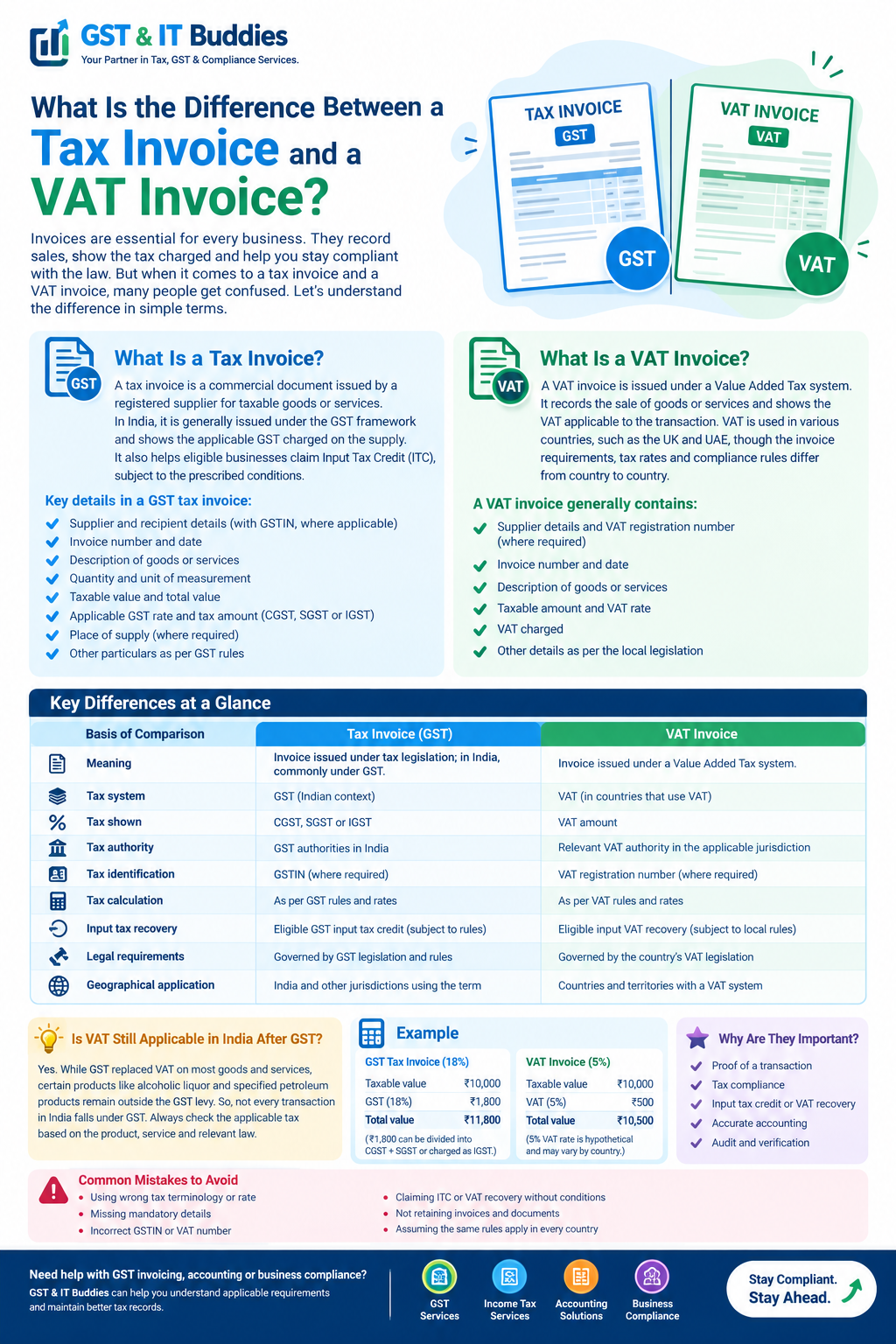
Invoices are essential documents for businesses because they record sales, communicate payment details, and help maintain accurate tax records. Two terms that often confuse business owners are tax invoice and VAT invoice. Although both documents record transactions and may show tax charged on a sale, they relate to different indirect tax systems. A tax invoice is commonly used under the Goods and Services Tax (GST) system in India, whereas a VAT invoice relates to the Value Added Tax (VAT) system used in various jurisdictions.
Understanding the difference between a tax invoice and a VAT invoice is important for businesses, accountants, retailers, and finance professionals who want to maintain proper documentation and comply with applicable tax laws.
What Is a Tax Invoice? A tax invoice is a commercial document issued by a registered supplier for taxable goods or services under the applicable tax legislation. In India, registered suppliers generally issue tax invoices for taxable supplies under the GST framework, subject to the relevant rules and exceptions.
A tax invoice records the transaction details and specifies the applicable GST charged on the supply. It also serves as an important document for eligible businesses claiming Input Tax Credit (ITC), subject to the prescribed conditions.
Key Details Included in a GST Tax Invoice: A GST tax invoice generally contains:
Name, address, and GSTIN of the supplier.
Invoice number and date of issue.
Recipient details, including GSTIN where applicable.
Description of goods or services supplied.
Quantity and unit of measurement, where applicable.
Total value and taxable value of the supply.
Applicable GST rate and tax amount, such as CGST, SGST, or IGST.
Place of supply details where required.
Other particulars prescribed under GST rules.
These details help businesses record transactions correctly and support their GST compliance activities.
What Is a VAT Invoice? A VAT invoice is a document issued by a supplier under a Value Added Tax system. It records the sale of goods or services and identifies the VAT applicable to the transaction.
VAT systems operate in various countries, including the United Kingdom and the United Arab Emirates, although their invoice requirements, tax rates, and compliance rules differ.
A VAT invoice generally contains the supplier's details, invoice number, date, description of goods or services, taxable amount, applicable VAT rate, and VAT charged. The exact information required depends on the relevant country's legislation and the type of transaction.
Businesses registered for VAT may use qualifying VAT invoices to support their accounting records and recover eligible input VAT, subject to local rules.
Difference Between a Tax Invoice and a VAT Invoice The primary difference is the tax framework under which the invoice is issued. A tax invoice under India's GST system records GST, while a VAT invoice records VAT under the applicable VAT legislation.
Basis of Comparison Tax Invoice VAT Invoice Meaning Invoice issued under an applicable tax system; in India, commonly associated with GST Invoice issued under a Value Added Tax system Tax system GST in the Indian context VAT in jurisdictions that use VAT Tax displayed Applicable GST, such as CGST, SGST, or IGST Applicable VAT amount Tax authority Relevant GST authorities in India Relevant VAT authority in the applicable jurisdiction Tax identification GSTIN in India, where required VAT registration number, where required Tax calculation Based on applicable GST provisions and rates Based on applicable VAT provisions and rates Input tax recovery Eligible GST input tax credit, subject to GST rules Eligible input VAT recovery, subject to local VAT rules Legal requirements Governed by applicable GST legislation and rules Governed by the applicable country's VAT legislation Geographical application India and other jurisdictions using the term under their respective tax laws Countries and territories operating a VAT system Important: The term "tax invoice" is not exclusive to GST. Other countries may also use the term for invoices issued under their own tax legislation. Therefore, the exact legal requirements depend on the country and the tax system involved.
Is VAT Still Applicable in India After GST? India introduced the Goods and Services Tax on 1 July 2017, replacing several indirect taxes, including VAT on many goods and services previously covered by state VAT laws.
However, VAT did not disappear entirely. Certain products, such as alcoholic liquor for human consumption and specified petroleum products, remain outside the GST levy, and state VAT or other applicable state taxes may continue to apply to them.
Consequently, businesses should not assume that every transaction in India falls under GST. The applicable tax depends on the product or service, the nature of the transaction, and the relevant legislation.
For ordinary taxable supplies covered by GST, registered suppliers generally issue GST tax invoices rather than legacy VAT invoices.
Example: Tax Invoice vs VAT Invoice. Consider a business selling products with a taxable value of ₹10,000.
Example 1: GST Tax Invoice in India. Assume the applicable GST rate is 18%.
Taxable value: ₹10,000
GST at 18%: ₹1,800
Total invoice value: ₹11,800
The GST invoice should show the applicable tax details. Depending on the transaction, the ₹1,800 tax may be divided into CGST and SGST or charged as IGST.
Example 2: VAT Invoice in a VAT Jurisdiction. Assume a business in a jurisdiction applies a hypothetical VAT rate of 5%.
Taxable value: ₹10,000
VAT at 5%: ₹500
Total invoice value: ₹10,500
The VAT invoice would record the applicable VAT amount and other details required by that jurisdiction.
These examples are illustrative. The 5% VAT rate is hypothetical and does not represent the rate applicable to every country or transaction.
Why Are Tax Invoices and VAT Invoices Important? Both types of invoices support reliable financial records and tax compliance.
-
Evidence of a Transaction: An invoice records the goods or services supplied, the parties involved, the transaction value, and the applicable tax.
-
Tax Compliance: Correct invoice preparation helps businesses comply with the documentation and reporting requirements of the relevant tax system.
-
Input Tax Credit or VAT Recovery: Eligible businesses may use valid invoices to support claims for GST input tax credit or input VAT recovery, subject to the applicable conditions.
-
Accurate Accounting: Invoices help businesses record sales, purchases, tax liabilities, and amounts receivable or payable.
-
Audit and Verification: Proper invoice records make it easier to verify transactions during internal reviews, tax assessments, and audits.
Common Mistakes Businesses Should Avoid: Businesses should pay attention to the following points when preparing or processing invoices:
Using VAT terminology and tax treatment when the transaction is governed by GST.
Applying an incorrect tax rate.
Omitting mandatory invoice particulars.
Entering an incorrect GSTIN or VAT registration number.
Claiming input tax credit or VAT recovery without meeting the applicable conditions.
Failing to retain invoices and supporting documents.
Assuming invoice requirements are identical across different countries.
Businesses involved in international trade should verify the applicable rules in the country where the transaction is taxable.
Frequently Asked Questions (FAQs)
-
What is the main difference between a tax invoice and a VAT invoice? A tax invoice is a general term for an invoice issued under applicable tax legislation. In India, it commonly refers to an invoice issued under GST. A VAT invoice records VAT under a jurisdiction's Value Added Tax system.
-
Is a GST invoice the same as a VAT invoice? No, not necessarily. A GST invoice records GST under the relevant GST legislation, while a VAT invoice records VAT under the relevant VAT legislation. Their purpose may be similar, but their legal requirements and tax treatment differ.
-
Can a business issue a VAT invoice in India? For supplies governed by GST, a registered supplier generally issues a GST tax invoice when required. VAT may still apply to certain transactions outside GST, depending on the applicable state tax law and product category.
-
Can a tax invoice be used to claim Input Tax Credit? Yes, an eligible GST-registered recipient may claim Input Tax Credit using a valid tax invoice, provided the statutory requirements and applicable conditions are satisfied. Possessing an invoice alone does not automatically guarantee eligibility.
-
Which details are required on an invoice? The required details depend on the applicable law. They commonly include the supplier's identification details, invoice number, date, description of goods or services, taxable value, tax rate, and tax amount.
-
Is VAT still applicable in India? Yes, VAT or other applicable state taxes may continue to apply to certain products outside the GST levy. For most supplies covered by GST, the GST framework applies instead of the earlier VAT system.
Conclusion: Understanding the difference between a tax invoice and a VAT invoice helps businesses maintain accurate records and follow the correct tax procedures. While both documents record taxable transactions, the applicable tax legislation determines their format, tax calculation, and compliance requirements.
In India, businesses should generally follow GST invoice rules for supplies covered by GST and check the relevant state tax provisions for transactions that remain outside the GST framework. For international transactions, the local VAT rules should be reviewed before issuing an invoice.
Need help with GST invoicing, accounting, or business compliance? GST & IT Buddies can help you understand applicable requirements and maintain better tax records.