

Tax compliance is an essential responsibility for every business operating in India. Businesses and professionals meeting the prescribed conditions must get their accounts audited by a qualified accountant and submit the audit report within the applicable deadline. But what happens when a business fails to conduct a mandatory tax audit? Missing a tax audit deadline or failing to obtain the required audit report can result in financial penalties and additional compliance complications. It may also create difficulties when filing income tax returns and maintaining accurate financial records.
What Is a Mandatory Tax Audit?
A tax audit is an examination of a taxpayer's financial records, books of accounts and other relevant documents to verify whether income, expenses, deductions and tax-related information have been properly reported.
It helps ensure that businesses follow the applicable provisions of income tax law and maintain accurate financial information.
A tax audit is generally conducted by a Chartered Accountant or another accountant authorised under the applicable law.
The objective is to:
- Verify the accuracy of financial statements.
- Check business income and expenditure.
- Identify discrepancies in financial records.
- Verify compliance with applicable tax provisions.
- Ensure accurate reporting of financial information.
## 2. Who Is Required to Conduct a Tax Audit in India?
Under Section 63 of the Income-tax Act, 2025, applicable from 1 April 2026, tax audit requirements apply to businesses and professionals meeting specified conditions.
The general thresholds include:
**For businesses:**
- Tax audit is generally applicable when annual sales, turnover or gross receipts exceed ₹1 crore.
- The threshold increases to ₹10 crore if both cash receipts and cash payments do not exceed 5% of their respective totals.
**For professionals:**
- Tax audit is generally applicable when gross professional receipts exceed ₹50 lakh.
**Presumptive taxation cases:**
Certain taxpayers opting for presumptive taxation may also be required to conduct a tax audit if they declare profits below the prescribed limits and fulfil the applicable conditions.
Therefore, businesses should examine their turnover, transaction patterns and applicable presumptive taxation provisions before deciding whether a tax audit is mandatory.
## 3. What Happens If a Business Fails to Conduct a Mandatory Tax Audit?
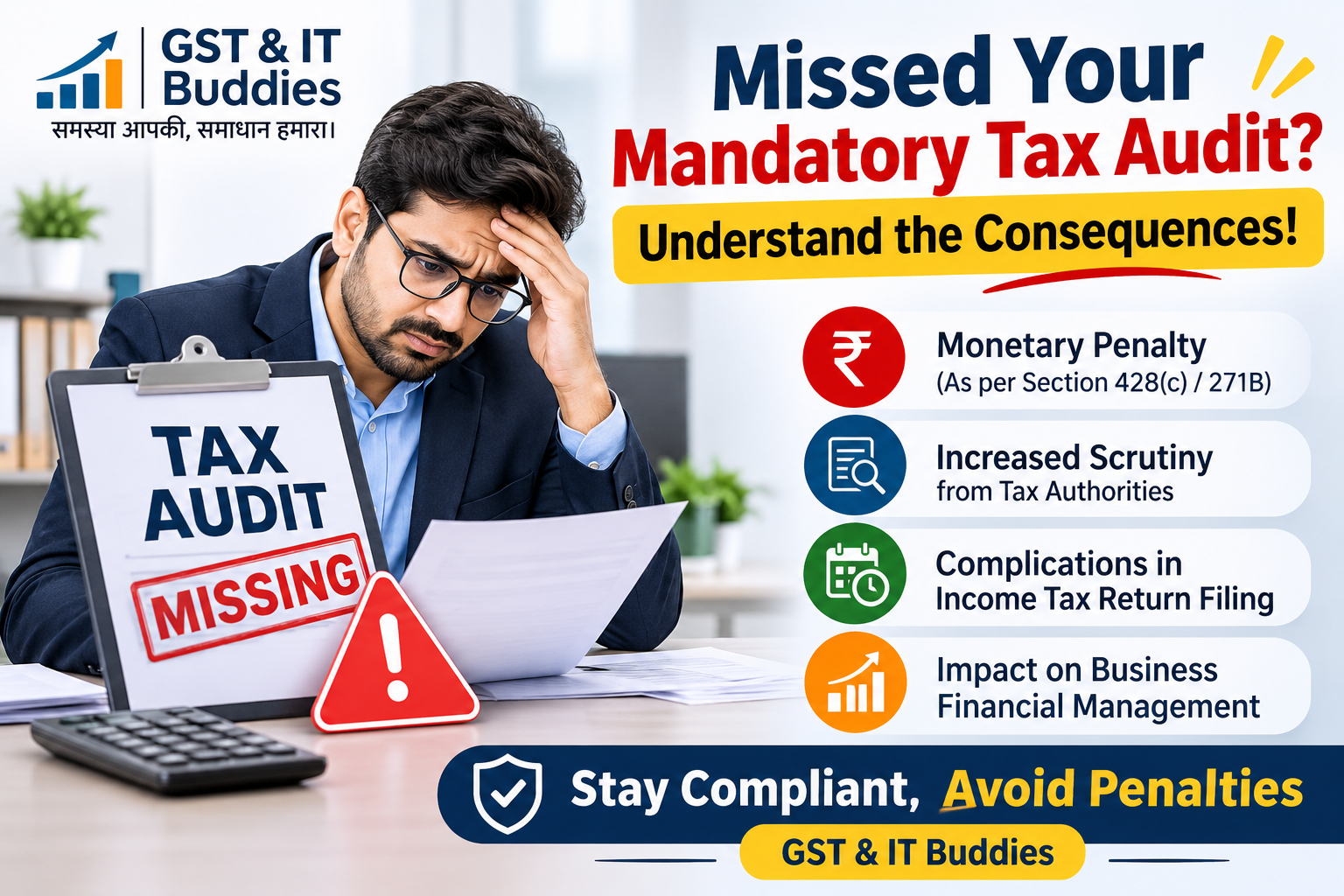
Failure to comply with mandatory tax audit requirements can create several consequences.
### A. Financial Penalty
One of the most significant consequences is the monetary penalty for failing to obtain the required audit or submit the audit report.
For tax years governed by the Income-tax Act, 2025, Section 446 provides for a penalty calculated as the lower of:
- 0.5% of total sales, turnover or gross receipts; or
- ₹1,50,000.
For example:
Suppose a business has an annual turnover of ₹2 crore and fails to comply with its mandatory tax audit requirement.
0.5% of ₹2 crore = ₹1,00,000.
Since ₹1,00,000 is lower than ₹1,50,000, the potential penalty under this provision would be ₹1,00,000.
The actual penalty depends on the applicable legal provisions and the facts of the case.
### B. Increased Tax Compliance Risks
When a business does not complete its mandatory audit, important financial information may remain unverified.
This can increase the possibility of:
- Errors in income reporting.
- Incorrect expense classification.
- Inaccurate deduction claims.
- Differences between financial records and tax returns.
- Additional scrutiny during tax proceedings.
### C. Complications in Income Tax Return Filing
Businesses required to submit an audit report must ensure that the report and income tax return are filed according to the applicable statutory requirements.
Failure to complete the audit process can complicate return preparation and increase the risk of incorrect or incomplete disclosures.
### D. Additional Financial and Administrative Burden
Non-compliance may require businesses to spend additional time and resources resolving outstanding issues.
Management may need to organise missing documents, reconcile financial transactions, correct accounting records and respond to communications from the Income Tax Department.
### E. Impact on Business Financial Management
An incomplete audit process can also affect the quality of financial information available to business owners.
Without properly reviewed financial records, management may find it difficult to assess profitability, monitor expenses and make informed financial decisions.
## 4. Is There Any Relief From Tax Audit Penalties?
Yes. The law recognises that certain genuine circumstances may prevent a taxpayer from completing the required audit within the prescribed time.
Under the earlier Income-tax Act, 1961, Section 273B provided relief from specified penalties, including the penalty under Section 271B, where the taxpayer establishes a reasonable cause for the failure.
For example, circumstances such as genuine emergencies, unavoidable disruptions or other circumstances beyond the taxpayer's reasonable control may be relevant, depending on the facts and supporting evidence.
Businesses should maintain proper documentation to explain the circumstances behind any delay or failure.
The availability of relief must be examined under the applicable law for the relevant tax year. It should not be assumed that every delay automatically qualifies for an exemption.
## 5. How Can Businesses Avoid Tax Audit Non-Compliance?
Businesses can reduce the risk of missing tax audit requirements by following a structured compliance process.
**1. Monitor Annual Turnover**
Regularly review annual turnover and gross receipts to determine whether the business meets the prescribed audit threshold.
**2. Maintain Proper Books of Accounts**
Keep accurate records of sales, purchases, expenses, bank transactions, assets and liabilities.
**3. Reconcile Financial Transactions**
Compare accounting records with bank statements, invoices and other supporting documents to identify discrepancies.
**4. Consult a Qualified Professional**
Seek assistance from a qualified tax professional to determine audit applicability and ensure compliance with the applicable provisions.
**5. Track Important Due Dates**
Maintain a compliance calendar covering tax audit deadlines, income tax return filing dates and other statutory requirements.
**6. Complete the Audit Process on Time**
Provide the required documents and financial information to your auditor well before the applicable deadline.
## 6. What Is the Difference Between Section 271B and Section 446?
Businesses should understand the legislative transition introduced by the Income-tax Act, 2025.
| Particulars | Earlier Law | New Law |
|---|---|---|
| Tax audit provision | Section 44AB | Section 63 |
| Penalty provision | Section 271B | Section 446 |
| Maximum penalty | ₹1,50,000 | ₹1,50,000 |
| Penalty calculation | 0.5% of turnover or receipts, or ₹1.5 lakh, whichever is lower | Same calculation |
The Income-tax Act, 2025 came into effect on 1 April 2026.
For FY 2025-26 (AY 2026-27), the applicable tax audit requirements continue to be governed by the Income-tax Act, 1961. For Tax Year 2026-27 onwards, the corresponding provisions of the Income-tax Act, 2025 apply.
Businesses should identify the correct tax year before referring to a particular section or audit form.
## 7. Why Is Timely Tax Audit Important for Businesses?
A timely tax audit is not simply a statutory requirement. It also supports better financial management and business transparency.
Some important benefits include:
- Better accuracy in financial reporting.
- Improved tax compliance.
- Early identification of accounting discrepancies.
- Better financial planning.
- Reduced risk of avoidable penalties.
- Greater confidence in business records.
For growing businesses, maintaining proper financial records and meeting statutory deadlines can make long-term financial management easier.
## Conclusion
Failing to conduct a mandatory tax audit can expose a business to financial penalties, compliance complications and additional administrative responsibilities.
Under the Income-tax Act, 2025, Section 63 prescribes tax audit requirements, while Section 446 provides the penalty for failure to obtain the required audit or furnish the audit report.
Businesses should monitor their turnover, maintain accurate accounting records and complete the audit process within the applicable deadline.
**Stay compliant, maintain accurate financial records and avoid unnecessary tax-related complications with professional guidance.**
**GST & IT Buddies** helps businesses with accounting, taxation, GST compliance and business registration services.
Visit: https://www.gstnitbuddies.com/
Contact our experts for assistance with your business compliance requirements.
## Frequently Asked Questions (FAQs)
**Q1. What is the penalty for not conducting a mandatory tax audit in India?**
Under Section 446 of the Income-tax Act, 2025, the penalty is the lower of 0.5% of total sales, turnover or gross receipts, or ₹1,50,000.
**Q2. Is tax audit mandatory for every business?**
No. Tax audit is mandatory only for businesses and professionals meeting the prescribed turnover, receipt or other statutory conditions.
**Q3. What is the tax audit turnover limit for businesses?**
The general threshold is ₹1 crore. It increases to ₹10 crore if both cash receipts and cash payments do not exceed 5% of their respective totals.
**Q4. Is tax audit mandatory for professionals?**
Generally, professionals are required to get their accounts audited when gross professional receipts exceed ₹50 lakh, subject to applicable provisions.
**Q5. Can a business avoid a tax audit penalty?**
Relief may be available where the taxpayer establishes a legally recognised reasonable cause, subject to the applicable statutory provisions and supporting evidence.
**Q6. Which section covers tax audit under the Income-tax Act, 2025?**
Section 63 deals with tax audit requirements, while Section 446 covers the penalty for failure to get accounts audited or furnish the required audit report.
**Q7. Who can conduct a tax audit?**
A tax audit must be conducted by an accountant authorised under the applicable income tax law, subject to the prescribed eligibility requirements.
:::
Important legal update for publication: The Finance Act, 2026 introduced a significant change for Tax Year 2026–27 onwards. The applicable late-audit fee is now covered under Section 428(c) of the Income-tax Act, 2025:
- ₹75,000 for a delay of up to one month.
- ₹1,50,000 thereafter.
This replaces the earlier penalty-based provision for the new tax years.
The earlier regime continues to apply to FY 2025–26 (AY 2026–27), including the Section 271B penalty and Section 273B reasonable-cause relief.
Please make these corrections in the draft before publishing:
- Replace the Section 446 penalty discussion with Section 428(c) for Tax Year 2026–27 onwards.
- Retain Section 271B for FY 2025–26.
- Explain that reasonable-cause relief under Section 273B relates to the earlier law; do not automatically extend it to the new fee provision.
- Update the comparison table accordingly.