
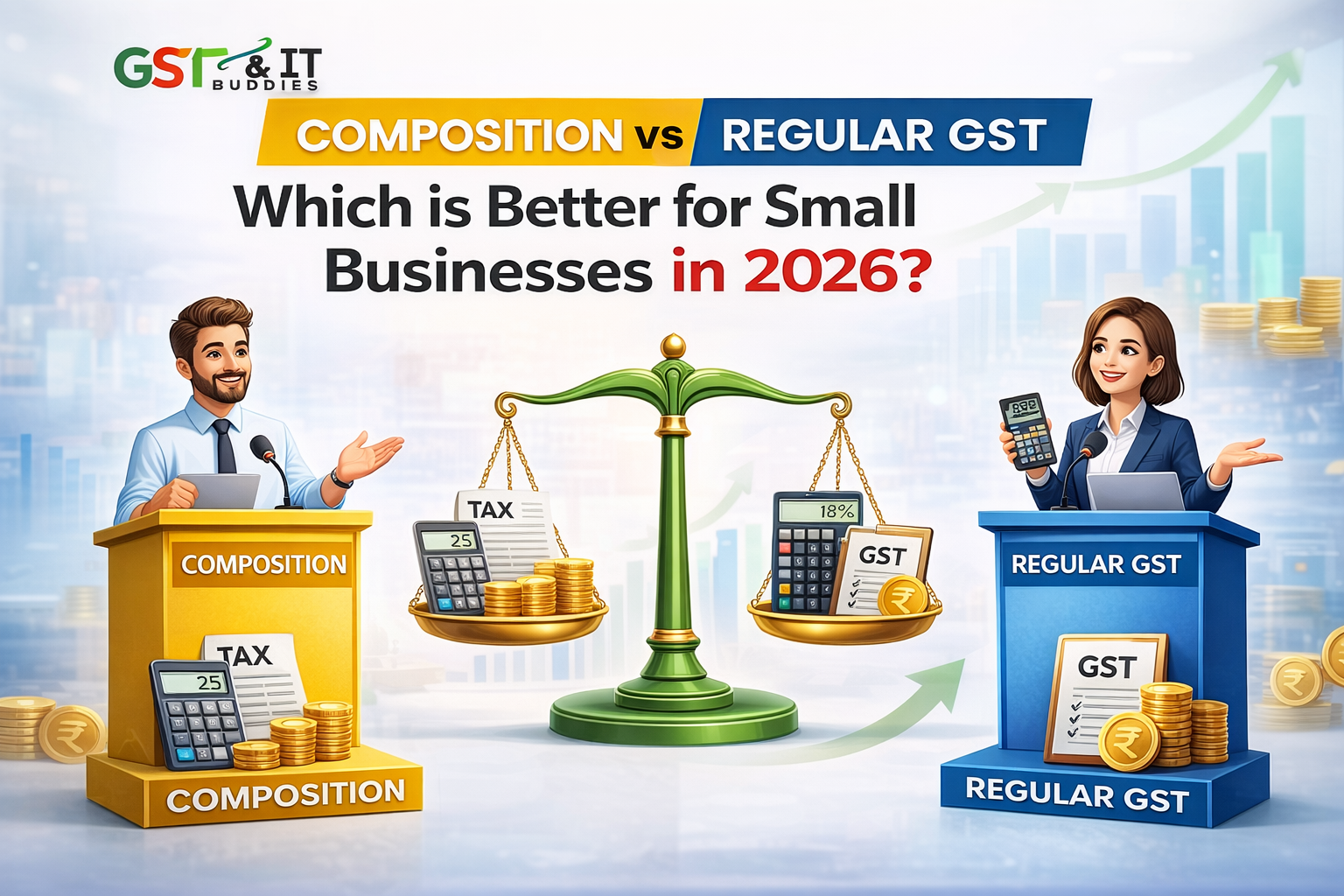
Choosing between the Composition Scheme and the Regular GST Scheme is one of the most important decisions for small businesses under the Goods and Services Tax regime. Your choice directly affects tax rate, compliance burden, pricing strategy, input tax credit eligibility, and overall profitability. In 2026, with increased GST scrutiny, AI-based notice systems, and stricter compliance tracking, selecting the correct scheme has become even more critical. Let’s understand both in depth. 1️⃣ What is the Composition Scheme? The Composition Scheme is a simplified taxation option under GST designed for small taxpayers. ✅ Eligibility (2026) Turnover up to ₹1.5 crore (₹75 lakh for special category states) Service providers up to ₹50 lakh (under composition for services) Not engaged in: Inter-state outward supply of goods E-commerce supply through operators like Amazon or Flipkart Manufacturing of notified goods (like ice cream, pan masala, tobacco)
Choosing the right GST scheme is crucial for small businesses in 2026. Under the Goods and Services Tax system, businesses can opt for either the Composition Scheme or the Regular GST Scheme. Your decision impacts tax liability, compliance burden, pricing strategy, profit margins, and eligibility for Input Tax Credit (ITC). With increasing GST scrutiny, AI-based notice systems, and stricter return matching, selecting the correct scheme has become more important than ever.
In this detailed guide, we explain the difference between Composition vs Regular GST, eligibility conditions, tax rates, advantages, disadvantages, and which option is better for your business in 2026.
What is the GST Composition Scheme?
The Composition Scheme is a simplified taxation scheme designed for small taxpayers to reduce the compliance burden.
Eligibility Criteria (2026)
-
Turnover up to ₹1.5 crore (₹75 lakh in special category states)
-
Service providers up to ₹50 lakh
-
Cannot make an inter-state outward supply
-
Cannot sell through e-commerce operators like Amazon or Flipkart
-
Cannot manufacture notified goods (tobacco, pan masala, ice cream)
GST Rates Under Composition
-
Traders & Manufacturers – 1%
-
Restaurants (non-alcoholic) – 5%
-
Service Providers – 6%
Key Features
-
Pay tax on turnover
-
Cannot collect GST separately from customers
-
Cannot claim Input Tax Credit (ITC)
-
Quarterly CMP-08 return
-
Annual GSTR-4 filing
-
Reduced compliance requirements
What is the Regular GST Scheme?
Under the Regular GST Scheme, businesses charge GST as per applicable slab rates (5%, 12%, 18%, 28%) and can claim ITC on purchases.
There is no turnover limit for remaining under the Regular Scheme.
Key Features
-
GST is charged on the invoice
-
Eligible to claim ITC
-
Inter-state sales allowed
-
E-commerce selling allowed
-
Monthly/Quarterly filing of:
-
GSTR-1
-
GSTR-3B
-
Annual GSTR-9
-
Composition vs Regular GST: Detailed Comparison (2026)
| Basis | Composition Scheme | Regular Scheme |
|---|---|---|
| Tax Rate | Low fixed rate | As per the GST slab |
| ITC Benefit | Not available | Available |
| Inter-State Sales | Not allowed | Allowed |
| E-commerce Supply | Not allowed | Allowed |
| Compliance | Very low | Moderate to high |
| Customer Type | Mostly B2C | B2B & B2C |
| Scalability | Limited | High |
Tax Calculation Example
Assume:
-
Annual turnover: ₹80 lakh
-
Purchases: ₹60 lakh
-
GST on purchases: 18%
Under Composition (1%)
Tax payable = 1% of ₹80 lakh = ₹80,000
No ITC benefit.
Under Regular Scheme (18%)
Output GST = ₹14,40,000
Input GST = ₹10,80,000
Net GST payable = ₹3,60,000
However, under Regular Scheme, GST is charged to customers and ITC reduces effective tax burden.
Advantages of the Composition Scheme
-
Simple compliance
-
Lower tax rate
-
Reduced paperwork
-
Suitable for small local retailers
-
Lower professional fees
Disadvantages
-
No ITC benefit
-
No inter-state supply
-
Limited business expansion
-
Not suitable for B2B customers
Advantages of the Regular GST Scheme
-
ITC benefit reduces tax cost
-
Better for B2B businesses
-
Inter-state supply allowed
-
E-commerce selling allowed
-
Higher credibility
-
Suitable for scaling a business
Disadvantages
-
Higher compliance
-
Monthly return filing
-
Increased scrutiny
-
Higher accounting requirement
Which GST Scheme is Better for Small Businesses in 2026?
Choose the Composition Scheme if:
-
You operate locally
-
Customers are mostly end consumers (B2C)
-
Your purchase GST is low
-
You want minimum compliance
-
You have no expansion plan
Choose the Regular GST Scheme if:
-
You deal with registered businesses (B2B)
-
You want to claim ITC
-
You sell online
-
You plan to expand across states
-
Your purchases attract high GST
Can You Switch Between Composition and Regular GST?
Yes. Businesses can switch at the beginning of the financial year:
-
File CMP-02 to opt for Composition
-
File ITC-03 to reverse ITC when shifting to Composition
-
File ITC-01 to claim ITC when moving to Regular
However, frequent switching may cause compliance complications.
Frequently Asked Questions (FAQs)
Is Composition GST cheaper than Regular GST?
It depends on the purchase GST and the customer profile. Composition has a lower rate but no ITC benefit.
Can a Composition dealer issue a tax invoice?
No. Only the Bill of Supply can be issued.
Can a Composition dealer sell outside the state?
No, interstate outward supply is not allowed.
Which scheme is better for service providers?
If turnover is below ₹50 lakh and compliance simplicity is priority, Composition (6%) may be suitable. Otherwise, Regular is better.
Final Verdict
There is no one-size-fits-all answer. The right choice depends on:
-
Profit margin
-
Purchase GST percentage
-
Customer type (B2B or B2C)
-
Business expansion plans
-
Compliance capability
Before selecting a scheme, perform a proper tax impact analysis to avoid future notices and losses.