
Running a small business in India comes with multiple financial responsibilities, and tax compliance is one of the most critical. However, paying taxes does not mean overpaying. With the right strategies, a business tax consultant can help legally reduce tax liability while ensuring full compliance with laws. In this blog, we’ll explore proven and legal ways tax consultants optimize taxes for small businesses.
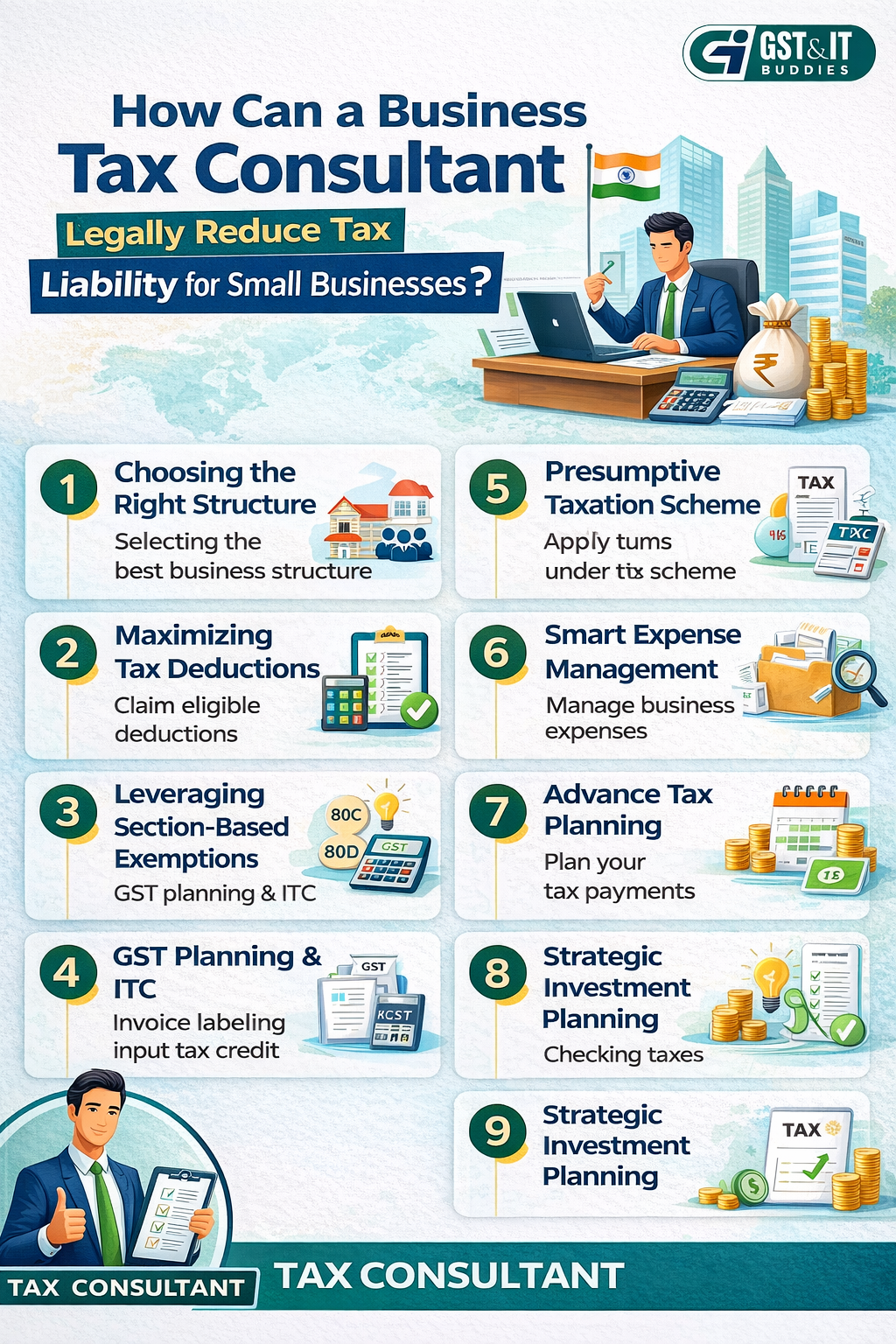
1. Choosing the Right Business Structure
One of the first steps in tax planning for small businesses is selecting the appropriate business structure:
- Sole Proprietorship
- Partnership Firm
- LLP (Limited Liability Partnership)
- Private Limited Company
Each structure has different tax rates and compliance requirements. A tax consultant evaluates your business model and suggests the most tax-efficient structure.
2. Maximizing Tax Deductions
A professional consultant ensures you claim all eligible deductions, such as:
- Rent and utility expenses
- Employee salaries
- Office supplies and operational costs
- Depreciation on assets
Using these deductions effectively can significantly reduce your taxable income.
3. Leveraging Section-Based Exemptions
The Income Tax Act offers various exemptions that small businesses often miss:
- Section 80C (investments)
- Section 80D (insurance premiums)
- Section 35 (business-related R&D expenses)
A tax expert identifies applicable exemptions and integrates them into your tax saving strategy.
4. GST Planning and Input Tax Credit (ITC)
Proper GST compliance and planning can lower your tax burden:
- Claiming Input Tax Credit (ITC) correctly
- Avoiding penalties through accurate filings
- Structuring invoices for maximum credit benefits
A consultant ensures your GST returns are optimized and error-free.
5. Presumptive Taxation Scheme
For eligible small businesses, opting for the presumptive taxation scheme under Sections 44AD, 44ADA, or 44AE can:
- Reduce compliance burden
- Simplify bookkeeping
- Lower taxable income
A tax consultant evaluates whether this scheme suits your business.
6. Smart Expense Management
Many businesses fail to categorize expenses correctly. A tax consultant helps:
- Identify allowable business expenses
- Maintain proper documentation
- Avoid disallowed expenses
This ensures maximum deductions and audit safety.
7. Advance Tax Planning
Instead of last-minute tax payments, consultants create a year-round tax plan:
- Estimate tax liability in advance
- Plan investments strategically
- Avoid interest and penalties
This proactive approach improves cash flow management.
8. Carry Forward and Set-Off of Losses
A key strategy to reduce taxes is utilizing business losses:
- Carry forward losses to future years
- Set off losses against profits
This helps in reducing future tax liability significantly.
9. Compliance and Risk Reduction
Non-compliance can lead to heavy penalties. A tax consultant ensures:
- Timely filing of returns
- Accurate financial reporting
- Proper documentation
This not only saves money but also builds credibility.
10. Strategic Investment Planning
Tax consultants guide businesses on tax-saving investments such as:
- Government schemes
- Insurance policies
- Capital investments
These investments reduce tax liability while growing wealth.
Conclusion
A business tax consultant in India plays a crucial role in helping small businesses legally reduce their tax burden. From choosing the right structure to optimizing deductions and ensuring GST compliance, their expertise ensures you pay only what is necessary—nothing more.
If you want to maximize profits and stay compliant, investing in professional tax consulting services is a smart business decision.