

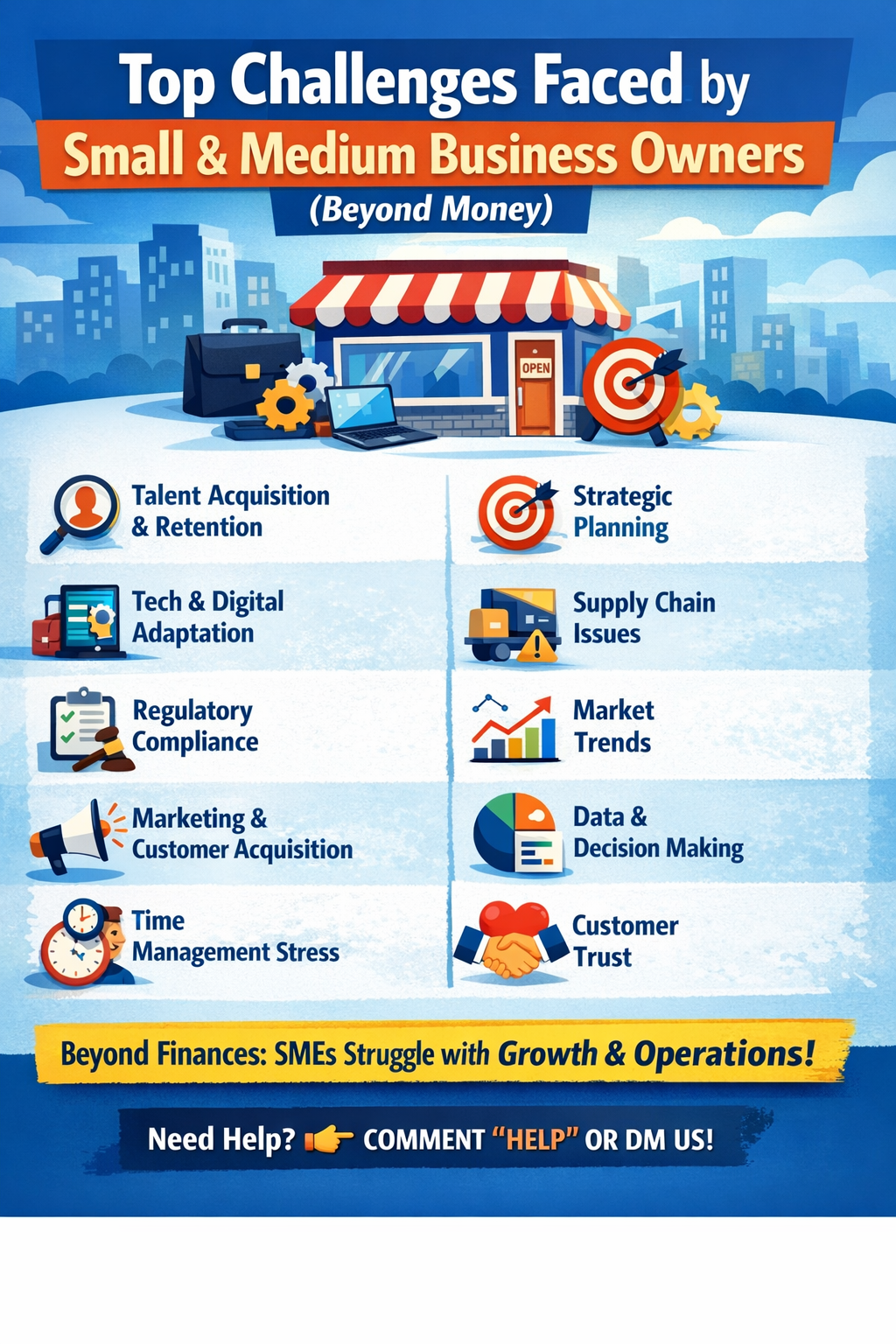
Top Challenges Faced by Small and Medium Business Owners (Beyond Money) Introduction When people talk about business struggles, the first thing that comes to mind is money. But in reality, small and medium business owners face several non-financial challenges that directly impact growth, sustainability, and profitability. Understanding these issues is crucial for building a scalable and future-ready business. 🔍 1. Talent Acquisition & Employee Retention Finding and retaining the right talent is one of the biggest challenges for SMEs. Skilled employees prefer large corporations High employee turnover affects productivity Training costs increase due to frequent hiring 👉 Impact: Reduced efficiency and increased operational stress
⚙️ 2. Adapting to Technology & Digital Transformation
Many small businesses struggle to keep up with rapid technological changes.
- Lack of digital knowledge
- Resistance to change
- Difficulty in selecting the right tools
👉 Impact: Loss of competitive edge and slower growth
📜 3. Regulatory Compliance & Legal Complexity
Keeping up with changing laws like GST, income tax, and other regulations is not easy.
- Frequent updates in compliance rules
- Risk of penalties due to errors
- Time-consuming documentation
👉 Impact: Business owners spend more time on compliance than growth
📈 4. Marketing & Customer Acquisition
Attracting and retaining customers is becoming harder than ever.
- Increasing competition (especially online)
- Rising digital marketing complexity
- Lack of clear branding strategy
👉 Impact: Inconsistent revenue and low visibility
🧠 5. Lack of Strategic Planning
Many SMEs operate on a day-to-day basis instead of long-term planning.
- No clear growth roadmap
- Poor decision-making due to lack of data
- Reactive instead of proactive approach
👉 Impact: Missed opportunities and unstable growth
⏳ 6. Time Management & Workload Pressure
Business owners often wear multiple hats.
- Managing operations, sales, compliance, and HR
- No delegation structure
- Burnout and stress
👉 Impact: Reduced productivity and poor decision quality
🤝 7. Vendor & Supply Chain Issues
Even if money is available, operational challenges persist.
- Delayed deliveries
- Quality inconsistencies
- Dependency on limited vendors
👉 Impact: Customer dissatisfaction and business disruption
🌐 8. Keeping Up with Market Trends
Markets are evolving rapidly due to digitalization and changing consumer behavior.
- Difficulty in identifying trends
- Slow adaptation to customer preferences
- Lack of market research
👉 Impact: Loss of relevance in the market
🔐 9. Data Management & Decision Making
Data is powerful—but only if used correctly.
- Poor record-keeping
- No analytics or reporting system
- Decisions based on assumptions
👉 Impact: Inefficient operations and missed growth insights
💬 10. Customer Trust & Relationship Building
In today’s competitive environment, trust is everything.
- Handling negative reviews
- Maintaining service quality
- Building long-term relationships
👉 Impact: Customer churn and weak brand reputation
✅ Conclusion
While financial constraints are important, non-monetary challenges often have a deeper impact on business success.
Small and medium business owners who focus on:
- Technology adoption
- Strategic planning
- Compliance management
- Customer experience
👉 will have a strong competitive advantage in today’s market.