


Introduction If you run a business or manage high volumes of money, you've probably asked: Is there any transaction limit in a current account? It's one of the most common questions business owners, freelancers, and finance managers have when choosing a bank. The short answer is: it depends on the bank and the type of transaction. But understanding what limits exist — and why — can save you from unexpected blocks at critical moments. This guide breaks down everything you need to know about current account transaction limits, what affects them, and how to ensure your account keeps up with your business.
What Is a Current Account?
A current account (also called a checking account in some regions) is a bank account designed for frequent, everyday transactions. Unlike savings accounts, current accounts are built for:
- Paying suppliers and vendors
- Receiving customer payments
- Managing payroll
- Handling bulk transfers and cash deposits
Due to their high-transaction nature, current accounts typically offer far more flexibility than savings accounts — but that doesn't mean they're completely without limits.
Do Current Accounts Have Transaction Limits?
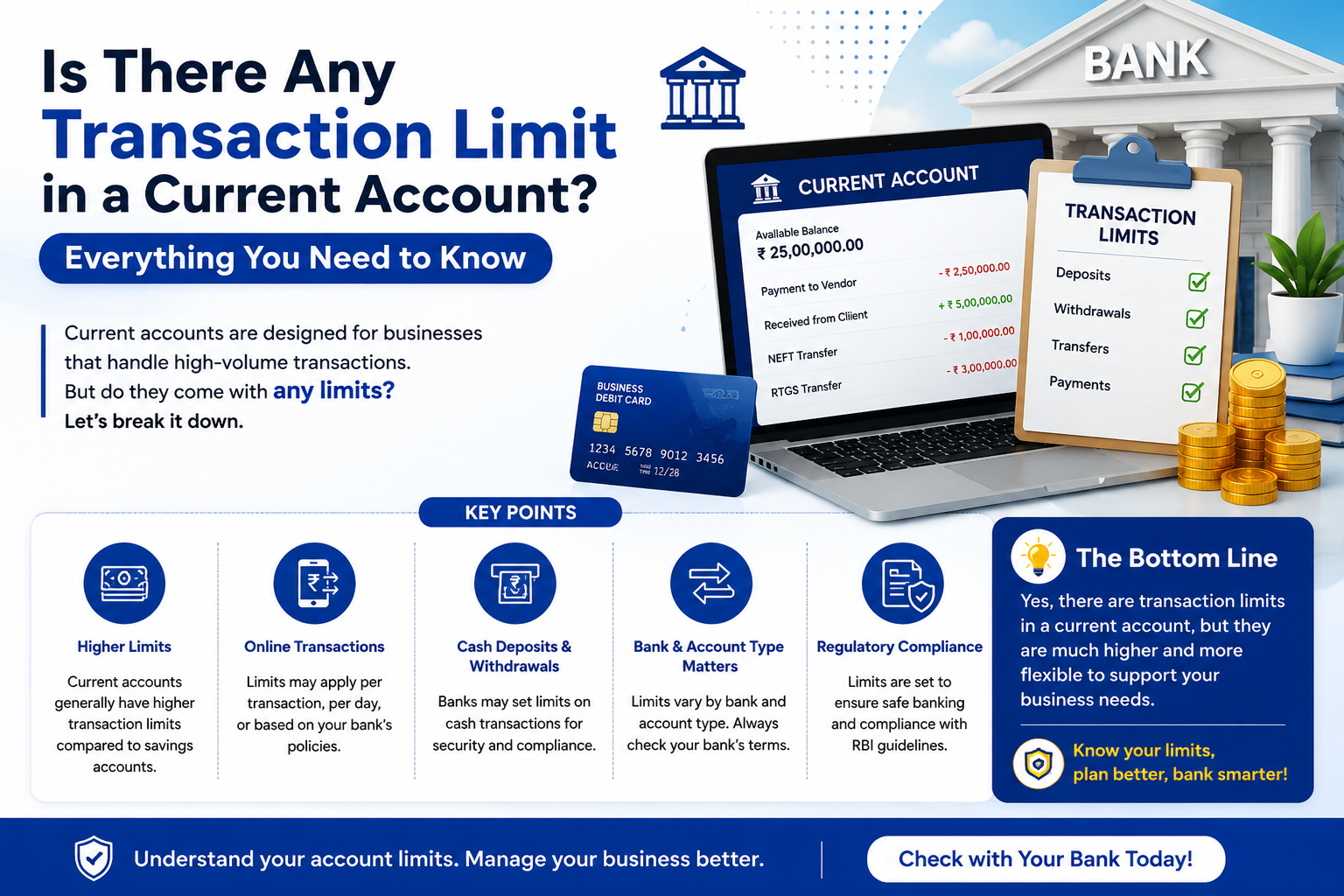
Yes — most current accounts have some form of transaction limit, though these vary significantly by bank, account tier, and transaction type. Here's a breakdown of the most common ones:
1. Daily Transaction Limit
Most banks impose a daily limit on the amount of money that can be transferred or withdrawn. This is a security measure to protect against fraud. Typical daily limits range from ₹10 lakh to several crore for business current accounts, depending on your account plan.
2. Per-Transaction Limit
Some banks impose a ceiling on individual transactions — for example, a single NEFT, RTGS, or IMPS transfer may have a per-transaction cap. RTGS transfers, for instance, have a minimum threshold of ₹2 lakh but no upper cap in many Indian banks.
3. Monthly Cash Deposit Limit
This is one of the most important limits for businesses that deal in cash. Many banks allow a free cash deposit limit (e.g., ₹5 lakh/month on base plans) and charge a fee beyond that threshold. Some premium current accounts offer unlimited free cash deposits.
4. Cheque Issuance Limits
Entry-level current accounts may limit the number of cheque leaves issued per month or per quarter. High-volume businesses should look for accounts that offer unlimited cheque books.
5. Online Transfer Limits (NEFT / RTGS / IMPS)
- NEFT: No minimum or maximum limit (set by RBI); individual banks may apply their own limits
- RTGS: Minimum ₹2 lakh; no upper limit
- IMPS: Generally up to ₹5 lakh per transaction (varies by bank)
Factors That Affect Your Transaction Limits
Not all current accounts are the same. Here's what determines your specific limits:
Account Tier / Plan
Banks offer multiple current account variants — Basic, Regular, Business, and Premium. Higher-tier accounts typically come with higher transaction caps and fewer restrictions.
Average Monthly Balance (AMB)
Many banks link your transaction privileges to the balance you maintain. A higher AMB often unlocks better limits, lower charges, and more features.
KYC and Compliance Status
A fully KYC-compliant account with verified business documents will generally have higher transaction limits than a newly opened or partially verified account.
Business Type and Turnover
Some banks customise limits based on your business profile. If you have a high-turnover business, you may be eligible for enhanced limits upon request or by upgrading your account.
Banking Channel
Limits can differ based on how you transact:
- Internet banking may have different caps than
- Mobile banking or
- Branch transactions
Can You Increase Your Current Account Transaction Limit?
Yes, in most cases. Here's how:
- Upgrade your account plan — Move to a higher-tier current account with better limits built in.
- Maintain a higher average balance — Banks often reward higher AMB with elevated limits.
- Request a limit enhancement — Contact your relationship manager or bank branch directly. Most banks can grant temporary or permanent limit increases with proper documentation.
- Provide business financials — Submitting GST returns, ITR, or turnover data can help justify higher limits.
Current Account Transaction Limits: A Quick Comparison
| Transaction Type | Typical Limit (India) | Notes |
|---|---|---|
| NEFT | No RBI cap | Bank-specific limits apply |
| RTGS | Min ₹2 lakh | No upper cap |
| IMPS | Up to ₹5 lakh/txn | Varies by bank |
| Daily debit | ₹10L – ₹1Cr+ | Depends on account type |
| Cash deposit (free) | ₹2L – ₹10L/month | Based on the plan |
| Cheque issuance | 50–Unlimited | Varies by tier |
Limits are indicative and vary by bank and account plan. Always check with your bank for exact figures.
Which Current Account Has the Highest Transaction Limits?
Premium business current accounts from major banks — such as HDFC Bank's Apex or MAX plan, ICICI Bank's Current Account variants, or Kotak's Edge/Elite accounts — tend to offer the highest limits. Fintech-powered accounts (like those from RazorpayX, Fi for Business, or Jupiter for Business) may also offer higher digital transaction ceilings with faster processing.
When comparing, look at:
- Free cash deposit limit per month
- Daily NEFT/RTGS/IMPS cap
- Number of free transactions per month
- Charges beyond free limits
Common Mistakes to Avoid
Assuming your current account has no limits. Even premium accounts have some caps — always verify before a large transaction.
Not informing your bank before bulk transfers. For unusually large one-time transfers, it's wise to notify your bank or relationship manager in advance to avoid a transaction hold.
Choosing a plan based on balance alone. Focus on the transaction limits and fee structure, not just the minimum balance requirement.
Ignoring cash deposit charges. If your business handles significant cash, the free cash deposit limit is one of the most important features to compare.
Conclusion
Current accounts are designed for high-frequency transactions, but they're not limit-free. Understanding your bank's specific caps — on daily transfers, per-transaction amounts, and monthly cash deposits — is essential for smooth business operations.
The good news: most limits are flexible. With the right account plan, a healthy average balance, and a conversation with your bank, you can almost always unlock higher transaction capabilities.
Before opening or upgrading a current account, ask your bank these key questions:
- What is my daily digital transfer limit?
- What is the free cash deposit limit per month?
- Can limits be increased and under what conditions?
- Are there charges for exceeding these limits?
Choosing the right current account isn't just about the balance requirement — it's about ensuring the account can keep pace with your business.
Have questions about your current account limits? Drop them in the comments or speak to your bank's business banking team for personalized guidance.