



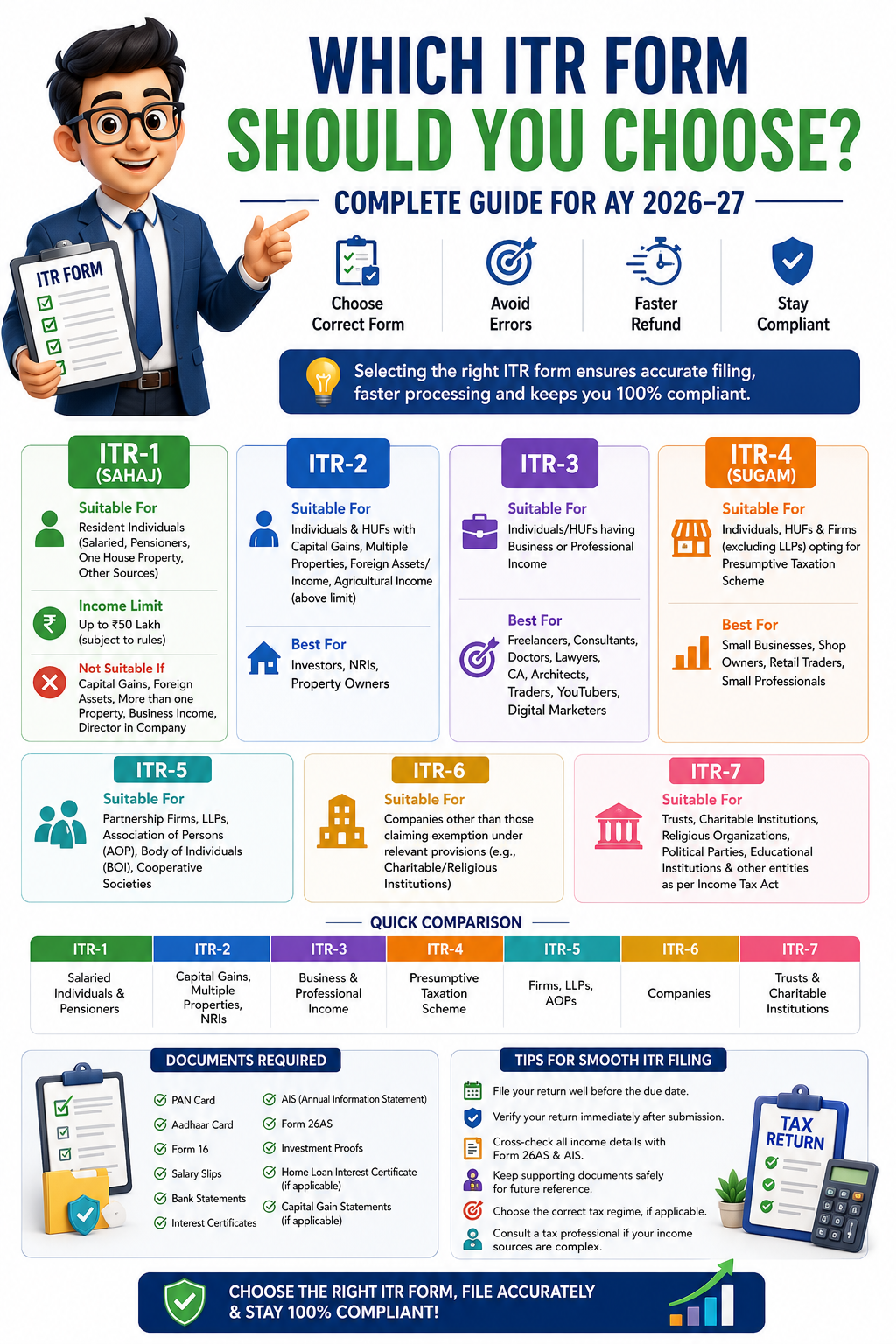
Which ITR Form Should You Choose? Complete Guide for AY 2026–27 Filing your Income Tax Return (ITR) is a crucial financial responsibility, but selecting the correct ITR form is equally important. Filing the wrong form can lead to notices, delays in refund processing, or even rejection of your return. Whether you're a salaried employee, freelancer, business owner, investor, or trust, this guide will help you understand which ITR form for AY 2026–27 is right for you.
Why Choosing the Correct ITR Form Matters
Selecting the appropriate ITR form helps you:
- Avoid filing errors
- Ensure faster tax refund processing
- Stay compliant with Income Tax rules
- Prevent notices from the Income Tax Department
- Report your income accurately
Different Types of ITR Forms for AY 2026–27
ITR-1 (Sahaj)
Suitable For
- Resident Individuals
- Salaried Employees
- Pensioners
- Individuals with one house property
- Income from other sources (excluding lottery and racehorses)
Income Limit
Generally applicable where total income is up to ₹50 lakh (subject to the latest Income Tax Department rules).
Not Suitable If
- Foreign assets
- Capital gains
- More than one house property
- Business income
- Director in a company
- Unlisted equity shares
ITR-2
Suitable For
Individuals and HUFs having:
- Capital gains
- Multiple house properties
- Foreign income or foreign assets
- Agricultural income above the prescribed limit
- Income above the ITR-1 eligibility criteria
Best For
- Investors
- NRI taxpayers
- Property owners
ITR-3
Suitable For
Individuals or HUFs earning:
- Business income
- Professional income
- Freelancers
- Consultants
- Doctors
- Lawyers
- Chartered Accountants
- Architects
Examples
- Digital marketers
- YouTubers
- Influencers
- Traders
- Freelance software developers
ITR-4 (Sugam)
Suitable For
Individuals, HUFs, and Firms (excluding LLPs) opting for the Presumptive Taxation Scheme under applicable sections.
Best For
- Small businesses
- Shop owners
- Retail traders
- Small professionals
- Freelancers eligible under presumptive taxation
ITR-5
Suitable For
- Partnership Firms
- LLPs
- Association of Persons (AOP)
- Body of Individuals (BOI)
- Cooperative Societies
ITR-6
Suitable For
Companies other than those claiming exemption under the relevant provisions applicable to charitable or religious entities.
ITR-7
Suitable For
Organizations required to file returns under specific provisions of the Income-tax Act, including:
- Trusts
- Charitable institutions
- Religious organizations
- Political parties
- Educational institutions eligible under the applicable sections
Quick Comparison of ITR Forms
| ITR Form | Suitable For |
|---|---|
| ITR-1 | Salaried Individuals & Pensioners |
| ITR-2 | Capital Gains, Multiple Properties, NRIs |
| ITR-3 | Business & Professional Income |
| ITR-4 | Presumptive Taxation Scheme |
| ITR-5 | Firms, LLPs, AOPs |
| ITR-6 | Companies |
| ITR-7 | Trusts & Charitable Institutions |
Documents Required Before Filing ITR
Keep these documents ready:
- PAN Card
- Aadhaar Card
- Form 16
- Salary Slips
- Bank Statements
- Interest Certificates
- AIS (Annual Information Statement)
- Form 26AS
- Investment Proofs
- Home Loan Interest Certificate (if applicable)
- Capital Gain Statements (if applicable)
Common Mistakes While Choosing an ITR Form
Avoid these common errors:
- Selecting ITR-1 despite having capital gains
- Not reporting interest income
- Choosing the wrong assessment year
- Ignoring foreign assets or foreign income
- Missing business or freelance income
- Entering incorrect bank account details
- Not reconciling Form 26AS and AIS before filing
Tips for Hassle-Free ITR Filing
- File your return well before the due date.
- Verify your return immediately after submission.
- Cross-check all income details with Form 26AS and AIS.
- Keep supporting documents safely for future reference.
- Choose the correct tax regime, if applicable.
- Consult a tax professional if your income sources are complex.
Frequently Asked Questions (FAQs)
1. Which ITR form is used by salaried employees?
Most eligible salaried individuals can file ITR-1 (Sahaj), subject to the prescribed eligibility conditions.
2. Can freelancers file ITR-1?
No. Freelancers generally file ITR-3 or ITR-4, depending on the nature of their income and eligibility.
3. Which ITR form is applicable for business owners?
Business owners typically file ITR-3 or ITR-4, depending on whether they opt for the presumptive taxation scheme.
4. Which ITR form should an NRI use?
NRIs generally use ITR-2 or ITR-3, depending on their sources of income.
5. What happens if I file the wrong ITR form?
Using the wrong ITR form may result in your return being treated as defective, delayed processing, or the need to revise your return.
Conclusion
Choosing the correct ITR form for AY 2026–27 is the first step toward smooth and compliant income tax filing. Your choice depends on factors such as your income sources, residential status, business or professional income, capital gains, and other financial details.
If you're unsure which form applies to your situation, seeking professional guidance can help ensure accurate filing and reduce the risk of errors.