



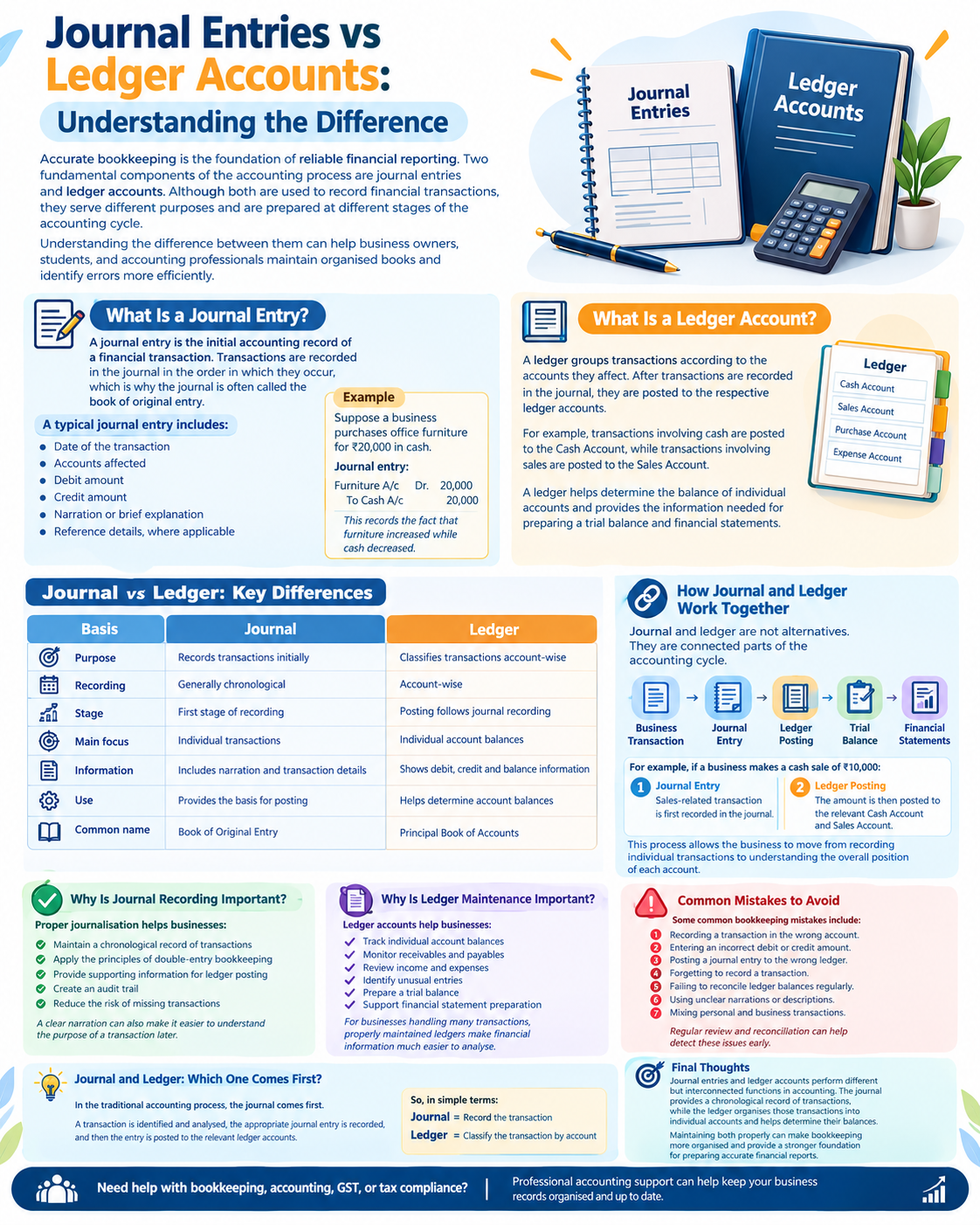
Accurate bookkeeping underpins reliable financial reporting. Two fundamental components of the accounting process are journal entries and ledger accounts. Although both are used to record financial transactions, they serve different purposes and are prepared at different stages of the accounting cycle. Understanding the difference between them can help business owners, students, and accounting professionals maintain organised books and identify errors more efficiently.
What Is a Journal Entry?
A journal entry is the initial accounting record of a financial transaction. Transactions are recorded in the journal in the order in which they occur, which is why the journal is often called the book of original entry.
A typical journal entry includes:
- Date of the transaction
- Accounts affected
- Debit amount
- Credit amount
- Narration or brief explanation
- Reference details, where applicable
Example
Suppose a business purchases office furniture for ₹20,000 in cash.
The journal entry would be:
Furniture A/c Dr. ₹20,000
To Cash A/c ₹20,000
This records the fact that furniture increased while cash decreased.
What Is a Ledger Account?
A ledger groups transactions according to the accounts they affect. After transactions are recorded in the journal, they are posted to the respective ledger accounts.
For example, transactions involving cash are posted to the Cash Account, while transactions involving sales are posted to the Sales Account.
A ledger helps determine the balance of individual accounts and provides the information needed for preparing a trial balance and financial statements.
ournal vs Ledger: Key Differences
| Basis | Journal | Ledger |
|---|---|---|
| Purpose | Records transactions initially | Classifies transactions account-wise |
| Recording | Generally chronological | Account-wise |
| Stage | First stage of recording | Posting follows journal recording |
| Main focus | Individual transactions | Individual account balances |
| Information | Includes narration and transaction details | Shows debit, credit and balance information |
| Use | Provides the basis for posting | Helps determine account balances |
| Common name | Book of Original Entry | Principal Book of Accounts |
How Journal and Ledger Work Together
Journal and ledger are not alternatives. They are connected parts of the accounting cycle.
The basic flow is:
Business Transaction → Journal Entry → Ledger Posting → Trial Balance → Financial Statements
For example, if a business makes a cash sale of ₹10,000:
Journal Entry
The sales-related transaction is first recorded in the journal.
Ledger Posting
The amount is then posted to the relevant Cash Account and Sales Account.
This process allows the business to move from recording individual transactions to understanding the overall position of each account.