
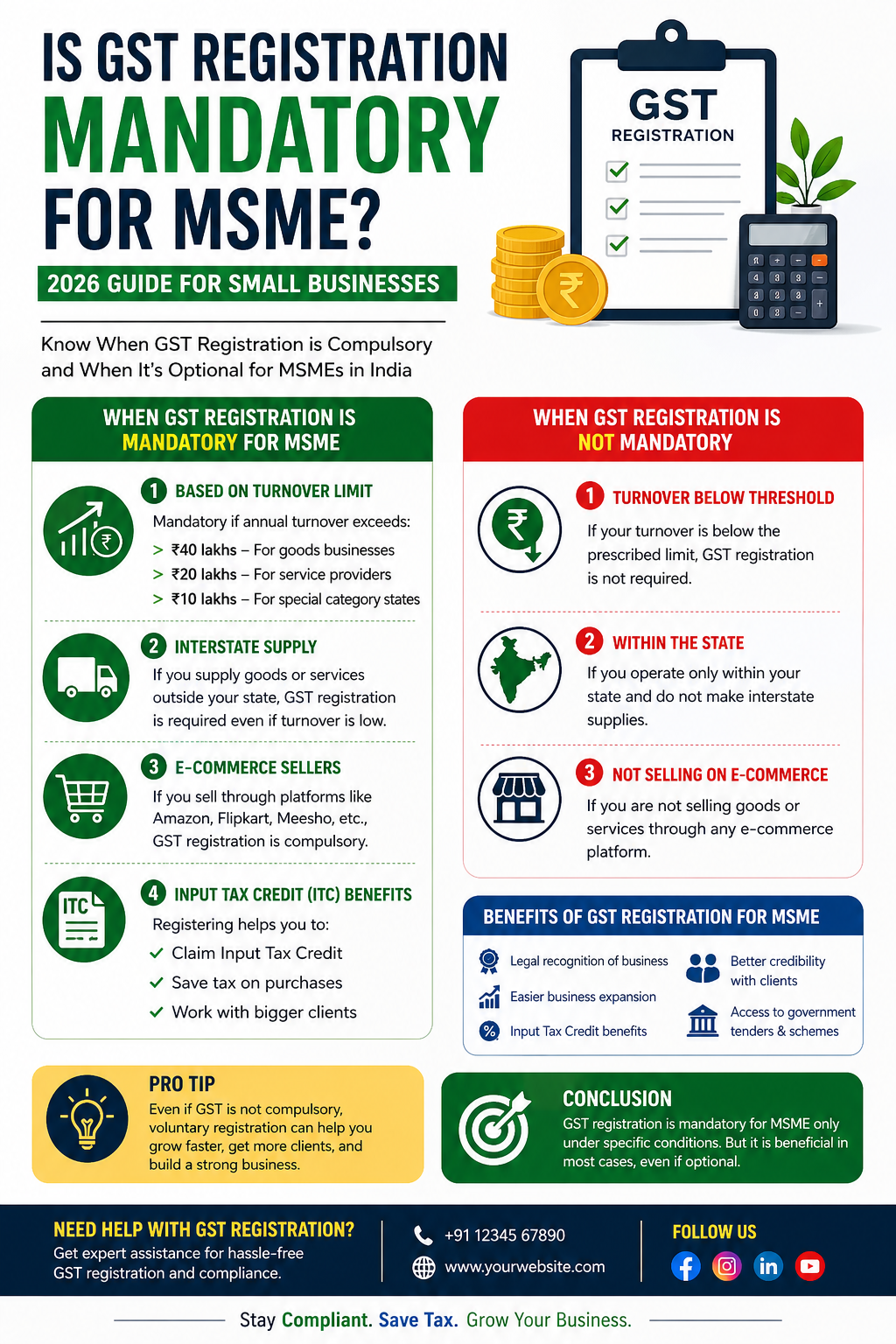
🧾 Is GST Registration Mandatory for MSMEs in India? (2026 Guide) If you run a Micro, Small, or Medium Enterprise (MSME), one of the most common questions is: 👉 “Do I need GST registration?” The answer is: It depends on your turnover and business type. 📌 When GST Registration is Mandatory for MSME 1. Based on Turnover Limit GST registration becomes compulsory if your annual turnover exceeds: ₹40 lakhs → For goods businesses ₹20 lakhs → For service providers ₹10 lakhs → For special category states If your MSME crosses these limits, GST registration is mandatory.
2. Interstate Supply (Very Important )
If you sell goods or services outside your state, GST registration is required even if your turnover is low.
Example:
If you’re in Rajasthan and provide services to Delhi → GST is required.
3. E-commerce Sellers
If you sell through platforms like Amazon, Flipkart, etc. → GST registration is compulsory.
4. Input Tax Credit (ITC Benefits)
Even if not mandatory, many MSMEs voluntarily register to:
- Claim Input Tax Credit
- Save tax on purchases
- Work with bigger clients
When GST Registration is NOT Mandatory
You don’t need GST registration if:
- Your turnover is below threshold
- You operate only within your state
- You are not selling via e-commerce
Benefits of GST Registration for MSME
- ✅ Legal recognition of business
- ✅ Easier business expansion
- ✅ Input Tax Credit benefits
- ✅ Better credibility with clients
- ✅ Access to government tenders
Pro Tip (For MSME Owners)
Even if GST is not compulsory, voluntary registration can help you grow faster, especially if:
- You want corporate clients
- You plan to scale your business
- You deal with B2B customers
Conclusion
👉 GST registration is mandatory for MSMEs only under specific conditions
👉 But beneficial in most cases, even if optional