

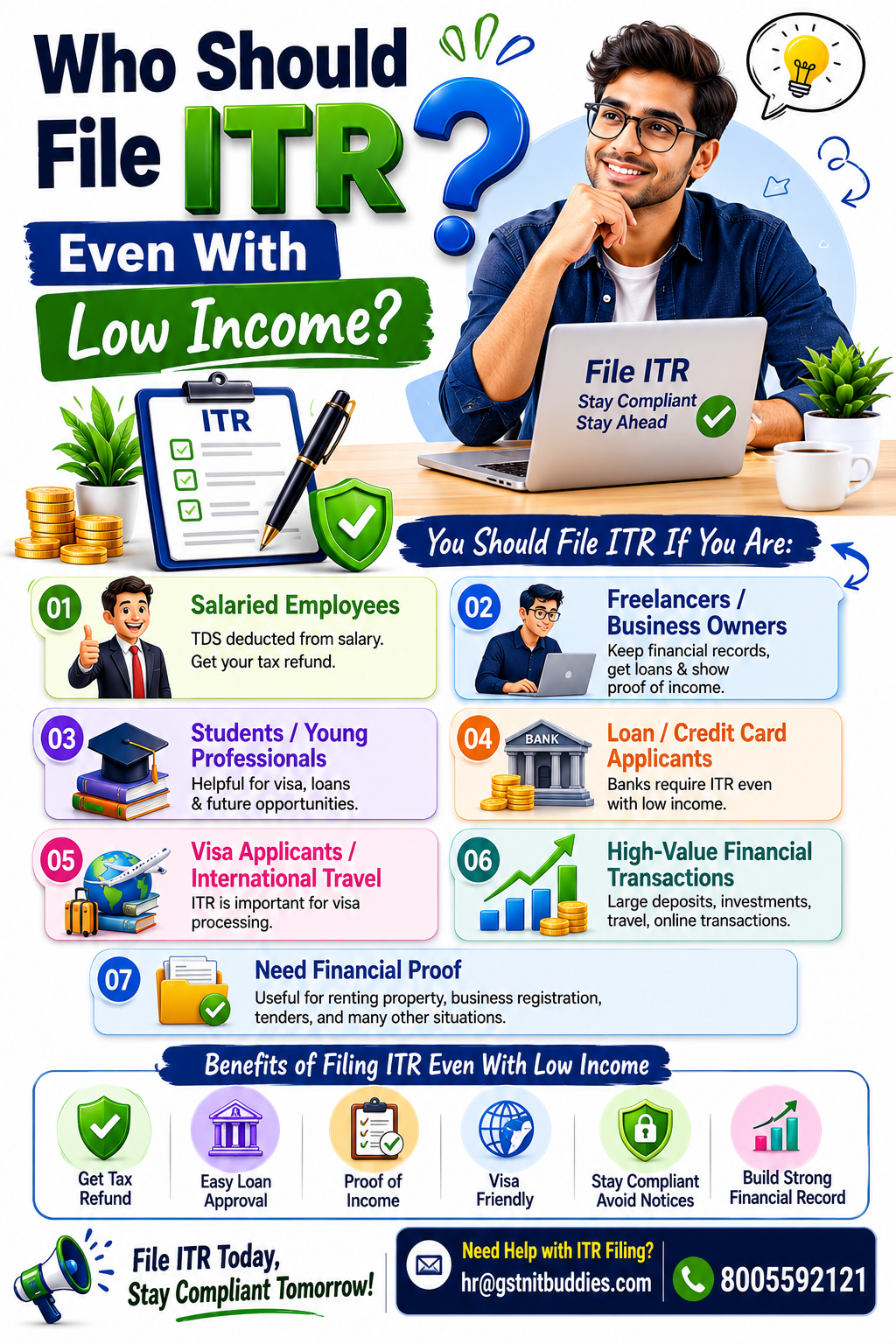
Filing an Income Tax Return (ITR) is often seen as something only high earners need to do. However, even if your income is low or below the taxable limit, filing an ITR can still be beneficial — and in some cases, necessary. Many individuals skip ITR filing, assuming, “My income is low, so I don’t need to file taxes.” But this can lead to missed financial benefits and unnecessary complications in the future. In this blog, we explain who should file an ITR even with a low income and why it matters.
Who Should File ITR Even With Low Income?
1. Salaried Employees Wanting Tax Refunds
If your employer deducted TDS (Tax Deducted at Source) from your salary, but your total income falls below the taxable limit, you should still file an ITR.
Why?
Filing ITR helps you claim a tax refund from the government.
Example:
Suppose your employer deducted ₹12,000 as TDS, but your annual income is not taxable. By filing ITR, you can get the deducted amount refunded.
2. Freelancers or Small Business Owners
Freelancers, consultants, and small business owners often have irregular income.
Even if your income is low, filing ITR helps:
✔ Maintain financial records
✔ Improve loan eligibility
✔ Show proof of income
✔ Avoid future compliance issues
3. Students or Young Professionals
If you are a student doing internships, freelancing, or part-time work, filing an ITR can be useful.
Benefits include:
- Easier visa approvals
- Better financial credibility
- Proof of earnings
Even with a low income, maintaining a tax record can help in the future.
4. People Applying for Loans or Credit Cards
Banks often ask for ITR documents while approving:
- Home loans
- Personal loans
- Car loans
- Business loans
Even if your income is below the taxable limit, regularly filing ITR improves financial trustworthiness.
5. Individuals Planning to Apply for a Visa
Many countries ask for ITR records of the last 2–3 years during visa processing.
If you plan to travel abroad for:
- Education
- Business
- Tourism
- Employment
Filing ITR can strengthen your visa application.
6. People with High-Value Financial Transactions
Even with low income, filing may become important if you have:
- Large bank deposits
- High-value investments
- Foreign travel expenses
- Significant online transactions
This helps maintain transparency and avoid unnecessary notices.
7. Individuals Wanting Financial Proof
An ITR works as an official income proof document.
It may help while:
✔ Renting property
✔ Applying for government tenders
✔ Business registration
✔ Financial planning
Benefits of Filing ITR Even With Low Income
1. Easy Loan Approval
Banks prefer applicants with ITR history.
2. Tax Refund Claims
You can recover excess TDS deducted.
3. Better Financial Record
Creates documented proof of income.
4. Smooth Visa Processing
Useful for international travel applications.
5. Future Financial Security
Helps avoid issues if income increases later.
Final Thoughts
Even if your income is low, filing an ITR can be a smart financial decision. It helps build financial credibility, claim refunds, improve loan eligibility, and maintain proper records.
In many situations, filing ITR is not just about paying tax — it’s about building financial trust and staying prepared for future opportunities.
Need help with ITR filing, tax planning, or compliance? Get expert assistance and file your return accurately and on time.