


As businesses grow, many partnership firms start looking for a more structured legal framework, better credibility, limited liability protection, and easier access to funding. One of the most common questions entrepreneurs ask is: Can a partnership firm be converted into an LLP or a private limited company? The answer is Yes. Under Indian laws, a partnership firm can be converted into either a Limited Liability Partnership (LLP) or a Private Limited Company, subject to specific conditions and compliance requirements.
Why Convert a Partnership Firm?
Many businesses initially start as partnership firms due to their simple setup and low compliance requirements. However, as operations expand, the limitations of a partnership become apparent.
Key Reasons for Conversion
- Limited liability protection for owners
- Better business credibility
- Easier fundraising opportunities
- Perpetual succession
- Improved corporate governance
- Enhanced brand image
- Tax and compliance advantages in certain cases
Conversion of Partnership Firm into LLP
A partnership firm can be converted into an LLP under the provisions of the LLP Act, 2008.
Benefits of LLP Conversion
Limited Liability Protection
Partners' personal assets remain protected from business liabilities.
Separate Legal Entity
The LLP has its own legal identity distinct from its partners.
Lower Compliance than a Company
LLPs generally have fewer compliance requirements than private limited companies.
Perpetual Succession
The LLP continues to exist regardless of changes in partners.
No Restriction on Ownership Transfer
Ownership can be transferred through partner admission and retirement procedures.
Eligibility for Conversion into LLP
To convert a partnership firm into an LLP:
- All partners of the firm must become partners in the LLP.
- No person other than existing partners can be added during conversion.
- The partnership firm should be registered under the Partnership Act.
- Necessary approvals and consents must be obtained.
Process of Converting Partnership Firm into LLP
Step 1: Obtain Digital Signature Certificates (DSC)
All designated partners must obtain DSCs.
Step 2: Apply for DPIN
Designated Partner Identification Numbers are required.
Step 3: Reserve LLP Name
Apply for name approval through the MCA portal.
Step 4: File Incorporation Documents
Submit incorporation forms and conversion documents.
Step 5: Obtain Certificate of Registration
Upon approval, the Registrar issues the LLP registration certificate.
Step 6: Execute LLP Agreement
Partners must execute and file the LLP Agreement within the prescribed period.
Conversion of Partnership Firm into Private Limited Company
Businesses seeking external investment, venture capital, or stronger market credibility often prefer conversion into a private limited company.
Benefits of Company Conversion
Limited Liability
Shareholders' liability is restricted to their shareholding.
Better Fundraising Opportunities
Investors generally prefer company structures.
Higher Credibility
Banks, vendors, and customers often view companies as more reliable.
Easy Ownership Transfer
Shares can be transferred subject to company regulations.
Business Expansion
Suitable for startups and rapidly growing businesses.
Eligibility for Conversion into Company
Generally, the following conditions apply:
- All partners become shareholders of the company.
- Necessary approvals are obtained.
- Required incorporation documents are filed with the MCA.
- The firm's assets and liabilities are transferred to the company.
Process of Conversion into Private Limited Company
Step 1: Obtain DSC and DIN
Directors must obtain Digital Signature Certificates and Director Identification Numbers.
Step 2: Name Reservation
Reserve the proposed company name.
Step 3: Draft MOA and AOA
Prepare the Memorandum and Articles of Association.
Step 4: File Incorporation Application
Submit incorporation documents with the Registrar of Companies.
Step 5: Obtain Certificate of Incorporation
Upon approval, the company is legally formed.
Step 6: Transfer Assets and Liabilities
The business assets and obligations are transferred to the new company structure.
LLP vs Company: Which Is Better?
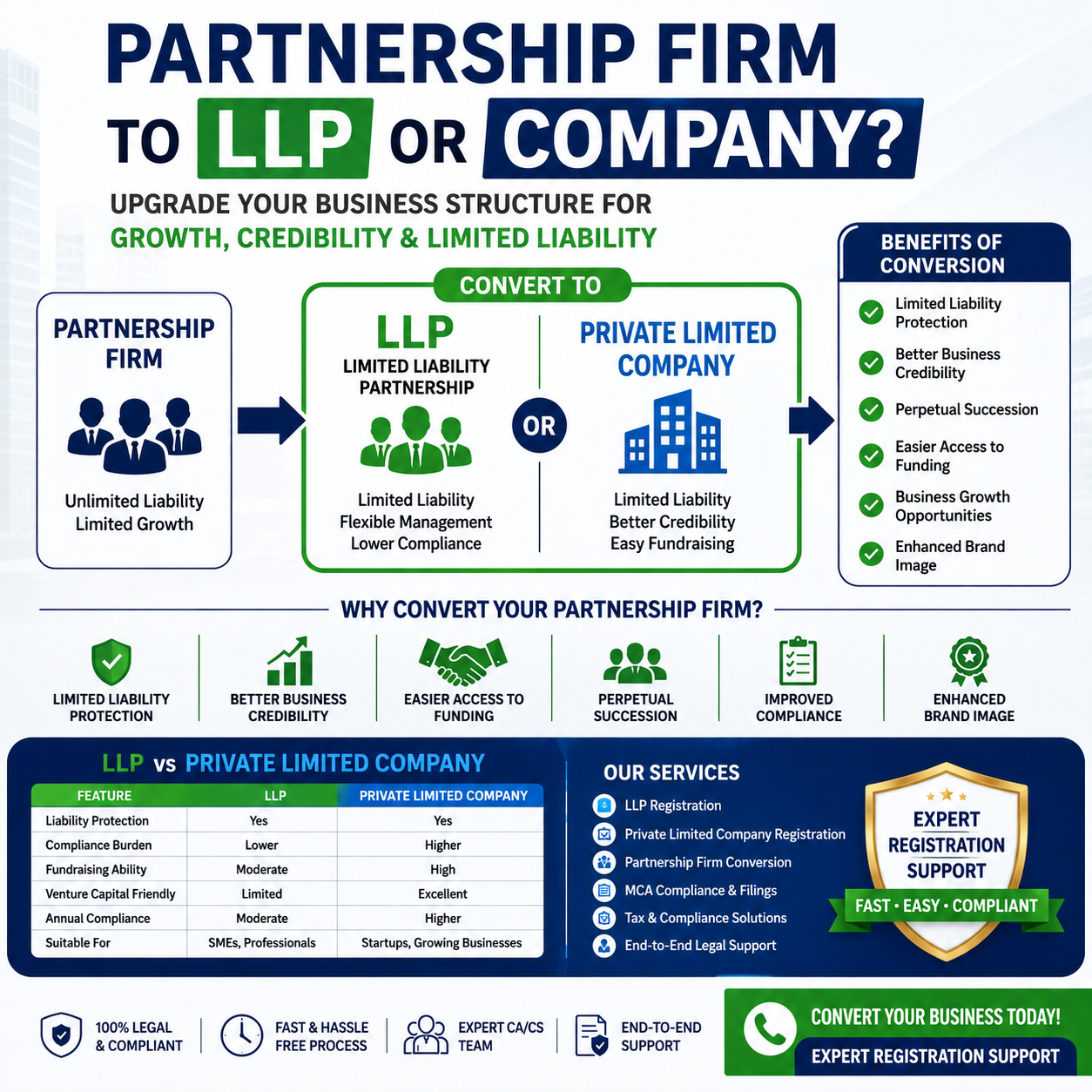
| Particulars | LLP | Private Limited Company |
|---|---|---|
| Liability Protection | Yes | Yes |
| Compliance Burden | Lower | Higher |
| Fundraising Ability | Moderate | High |
| Venture Capital Friendly | Limited | Excellent |
| Annual Compliance | Moderate | Higher |
| Suitable For | SMEs, Professionals | Startups, Growing Businesses |