



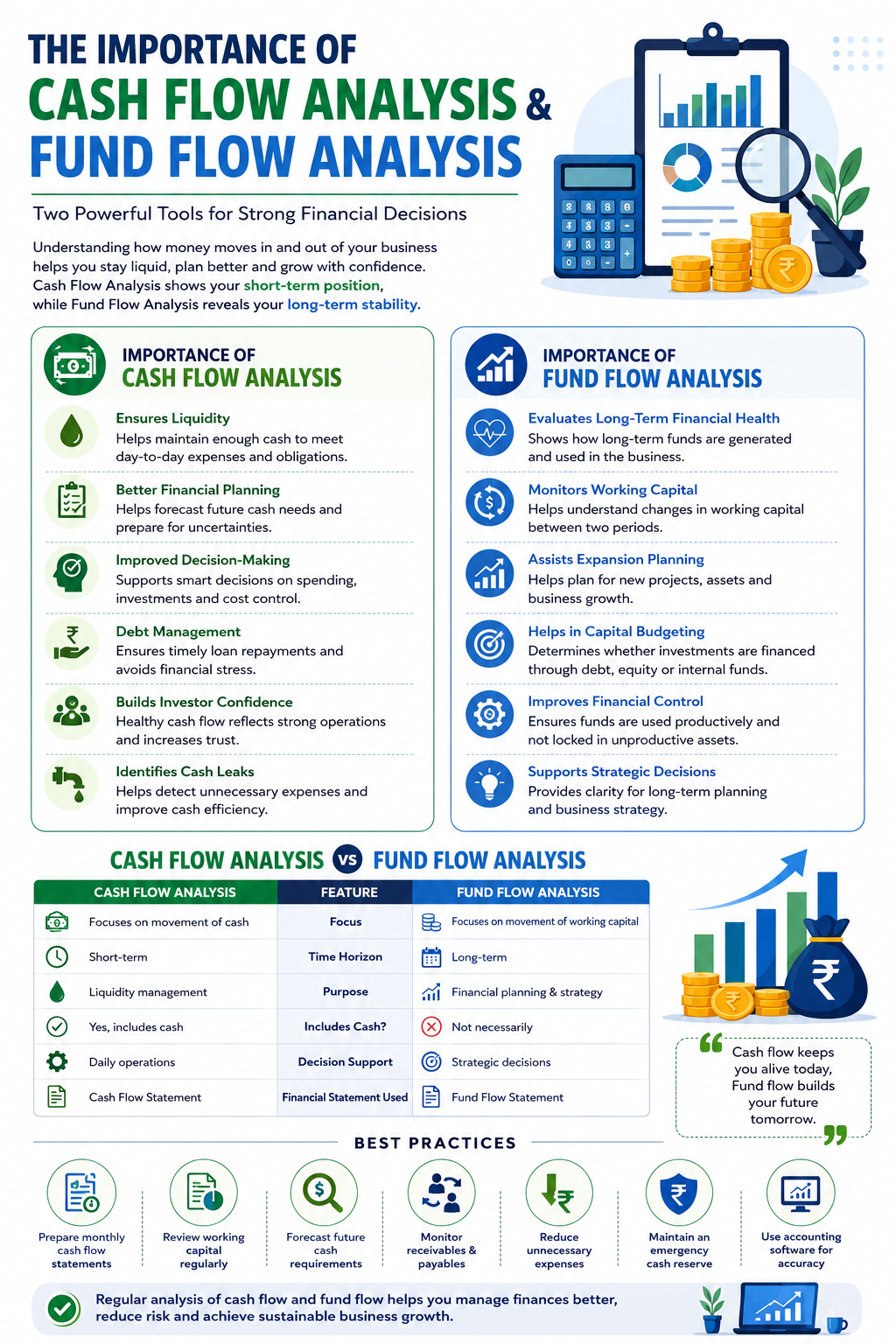
What Is Cash Flow Analysis and Fund Flow Analysis? Understanding a company's financial position goes beyond checking its profit. A business can be profitable but still struggle to pay salaries, suppliers, or loan installments due to poor cash management. This is where cash flow analysis and fund flow analysis become essential.
Both analyses help business owners, accountants, investors, and financial managers understand how money moves through an organization. While they are often discussed together, they serve different purposes and provide different financial insights.
In this guide, you'll learn the importance of cash flow analysis and fund flow analysis, their differences, advantages, and why every business should regularly review both.
What Is Cash Flow Analysis?
Cash flow analysis examines the movement of cash and cash equivalents into and out of a business during a specific period.
It answers questions such as:
- Is the business generating enough cash?
- Can it pay its short-term obligations?
- Is there enough cash for expansion?
- Are operating activities producing positive cash flow?
Cash flow analysis is usually divided into three sections:
1. Operating Activities
Cash generated from regular business operations, such as:
- Customer payments
- Supplier payments
- Employee salaries
- Operating expenses
2. Investing Activities
Cash related to long-term investments, including:
- Purchase of machinery
- Sale of equipment
- Investment in securities
3. Financing Activities
Cash transactions involving funding, including:
- Bank loans
- Share capital
- Dividend payments
- Loan repayments
What Is Fund Flow Analysis?
Fund flow analysis studies the movement of working capital between two accounting periods.
Instead of focusing only on cash, it explains:
- Where funds came from
- How funds were utilized
- Changes in working capital
- Long-term financial decisions
Fund flow analysis helps businesses understand whether funds are being used efficiently for expansion and growth.
Importance of Cash Flow Analysis
1. Maintains Business Liquidity
A business must have enough cash available to pay:
- Employee salaries
- Rent
- Taxes
- Utility bills
- Suppliers
Cash flow analysis helps prevent liquidity shortages.
2. Improves Financial Planning
Businesses can forecast future cash requirements and prepare for:
- Seasonal demand
- Business expansion
- Emergency expenses
- Loan repayments
3. Supports Better Decision-Making
Management can decide whether to:
- Purchase new equipment
- Hire employees
- Invest in new projects
- Delay unnecessary expenses
based on actual cash availability.
4. Helps Manage Debt
Cash flow analysis shows whether the company can comfortably:
- Pay loan EMIs
- Cover interest expenses
- Avoid cash shortages
5. Builds Investor Confidence
Investors prefer companies with strong and consistent operating cash flow because it reflects healthy business operations.
6. Identifies Cash Leaks
Cash flow reports help identify:
- Unnecessary expenses
- Delayed customer payments
- Excessive inventory purchases
- Poor cash management practices
Importance of Fund Flow Analysis
1. Evaluates Long-Term Financial Health
Fund flow analysis explains how long-term funds are generated and utilized, making it valuable for strategic planning.
2. Monitors Working Capital Changes
It helps businesses understand whether working capital has increased or decreased and why.
3. Assists Expansion Planning
Before opening a new branch or investing in equipment, businesses can analyze whether sufficient long-term funds are available.
4. Helps in Capital Budgeting
Management can assess whether investments are financed through:
- Internal funds
- Loans
- Equity
- Sale of assets
5. Improves Financial Control
Fund flow statements reveal whether funds are being used productively or tied up in unproductive assets.
6. Supports Strategic Decision-Making
Business owners can evaluate major financial decisions with greater confidence.
Cash Flow Analysis vs Fund Flow Analysis
| Feature | Cash Flow Analysis | Fund Flow Analysis |
|---|---|---|
| Focus | Movement of cash | Movement of working capital |
| Time Horizon | Short-term | Long-term |
| Purpose | Liquidity management | Financial planning |
| Includes Cash? | Yes | Not necessarily |
| Decision Support | Daily operations | Strategic decisions |
| Financial Statement Used | Cash Flow Statement | Fund Flow Statement |
Benefits for Small Businesses
Small businesses often face cash shortages despite earning profits.
Cash flow analysis helps them:
- Track daily cash availability
- Pay suppliers on time
- Plan inventory purchases
- Manage taxes effectively
- Avoid overdrafts
Fund flow analysis helps them:
- Plan expansion
- Purchase new assets
- Arrange long-term financing
- Improve financial stability
Benefits for Investors
Investors use both analyses before investing.
They evaluate:
- Company's ability to generate cash
- Long-term financial stability
- Debt repayment capacity
- Operational efficiency
- Growth potential
Companies with strong cash flow and healthy fund management generally attract more investor confidence.
Common Mistakes Businesses Make
Many businesses overlook financial analysis by:
- Focusing only on profit
- Ignoring cash shortages
- Not monitoring working capital
- Delaying cash flow reviews
- Depending heavily on borrowed funds
Regular analysis helps avoid these issues.
Best Practices
To improve financial management:
- Prepare monthly cash flow statements.
- Review working capital regularly.
- Forecast future cash needs.
- Monitor receivables and payables.
- Reduce unnecessary expenses.
- Maintain an emergency cash reserve.
- Compare actual cash flow with projections.
- Use accounting software for accurate reporting.
Conclusion
Cash flow analysis and fund flow analysis are essential tools for understanding a company's financial performance from different perspectives.
Cash flow analysis ensures that a business has enough cash to meet its daily obligations and maintain smooth operations. Fund flow analysis focuses on the broader movement of working capital, helping businesses make informed long-term financial decisions.
Using both analyses together enables better budgeting, stronger financial control, improved investment planning, and sustainable business growth. Whether you're a startup, a growing business, or an established company, regularly reviewing cash flow and fund flow can help strengthen your financial health and support smarter decision-making.
Frequently Asked Questions (FAQs)
1. What is the main purpose of cash flow analysis?
Its primary purpose is to monitor cash inflows and outflows so a business can maintain liquidity and meet financial obligations.
2. Why is fund flow analysis important?
Fund flow analysis helps businesses understand changes in working capital and evaluate how long-term funds are generated and utilized.
3. What is the difference between cash flow analysis and fund flow analysis?
Cash flow analysis focuses on actual cash movement, while fund flow analysis examines changes in working capital between accounting periods.
4. Which is more useful for business planning?
Both are valuable. Cash flow analysis supports short-term operational planning, while fund flow analysis assists with long-term financial strategy.
5. Can a profitable business face cash flow problems?
Yes. A business may report accounting profits but still experience cash shortages due to delayed customer payments, high inventory levels, or significant debt obligations.