


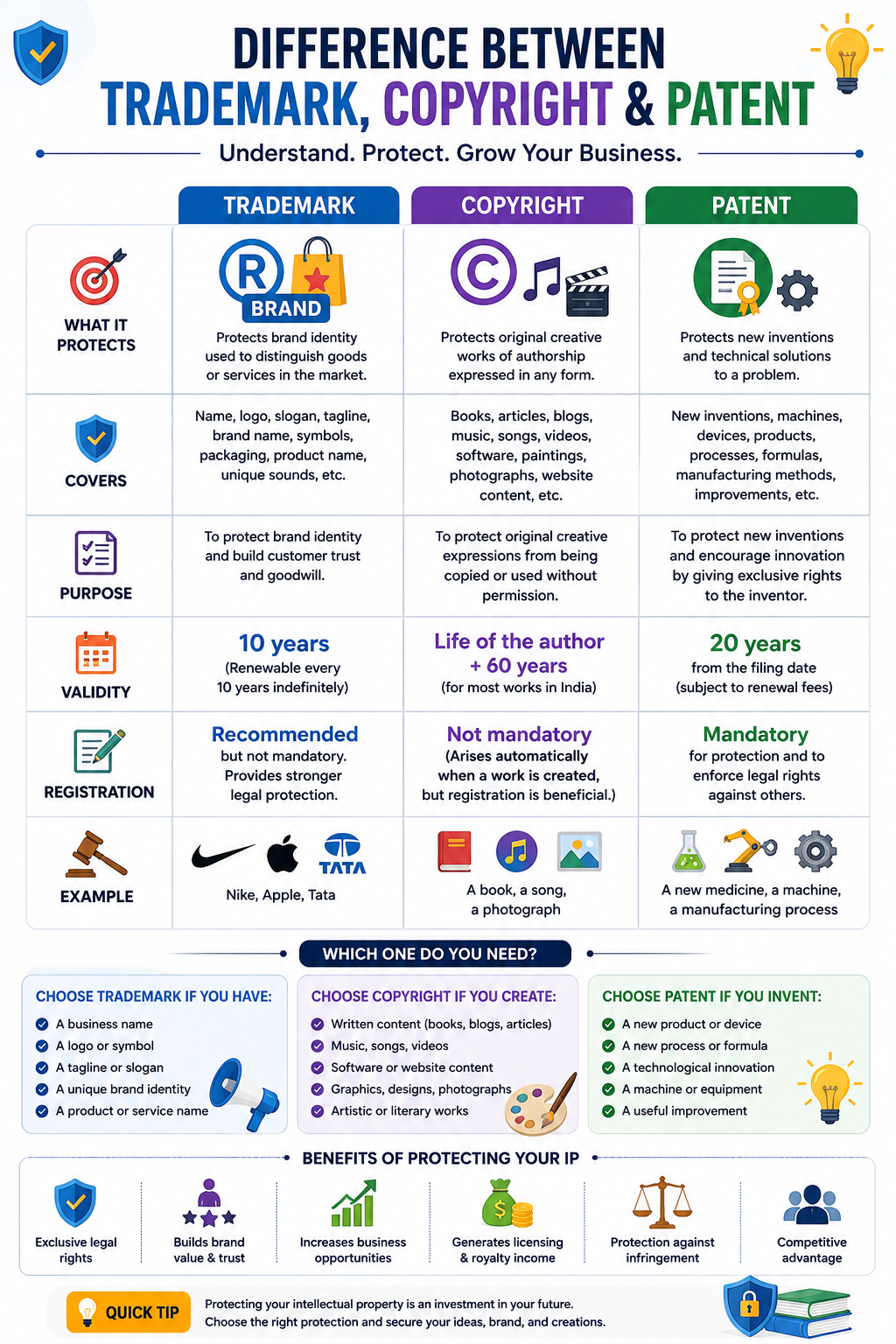
If you've created a brand, invented a product, or produced original content, protecting your intellectual property is essential. However, many business owners and creators often confuse trademarks, copyrights, and patents. Although all three are forms of Intellectual Property Rights (IPR), they protect different types of creations. In this guide, we'll explain the difference between Trademark, Copyright, and Patent, their benefits, validity, registration process, and help you determine which protection is right for you.
What Are Intellectual Property Rights (IPR)?
Intellectual Property Rights (IPR) are legal rights that protect creations of the human mind, such as:
- Brand names
- Logos
- Artistic works
- Books
- Software
- Music
- Inventions
- Industrial designs
Registering your intellectual property gives you exclusive legal rights and helps prevent unauthorized use.
What Is a Trademark?
A Trademark protects the identity of your brand.
It can include:
- Business name
- Brand name
- Logo
- Tagline
- Symbol
- Product name
- Packaging
- Unique sounds (in certain cases)
Example
- Nike®
- Apple®
- Tata®
Trademark Protects
- Brand recognition
- Business identity
- Customer trust
Validity
- 10 years, with unlimited renewals every 10 years.
What Is Copyright?
Copyright protects original creative works.
It covers:
- Books
- Articles
- Blogs
- Music
- Paintings
- Photographs
- Software code
- Videos
- Movies
- Website content
Copyright protection arises automatically when an original work is created, although registration provides stronger legal evidence in disputes.
Example
- A company's website content
- A YouTube video
- A software program
- A photograph
Validity
Generally lasts for the lifetime of the author plus 60 years in India (for most literary, dramatic, musical, and artistic works).
What Is a Patent?
A Patent protects new inventions and technological innovations.
It applies to:
- Machines
- Devices
- Manufacturing processes
- Chemical formulas
- Medical devices
- Technology innovations
A patent gives the inventor exclusive rights to make, use, sell, or license the invention.
Example
- A new pharmaceutical formula
- An innovative manufacturing process
- A unique engineering device
Validity
Generally 20 years from the filing date, subject to payment of renewal fees.
Trademark vs Copyright vs Patent
| Feature | Trademark | Copyright | Patent |
|---|---|---|---|
| Protects | Brand identity | Creative works | Inventions |
| Covers | Name, logo, slogan | Books, music, software, videos | Products, machines, processes |
| Registration | Recommended | Optional but beneficial | Mandatory for protection |
| Validity | 10 years (renewable) | Life of author + 60 years (most works) | 20 years |
| Purpose | Brand protection | Content protection | Innovation protection |
Which One Do You Need?
Choose a Trademark if you have:
- A business name
- A logo
- A product name
- A brand identity
- A tagline
Choose Copyright if you create:
- Blogs
- Articles
- Videos
- Books
- Music
- Software
- Website content
- Graphics
Choose a Patent if you invented:
- A new product
- A machine
- A manufacturing process
- A technological innovation
- A unique device
Benefits of Registering Intellectual Property
Protecting your intellectual property offers several advantages:
- Exclusive ownership rights
- Legal protection against infringement
- Enhanced brand value
- Increased customer trust
- Business growth opportunities
- Licensing and royalty income
- Competitive advantage
- Easier expansion into new markets
Common Mistakes Businesses Make
Avoid these common errors:
- Launching a brand without a trademark search
- Assuming copyright protects a brand name
- Delaying patent applications after public disclosure
- Ignoring intellectual property registration
- Using logos or content without permission
- Forgetting to renew trademark registrations
Why Intellectual Property Matters for Startups
For startups, intellectual property can be one of the most valuable assets. It helps:
- Build investor confidence
- Protect innovative ideas
- Prevent brand imitation
- Increase company valuation
- Create long-term competitive advantages
Protecting your IP early can save time, money, and legal challenges later.
Final Thoughts
Understanding the difference between Trademark, Copyright, and Patent is crucial for protecting your business, creativity, and innovations.
- A trademark safeguards your brand identity.
- Copyright protects original creative works.
- Patent secures new inventions and technological innovations.
Choosing the right type of intellectual property protection helps secure your competitive advantage and ensures your hard work remains protected.
Frequently Asked Questions (FAQs)
1. What is the main difference between a trademark, copyright, and patent?
A trademark protects brands, a copyright protects original creative works, and a patent protects inventions.
2. Can I have both a trademark and a copyright?
Yes. For example, your business logo may be protected by trademark law, while original artwork associated with it may also qualify for copyright protection, depending on the circumstances.
3. Is trademark registration mandatory?
Registration is not always mandatory, but it provides stronger legal rights and makes enforcement easier.
4. How long does trademark protection last?
A registered trademark is valid for 10 years and can be renewed every 10 years, provided it remains in good standing.
5. How long is a patent valid in India?
A patent is generally valid for 20 years from the filing date, subject to payment of the required renewal fees.