

Paying income tax is a legal responsibility, but paying more tax than required is not. The Income Tax Act provides several deductions that allow taxpayers to reduce their taxable income through eligible investments and expenses. Among the most popular tax-saving provisions are Section 80C, Section 80D, and Section 80CCD. These deductions are especially beneficial for salaried employees, self-employed professionals, and business owners who opt for the old tax regime. In this guide, we'll explain how these sections work, who can claim them, their deduction limits, and practical tips to maximize your tax savings.
What Are Income Tax Deductions?
Income tax deductions are eligible expenses or investments that reduce your taxable income. A lower taxable income means you pay less tax.
For example:
- Gross Annual Income: ₹10,00,000
- Eligible Deductions: ₹2,00,000
- Taxable Income: ₹8,00,000
This reduction can significantly lower your tax liability.
Note: Most deductions under Sections 80C, 80D, and 80CCD are available only if you choose the Old Tax Regime. The New Tax Regime has limited deduction benefits.
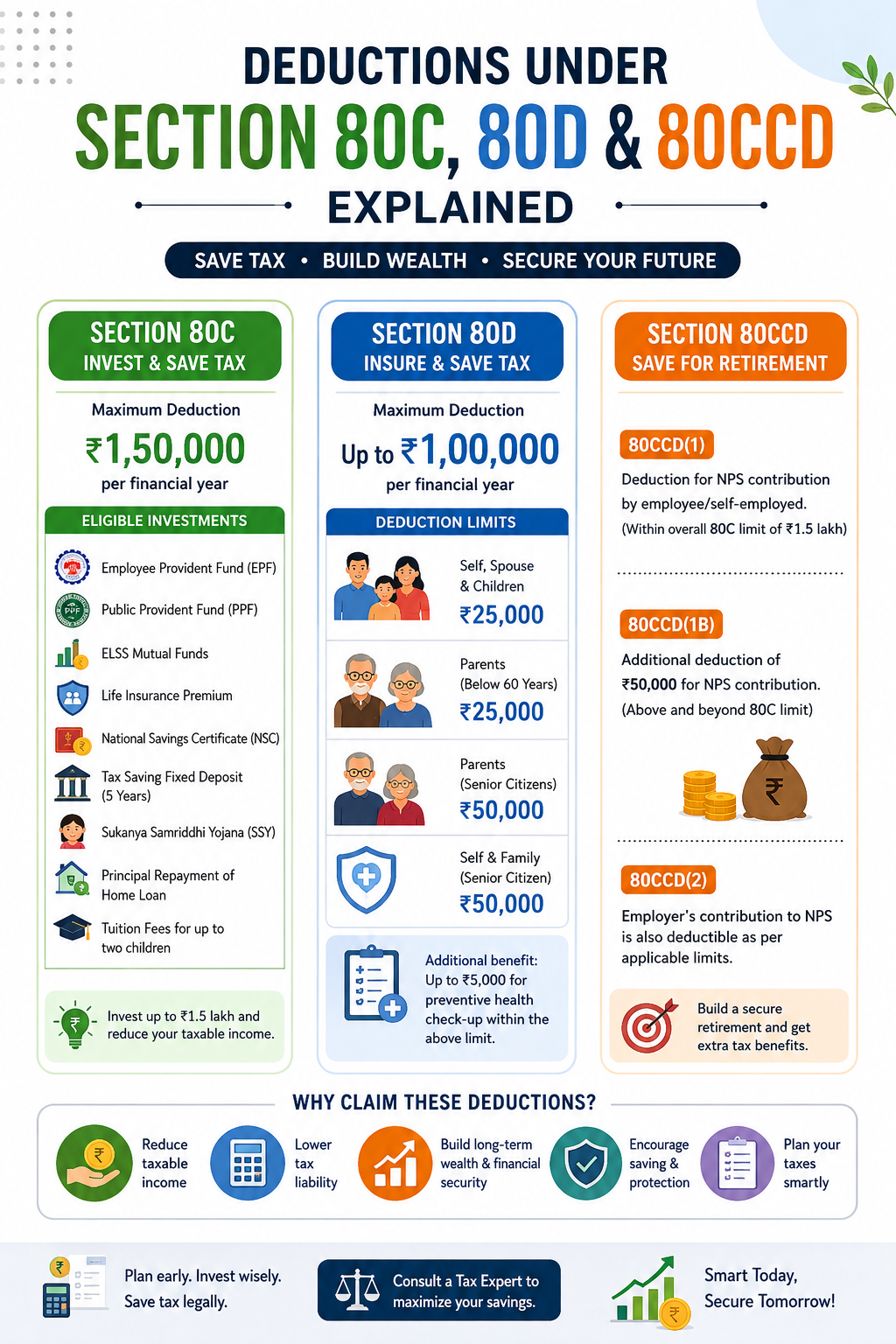
Section 80C Explained
Section 80C is one of the most commonly used tax-saving provisions.
It allows taxpayers to claim deductions for specific investments and expenses.
Maximum Deduction Limit
₹1,50,000 per financial year
This is the combined limit for eligible investments under Section 80C.
Eligible Investments Under Section 80C
You can claim deductions on:
- Employee Provident Fund (EPF)
- Public Provident Fund (PPF)
- Equity Linked Savings Scheme (ELSS)
- National Savings Certificate (NSC)
- Sukanya Samriddhi Yojana (SSY)
- 5-Year Tax Saving Fixed Deposits
- Life Insurance Premium
- Principal Repayment of Home Loan
- Tuition Fees for up to two children
- Senior Citizens Savings Scheme (SCSS)
Example
Rahul invests:
- PPF – ₹60,000
- ELSS – ₹50,000
- Life Insurance Premium – ₹40,000
Total Investment = ₹1,50,000
He can claim the full deduction of ₹1,50,000 under Section 80C.
Section 80D Explained
Section 80D provides deductions for health insurance premiums paid for yourself and eligible family members.
It encourages taxpayers to invest in health insurance while reducing taxable income.
Deduction Limits Under Section 80D
| Insured Person | Maximum Deduction |
|---|---|
| Self, Spouse & Children | ₹25,000 |
| Parents (Below 60 Years) | ₹25,000 |
| Parents (Senior Citizens) | ₹50,000 |
| Self & Family (Senior Citizen) | ₹50,000 |
Preventive Health Check-up
You can also claim up to ₹5,000 for preventive health check-ups within the overall Section 80D limit.
Example
Priya pays:
- Family Health Insurance = ₹24,000
- Parents' Health Insurance = ₹46,000
Total Deduction:
₹70,000
Section 80CCD Explained
Section 80CCD allows deductions for contributions made to the National Pension System (NPS).
It is designed to encourage retirement savings.
Types of Deductions Under Section 80CCD
Section 80CCD(1)
Available for:
- Salaried Employees
- Self-employed Individuals
This deduction falls within the overall Section 80C limit of ₹1.5 lakh.
Section 80CCD(1B)
An additional deduction of ₹50,000 is available for NPS contributions.
This deduction is over and above the ₹1.5 lakh limit under Section 80C.
This is one of the best ways to save extra tax.
Section 80CCD(2)
Employer's contribution to the NPS is deductible, subject to applicable limits under the Income Tax Act.
This benefit is generally available to salaried employees receiving employer contributions.
Example of Combined Tax Savings
Suppose Aman has:
- EPF = ₹70,000
- ELSS = ₹50,000
- Life Insurance = ₹30,000
- Health Insurance = ₹25,000
- Additional NPS Contribution = ₹50,000
His deductions would be:
| Section | Amount |
|---|---|
| 80C | ₹1,50,000 |
| 80D | ₹25,000 |
| 80CCD(1B) | ₹50,000 |
Total Deduction = ₹2,25,000
This reduces his taxable income by ₹2.25 lakh.
Comparison of Sections 80C, 80D & 80CCD
| Feature | Section 80C | Section 80D | Section 80CCD |
|---|---|---|---|
| Purpose | Investments | Health Insurance | NPS Contribution |
| Maximum Limit | ₹1.5 Lakh | Up to ₹1 Lakh (depending on eligibility) | Additional ₹50,000 under 80CCD(1B) |
| Best For | Tax Saving Investments | Medical Protection | Retirement Planning |
Benefits of Claiming These Deductions
- Reduce taxable income
- Lower overall tax liability
- Build long-term wealth
- Secure your family's financial future
- Encourage disciplined investing
- Improve retirement planning
- Promote financial security
Common Mistakes to Avoid
- Investing only at the end of the financial year.
- Forgetting to keep investment and insurance receipts.
- Missing the additional ₹50,000 NPS deduction under Section 80CCD(1B).
- Buying insurance only for tax benefits instead of adequate coverage.
- Assuming deductions are available under the New Tax Regime without checking eligibility.
Tax Planning Tips
- Start tax planning at the beginning of the financial year.
- Spread investments throughout the year instead of making last-minute investments.
- Review your insurance coverage annually.
- Consider NPS for additional retirement savings.
- Consult a qualified tax professional before filing your Income Tax Return.
Who Should Use These Deductions?
These deductions are beneficial for:
- Salaried Employees
- Self-employed Professionals
- Business Owners
- Freelancers
- Senior Citizens
- First-time Taxpayers
- Individuals planning long-term investments
Final Thoughts
Sections 80C, 80D, and 80CCD are among the most effective tools available for reducing taxable income under the old tax regime. By combining eligible investments, health insurance premiums, and NPS contributions, taxpayers can lower their tax liability while building long-term financial security.
Thoughtful tax planning should align with your financial goals rather than focus solely on saving tax. Review your eligibility each financial year and maintain proper documentation to support your claims.
Frequently Asked Questions (FAQs)
1. What is the maximum deduction under Section 80C?
You can claim up to ₹1,50,000 in a financial year for eligible investments and expenses.
2. Can I claim both Section 80C and Section 80D?
Yes. They are separate deductions and can both be claimed if you meet the eligibility requirements.
3. Is the ₹50,000 deduction under Section 80CCD(1B) separate from Section 80C?
Yes. The deduction under Section 80CCD(1B) is in addition to the ₹1.5 lakh limit under Section 80C.
4. Can I claim health insurance for my parents?
Yes. Premiums paid for eligible parents may qualify for a deduction under Section 80D, subject to the applicable limits.
5. Are these deductions available under the New Tax Regime?
Most deductions under Sections 80C, 80D, and 80CCD(1B) are generally not available under the New Tax Regime. Check the latest tax rules or consult a tax professional to determine which regime is more beneficial for your situation.