

Starting an e-commerce business in India is exciting, but before you begin selling online through platforms like Amazon, Flipkart, or your own website, obtaining GST registration is one of the most important legal steps. Under Indian GST laws, most e-commerce sellers are required to register for GST, even if their turnover is below the normal threshold limit. Missing documents or incorrect details can delay the registration process and impact your business operations. In this blog, we’ll cover the mandatory documents required for GST registration for a new e-commerce startup in India.
Why GST Registration is Mandatory for E-Commerce Businesses
E-commerce businesses selling goods or services online generally need GST registration because online marketplaces collect Tax Collected at Source (TCS). Without GST registration:
You cannot legally sell on major marketplaces
Input Tax Credit (ITC) benefits may be lost
Your business may face compliance penalties
Marketplace account approvals can get delayed
Whether you are a sole proprietor, a partnership firm, an LLP, or a private limited company, proper GST documentation is essential.
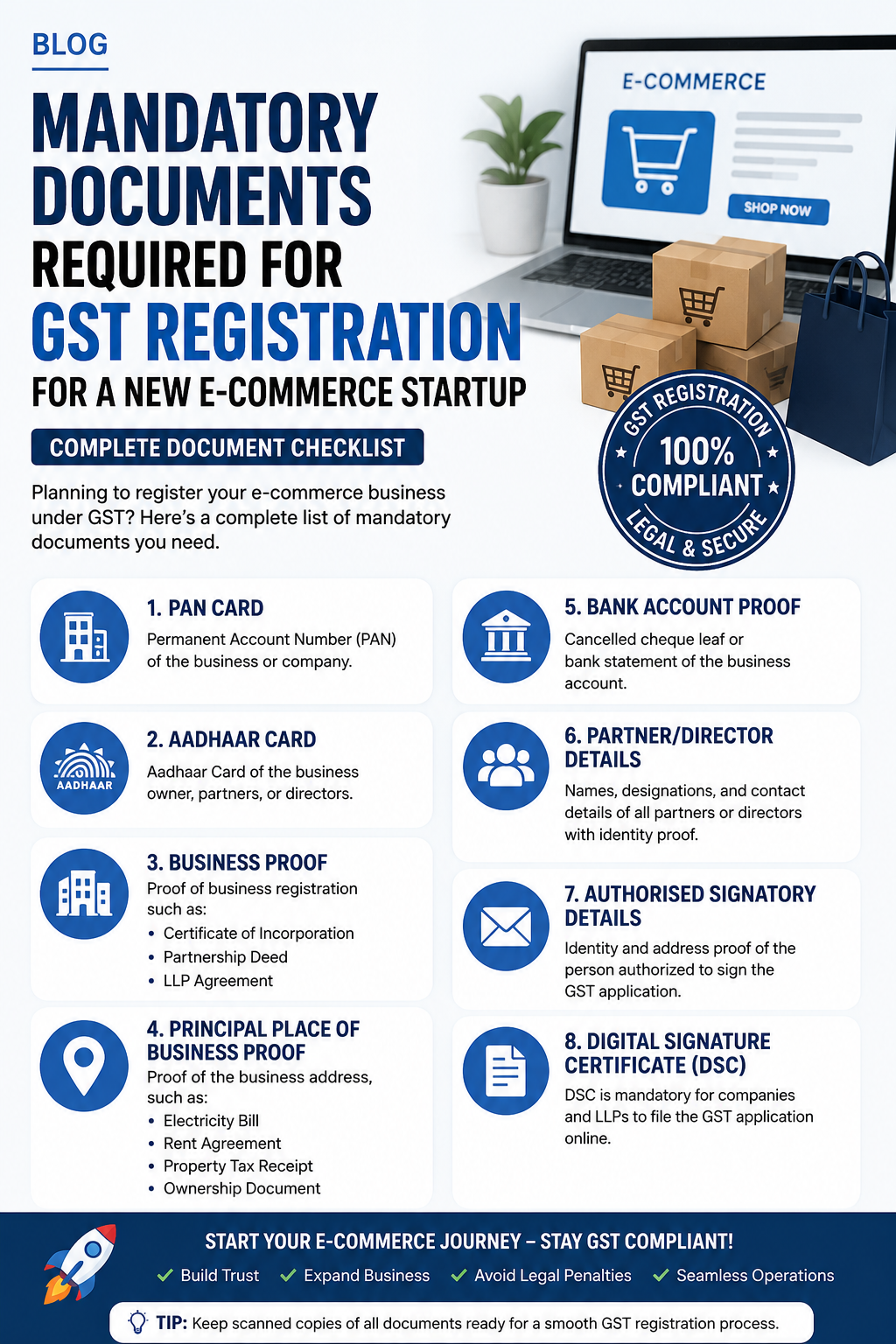
Complete List of Documents Required for GST Registration
1. PAN Card of the Business/Owner
The PAN card is the primary identity document required for GST registration.
Required:
- PAN card of proprietor (for sole proprietorship)
- PAN card of company or LLP (for registered entities)
The GST number is linked directly with the PAN details.
2. Aadhaar Card
Aadhaar verification is commonly used for GST authentication.
Required for:
- Proprietor
- Partners
- Directors
- Authorized signatory
Ensure that the mobile number linked with Aadhaar is active for OTP verification.
3. Business Registration Proof
Depending on your business structure, you must submit registration proof.
Examples:
- Certificate of Incorporation
- Partnership Deed
- LLP Agreement
- Shop Establishment Certificate
This document confirms the legal existence of your startup.
4. Address Proof of Principal Place of Business
You must provide valid proof of your business address.
Accepted documents include:
- Electricity bill
- Rent agreement
- Property tax receipt
- Municipal khata copy
- Ownership documents
If the property is rented, a No Objection Certificate (NOC) from the owner may also be required.
5. Bank Account Proof
GST authorities require proof of the business bank account.
Accepted documents:
- Cancelled cheque
- Bank statement
- First page of passbook
The business name should match the GST application details.
6. Passport-Size Photographs
Photographs of the proprietor, partners, or directors are required during the GST registration process.
Recommended:
- Recent passport-size photo
- Clear white background
- JPEG format for online upload
7. Digital Signature Certificate (DSC)
A DSC is mandatory for:
- Private Limited Companies
- LLPs
It is used for digitally signing the GST application online.
8. Authorized Signatory Proof
If someone else is filing GST on behalf of the business, authorization documents are required.
Documents include:
- Authorization letter
- Aadhaar card
- PAN card of authorized signatory
Additional Documents for E-Commerce Sellers
If you plan to sell on online marketplaces, you may also require:
- Trademark certificate (optional but recommended)
- Brand authorization letter
- Import Export Code (IEC) for international selling
- FSSAI license for food-related products
These documents help in faster marketplace onboarding and compliance.
Common Mistakes to Avoid During GST Registration
Incorrect Business Address
Mismatch between address proof and application details can lead to rejection.
Wrong PAN Details
Always verify PAN spelling and date of incorporation carefully.
Unclear Document Uploads
Blurry scans often delay approval.
Using Personal Bank Account
Business accounts are preferred for smoother verification.
Benefits of GST Registration for E-Commerce Startups
Legal Business Operations
Operate legally across India without compliance issues.
Input Tax Credit (ITC)
Claim GST paid on purchases and reduce tax burden.
Marketplace Approval
Register easily on e-commerce platforms.
Better Business Credibility
GST registration improves trust among customers and suppliers.
Final Thoughts
GST registration is one of the first and most important compliance steps for any e-commerce startup in India. Keeping all mandatory documents ready before applying can save time, reduce rejection chances, and help your business launch smoothly.
Whether you are starting a dropshipping store, D2C brand, online service business, or marketplace selling account, proper GST compliance helps build a strong foundation for long-term growth.
If you are planning to register your e-commerce startup under GST, preparing these documents in advance will make the process much faster and hassle-free.