

Moving goods from one place to another is a regular part of business operations. Under the Goods and Services Tax (GST) system in India, businesses may need to generate an E-Way Bill before transporting goods, depending on the value and nature of the movement. An E-Way Bill helps tax authorities track the movement of goods and supports GST compliance. Errors in an E-Way Bill can lead to delays, penalties, or other compliance issues.
In this guide, we explain what an E-Way Bill is, when it is required, applicable value limits, validity, who should generate it, and common mistakes businesses should avoid.
What Is an E-Way Bill Under GST?
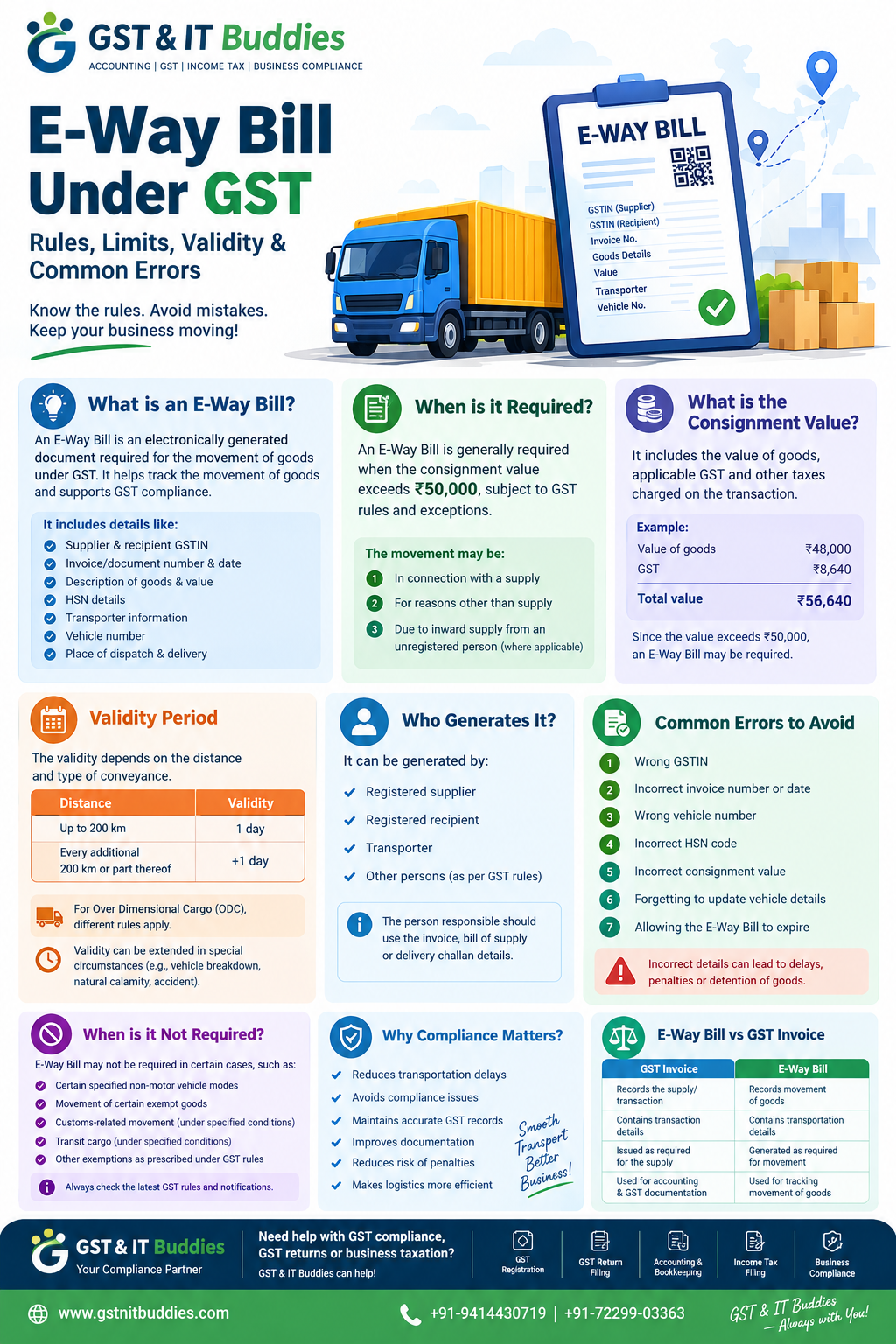
An E-Way Bill (Electronic Way Bill) is an electronically generated document required for the movement of goods under specified circumstances under GST.
It contains important information such as:
- Details of the supplier
- Details of the recipient
- Invoice or document number
- Description of goods
- Value of goods
- HSN details
- Transporter information
- Vehicle number
- Place of dispatch and delivery
The E-Way Bill is generated through the GST E-Way Bill system.
It generally needs to be carried by the person in charge of the conveyance during the transportation of goods where the requirement applies.
When Is an E-Way Bill Required?
Generally, an E-Way Bill is required when there is a movement of goods and the consignment value exceeds ₹50,000, subject to the applicable GST rules and exceptions.
The movement may be:
- In connection with a supply
- For reasons other than supply
- Due to an inward supply from an unregistered person, where applicable
For example, if a business transports taxable goods worth ₹75,000 from Rajasthan to Gujarat, an E-Way Bill may be required, subject to the applicable provisions.
Important Point
The ₹50,000 threshold is generally considered at the consignment value level, and businesses should also check applicable state-specific requirements and GST rules before transporting goods.
What Is Consignment Value for E-Way Bill?
Consignment value generally includes the value declared in the invoice, bill of supply, or delivery challan, as applicable.
It also takes into account applicable GST and other taxes charged on the transaction.
For example:
Value of goods: ₹48,000
GST: ₹8,640
Total invoice value: ₹56,640
Since the consignment value can exceed ₹50,000, the E-Way Bill requirement may apply.
Businesses should calculate the relevant value carefully before deciding whether an E-Way Bill is required.
Who Is Responsible for Generating the E-Way Bill?
Depending on the transaction and circumstances, the responsibility may fall on:
- Registered supplier
- Registered recipient
- Transporter
- Other persons specified under the GST rules
A registered person may generate the E-Way Bill using the required invoice, bill of supply, or delivery challan details.
If the supplier or recipient has not generated the E-Way Bill in circumstances where it is required, the transporter may have responsibilities under the applicable rules.
What Information Is Required to Generate an E-Way Bill?
Businesses should keep the relevant documents and transportation information ready.
Commonly required details include:
Part A
- GSTIN of supplier
- GSTIN of recipient
- Invoice/bill number
- Invoice/bill date
- Value of goods
- HSN/SAC details
- Reason for transportation
Part B
- Transporter details
- Mode of transport
- Vehicle number, where applicable
- Transport document details, where applicable
Accurate information is important because incorrect details can create compliance problems during transportation.
E-Way Bill Validity Period
The validity of an E-Way Bill depends primarily on the distance travelled and the type of conveyance.
For regular vehicles or conveyances, the general rule provides:
| Distance | General Validity |
|---|---|
| Up to 200 km | 1 day |
| Every additional 200 km or part thereof | 1 additional day |
For Over Dimensional Cargo (ODC), different validity provisions apply.
Businesses should check the current E-Way Bill rules because specific circumstances, extensions, and special provisions may affect validity.
Example
Suppose goods are transported for a distance of 450 km.
The applicable validity is generally calculated based on the prescribed distance slabs, including the additional distance or part thereof.
Can an E-Way Bill Be Extended?
In certain situations, the validity of an E-Way Bill can be extended according to the applicable GST provisions.
For example, circumstances such as:
- Vehicle breakdown
- Natural calamity
- Law-and-order issues
- Accident
- Trans-shipment delays
- Other exceptional circumstances
may affect transportation.
The person responsible should follow the applicable procedure and update the E-Way Bill within the permitted framework.
When Is an E-Way Bill Not Required?
GST rules provide various situations where an E-Way Bill may not be required.
Examples can include certain categories of goods and specific types of movement covered by the relevant rules.
Some commonly discussed situations include:
- Transportation by certain specified non-motor vehicle modes
- Movement of certain exempt goods
- Customs-related movement covered by specified conditions
- Movement within specified areas or circumstances
- Transit cargo under specified conditions
- Other exemptions prescribed under the GST rules
However, businesses should not assume that every movement of exempt or low-value goods is automatically outside the E-Way Bill requirements. The exact exemption should be checked against the applicable rules.
Common E-Way Bill Mistakes Businesses Should Avoid
Incorrect E-Way Bill details can cause unnecessary compliance problems.
Here are some common mistakes:
1. Entering the Wrong GSTIN
A supplier or recipient's GSTIN may be entered incorrectly.
Why it matters:
Incorrect GSTIN details can create invoice and compliance mismatches.
Tip:
Verify the GSTIN before submitting the E-Way Bill.
2. Wrong Invoice Number or Date
The invoice number and date should match the underlying tax invoice or document.
Entering incorrect details may create problems during verification.
3. Incorrect Vehicle Number
Vehicle details should be entered carefully.
Even a small error in the vehicle registration number can create difficulties during transit.
4. Incorrect HSN Code
Businesses should ensure that the HSN entered in the E-Way Bill corresponds appropriately with the goods being transported.
5. Incorrect Consignment Value
Businesses sometimes calculate the value incorrectly or enter an amount that does not match the relevant document.
Always reconcile the E-Way Bill with the invoice or other applicable document.
6. Forgetting to Update Vehicle Details
When goods are transported through multiple vehicles or there is a change in the vehicle, the required E-Way Bill information should be updated according to the applicable rules.
7. Allowing the E-Way Bill to Expire
Businesses should monitor the validity period and transportation status.
Unexpected delays can result in the E-Way Bill becoming invalid if appropriate action is not taken.
What Happens If an E-Way Bill Is Not Generated?
If an E-Way Bill is required but is not generated, the movement of goods can result in GST compliance issues.
Depending on the circumstances, authorities may take action under the applicable GST provisions, including detention of goods or conveyance and applicable penalties.
Therefore, businesses should verify E-Way Bill requirements before dispatching goods.
E-Way Bill and GST Invoice: What Is the Difference?
An E-Way Bill and GST invoice serve different purposes.
| GST Invoice | E-Way Bill |
|---|---|
| Records the supply/transaction | Records movement of goods |
| Contains transaction details | Contains transportation details |
| Issued/generated as required for the supply | Generated as required for movement under GST rules |
| Used for accounting and GST documentation | Used for tracking movement of goods |
A business may need both documents for a transaction involving movement of goods.
E-Way Bill for Interstate and Intrastate Movement
E-Way Bill requirements can apply to both:
Interstate Movement
Goods moving from one state to another may require an E-Way Bill when the applicable conditions are satisfied.
Intrastate Movement
Movement within the same state can also be covered by E-Way Bill requirements.
However, states may have specific provisions or notifications relating to certain intra-state movements.
Businesses should therefore check the applicable rules for the relevant state.
Practical E-Way Bill Compliance Checklist
Before dispatching goods, businesses can use this simple checklist:
✅ Verify supplier GSTIN
✅ Verify recipient GSTIN
✅ Match invoice number and date
✅ Check the value of goods
✅ Verify HSN details
✅ Enter the correct vehicle number
✅ Check transporter information
✅ Confirm the place of delivery
✅ Check E-Way Bill validity
✅ Update transportation details when required
✅ Keep the relevant invoice/document available during transit
Why Is E-Way Bill Compliance Important?
Proper E-Way Bill management can help businesses:
- Reduce transportation delays
- Avoid preventable compliance issues
- Maintain accurate GST records
- Improve documentation
- Reduce the risk of penalties
- Make logistics processes more efficient
For businesses handling frequent shipments, maintaining a proper E-Way Bill process can significantly reduce errors.
Final Thoughts
The E-Way Bill under GST is an important compliance requirement for businesses involved in the movement of goods. Understanding the applicable threshold, validity period, documentation requirements, and exemptions can help businesses avoid common mistakes.
Businesses should ensure that the information entered in the E-Way Bill matches the relevant invoice or transportation document. They should also monitor validity and update the required details whenever transportation circumstances change.
Because GST rules and notifications can change, businesses should verify the latest applicable provisions before relying on a particular exemption, threshold, or procedural requirement.
Need help with GST compliance, GST returns, or business taxation?
GST & IT Buddies can help businesses with GST registration, GST return filing, accounting, taxation, and other compliance requirements.
GST & IT Buddies — Accounting | GST | Income Tax | Business Compliance