
Introduction The Goods and Services Tax (GST) is one of India's most significant indirect tax reforms. Introduced on 1 July 2017, GST brought many central and state indirect taxes under a common tax system. It simplified taxation on the supply of goods and services by replacing several earlier taxes, including service tax, central excise duty on many goods, and state VAT on most goods.
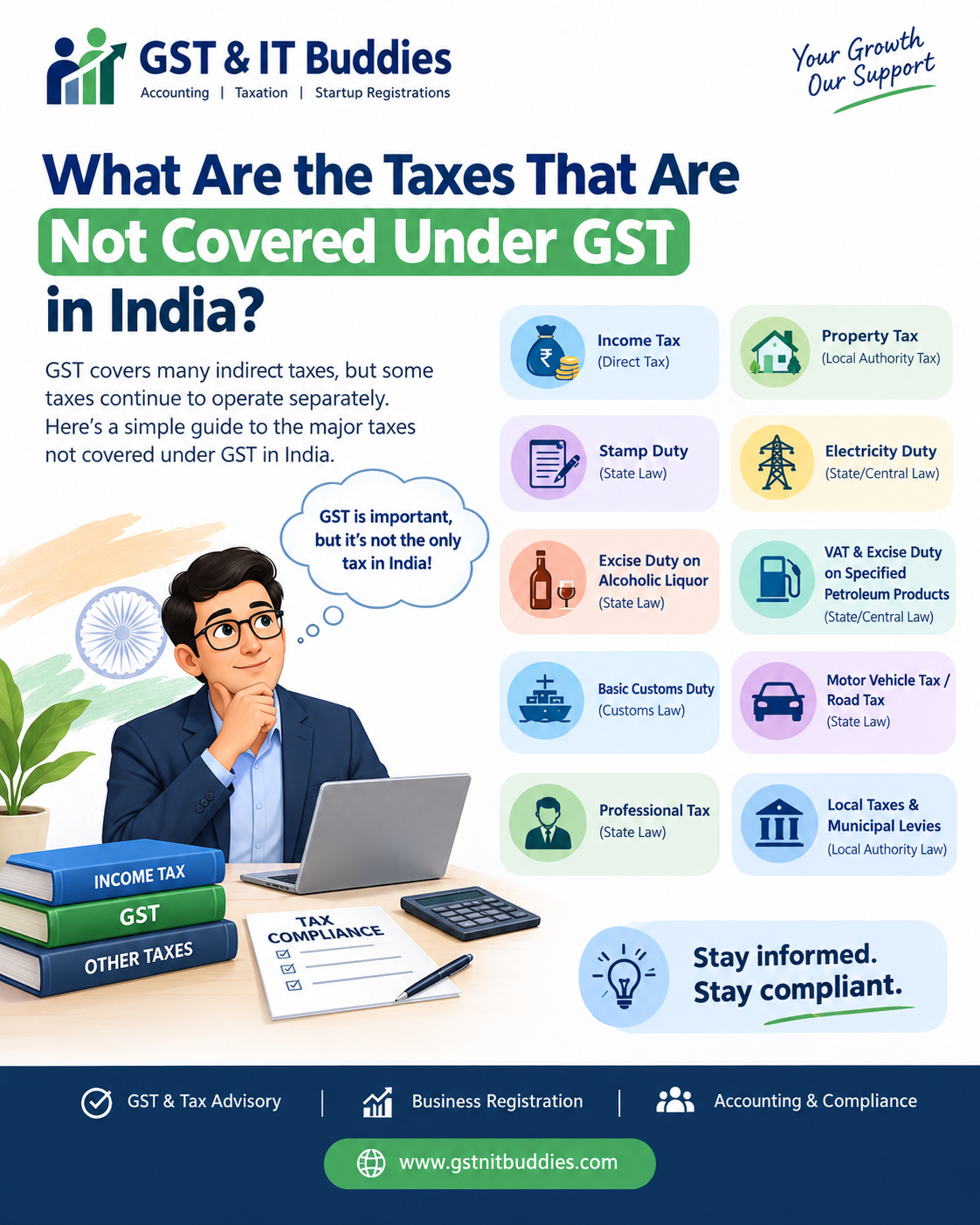
List of Major Taxes Not Covered Under GST in India
1. Income Tax
Income tax is a direct tax levied on taxable income earned by individuals, businesses, and other eligible taxpayers under the applicable income tax law.
Examples include:
-
Salary income tax
-
Tax on business and professional income
-
Tax on capital gains
-
Tax on interest and rental income, where applicable
Example: If an employee earns a taxable salary, income tax may apply to that income. GST is not charged merely because the employee receives a salary.
2. Property Tax
Property tax is generally imposed by municipal corporations and other local authorities on eligible residential, commercial, and other properties.
It helps fund local services such as road maintenance, sanitation, drainage, and public infrastructure.
Example: A business owner may need to pay municipal property tax on an office building, even if the business is already registered under GST.
Property tax and GST are separate obligations.
3. Stamp Duty and Registration Fees
Stamp duty is charged on specified legal instruments and transactions, such as property conveyances, leases, and certain agreements. Registration fees may also be payable when documents are registered with the relevant authority.
These charges operate under applicable stamp and registration laws rather than being subsumed into GST.
Example: A person purchasing a property may have to pay stamp duty and registration charges separately from any GST that may apply to the transaction.
The GST treatment of the underlying property transaction depends on its nature and the applicable law.
4. Electricity Duty
Electricity duty is imposed under applicable central or state legislation, depending on the levy. Electricity duty and electricity-related charges should be distinguished from GST on other goods or services.
The supply of electrical energy is generally exempt from GST, but taxable services associated with electricity may have a different treatment depending on the facts.
Example: A commercial establishment may pay electricity charges and applicable electricity duty while separately paying GST on other taxable business expenses.
5. Excise Duty on Alcoholic Liquor for Human Consumption
Alcoholic liquor for human consumption is outside the GST supply framework. State excise duties and other applicable state levies continue to apply.
Example: A state may impose excise duty on alcoholic liquor sold within its jurisdiction. This is not the same as GST charged on ordinary taxable goods.
6. VAT and Excise Duty on Specified Petroleum Products
Although GST covers many goods and services, five major petroleum products remain outside GST's levy on supplies until the GST Council recommends a date and the required legal arrangements take effect.
These products are:
-
Petroleum crude
-
High-speed diesel
-
Motor spirit (commonly known as petrol)
-
Natural gas
-
Aviation turbine fuel (ATF)
For these products, applicable state VAT or sales tax and central excise duty continue to be relevant under the existing legal framework.
Example: Petrol prices can include central excise duty and state VAT. These levies are separate from GST charged on other taxable goods and services.
Important: Do not assume that every petroleum-related product is outside GST. The treatment of each product depends on the applicable law.
7. Basic Customs Duty
Basic Customs Duty (BCD) is generally imposed on the import of goods under customs law. It is separate from GST.
However, imports may also attract Integrated GST (IGST) and other applicable duties or charges, subject to the relevant provisions and exemptions.
Example: When a business imports machinery, it may need to pay basic customs duty and applicable import IGST. The two are distinct levies.
8. Motor Vehicle Tax and Road Tax
Motor vehicle tax and road tax are generally imposed under applicable state motor vehicle laws. They are separate from GST.
GST may nevertheless apply to the sale or supply of a vehicle, depending on the transaction and applicable provisions.
Example: When someone purchases a vehicle, GST may be included in the vehicle's taxable price, while road tax and registration charges may be payable separately.
9. Professional Tax
Professional tax is a state-level tax imposed on certain individuals and professionals, subject to the applicable state law and constitutional limits.
It may apply to salaried employees, professionals, or other eligible persons depending on the state.
Example: An eligible employee may have professional tax deducted from salary in a state that levies it. This is separate from income tax and GST.
10. Local Taxes and Municipal Levies
Certain local levies, such as property tax and some municipal charges, continue outside GST.
The exact treatment depends on the nature of the charge, the authority imposing it, and the relevant law. Not every municipal fee or levy is automatically outside GST.
Example: A shop owner may pay municipal property tax to the local authority and GST on taxable goods or services purchased for the shop.
Summary Table: Taxes Outside GST
| Tax or levy | Main purpose or application |
|---|---|
| Income tax | Tax on taxable income |
| Property tax | Tax on eligible property |
| Stamp duty | Tax on specified instruments and transactions |
| Electricity duty | Applicable levy on electricity under relevant laws |
| State excise duty on alcoholic liquor | Tax on alcoholic liquor for human consumption |
| VAT and central excise duty on specified petroleum products | Applicable levies on petroleum products excluded from GST |
| Basic Customs Duty | Customs duty on imports |
| Motor vehicle tax or road tax | State levy on vehicles |
| Professional tax | State tax on eligible professions, trades, or employment |
| Certain municipal levies | Local taxes and charges under applicable laws |
The list is intended as a general guide. The legal basis and applicability of each levy may vary by state, transaction, and taxpayer.
Why Are These Taxes Not Included Under GST?
There are several reasons why some taxes continue outside the GST system.
1. Constitutional and Legal Provisions
The Constitution of India and relevant legislation define the scope of GST and the powers of the Union, states, and local authorities to levy taxes.
2. Direct Taxes Have a Different Purpose
Income tax is based on taxable income, whereas GST is generally linked to taxable supplies of goods and services. They serve different purposes and are governed by different laws.
3. Certain Goods Are Specifically Excluded
Alcoholic liquor for human consumption and the five specified petroleum products have special treatment under the GST framework. Separate state and central levies continue to apply as permitted by law.
4. Local Revenue Requirements
Property taxes and certain other local levies provide revenue to municipal and local authorities for public services and infrastructure.
5. Separate Customs and State Tax Frameworks
Basic Customs Duty, professional tax, motor vehicle tax, and other levies operate under their own legal frameworks.
Difference Between GST and Taxes Outside GST
| Basis | GST | Taxes outside GST |
|---|---|---|
| Nature | Generally an indirect tax on supplies | May be direct or indirect |
| Legal framework | GST laws | Income tax, customs, state, stamp, or local laws |
| Examples | CGST, SGST, IGST | Income tax, property tax, BCD |
| Collection | By authorised central and state tax authorities | By the authority responsible under the relevant law |
| Applicability | Depends on the supply and GST provisions | Depends on the particular tax law |
Do Businesses Need to Pay Both GST and Other Taxes?
Yes. A business may have multiple tax obligations under different laws.
For example, a registered business may need to:
-
Charge and pay GST on taxable supplies.
-
Pay income tax on taxable profits.
-
Pay property tax on eligible business premises.
-
Pay professional tax where applicable.
-
Pay customs duties and import IGST on imported goods, where applicable.
-
Pay stamp duty on specified legal instruments and transactions.
GST registration does not replace other tax registrations, returns, or payment obligations. Businesses should identify each applicable levy and comply with its separate rules.
Common Misconceptions About Taxes Outside GST
Misconception 1: All indirect taxes were removed after GST.
Correction: GST subsumed many indirect taxes, but certain duties and levies continue under separate laws.
Misconception 2: Petrol and diesel are taxed under GST.
Correction: The five specified petroleum products remain outside the GST levy on supplies until the required legal arrangements take effect. Existing VAT and excise duty rules continue to apply.
Misconception 3: No GST can apply to a transaction if stamp duty is paid.
Correction: Stamp duty and GST have different legal bases. Depending on the transaction, both may be relevant.
Misconception 4: Income tax and GST are interchangeable.
Correction: Income tax generally applies to taxable income, while GST generally applies to taxable supplies of goods and services.
Misconception 5: Everything connected with electricity is exempt from GST.
Correction: Electrical energy is generally exempt, but related goods and services may have different GST treatment.
Conclusion
India's tax system includes several levies that operate outside GST. Major examples include income tax, property tax, stamp duty, professional tax, basic customs duty, motor vehicle tax, and specified duties on alcoholic liquor and petroleum products.
For businesses, understanding the difference between GST and other taxes helps avoid missed payments, incorrect tax treatment, and compliance problems. Since applicability can vary by state and transaction, taxpayers should check the relevant legislation and current notifications before making tax decisions.
GST & IT Buddies helps businesses and individuals understand GST compliance, taxation, accounting, and business registration requirements.
Visit www.gstnitbuddies.com to explore our tax and compliance services.
Frequently Asked Questions (FAQs)
1. Which taxes are not covered under GST in India?
Major examples include income tax, property tax, stamp duty, professional tax, basic customs duty, motor vehicle tax, and specified levies on alcoholic liquor and petroleum products.
2. Is income tax included in GST?
No. Income tax is a direct tax on taxable income and is separate from GST.
3. Is petrol covered under GST?
Petrol is one of the five specified petroleum products currently outside the GST levy on supplies. Applicable VAT and central excise duty continue to be relevant.
4. Is stamp duty included in GST?
No. Stamp duty is imposed under applicable stamp laws. However, GST may separately apply to a related supply or transaction, depending on its nature and the law.
5. Is customs duty included in GST?
Basic Customs Duty is separate from GST. Imports may also attract IGST and other applicable charges.
6. Is property tax covered under GST?
No. Property tax is generally imposed by local authorities under their applicable laws.
7. Is electricity duty covered under GST?
Electricity duty operates under applicable electricity-related legislation and is separate from GST. The GST treatment of related goods and services depends on the specific transaction.
8. Are all taxes outside GST applicable to every business?
No. Tax obligations depend on the nature of the business, its transactions, location, income, assets, and applicable laws.
9. Why are some taxes still outside GST?
Some taxes have a different legal purpose, while certain goods and levies have been specifically excluded or continue under separate constitutional and statutory arrangements.
10. Where can businesses get help with GST and tax compliance?
Businesses can consult a qualified tax professional or contact GST & IT Buddies for assistance with applicable GST, taxation, accounting, and compliance requirements.