


India’s income tax system has entered a new phase with the Income-tax Act, 2025, effective 1 April 2026. The new legislation replaces the Income-tax Act, 1961, with a simplified structure designed to make tax provisions easier to understand and comply with. However, taxpayers should understand that a new law does not automatically mean an entirely new tax calculation method. Taxpayers must still consider the applicable tax rates, eligible deductions, rebates, and other provisions when calculating the final tax liability.
What Is the Income-tax Act, 2025?
The Income-tax Act, 2025, is India’s updated legislation governing income tax. It came into force on 1 April 2026 and replaces the Income-tax Act, 1961.
The new Act reorganises and simplifies the presentation of income tax provisions while retaining the underlying tax policy, subject to applicable amendments.
Some important features include:
Simplified language and a reorganised legal structure.
A more streamlined presentation of tax provisions.
Updated tax forms and compliance procedures.
Continued application of prescribed tax rates, deductions, rebates, and exemptions.
The introduction of the term “tax year” for the relevant annual tax period.
For income earned during the tax year 2026–27, taxpayers must follow the provisions applicable under the new Act.
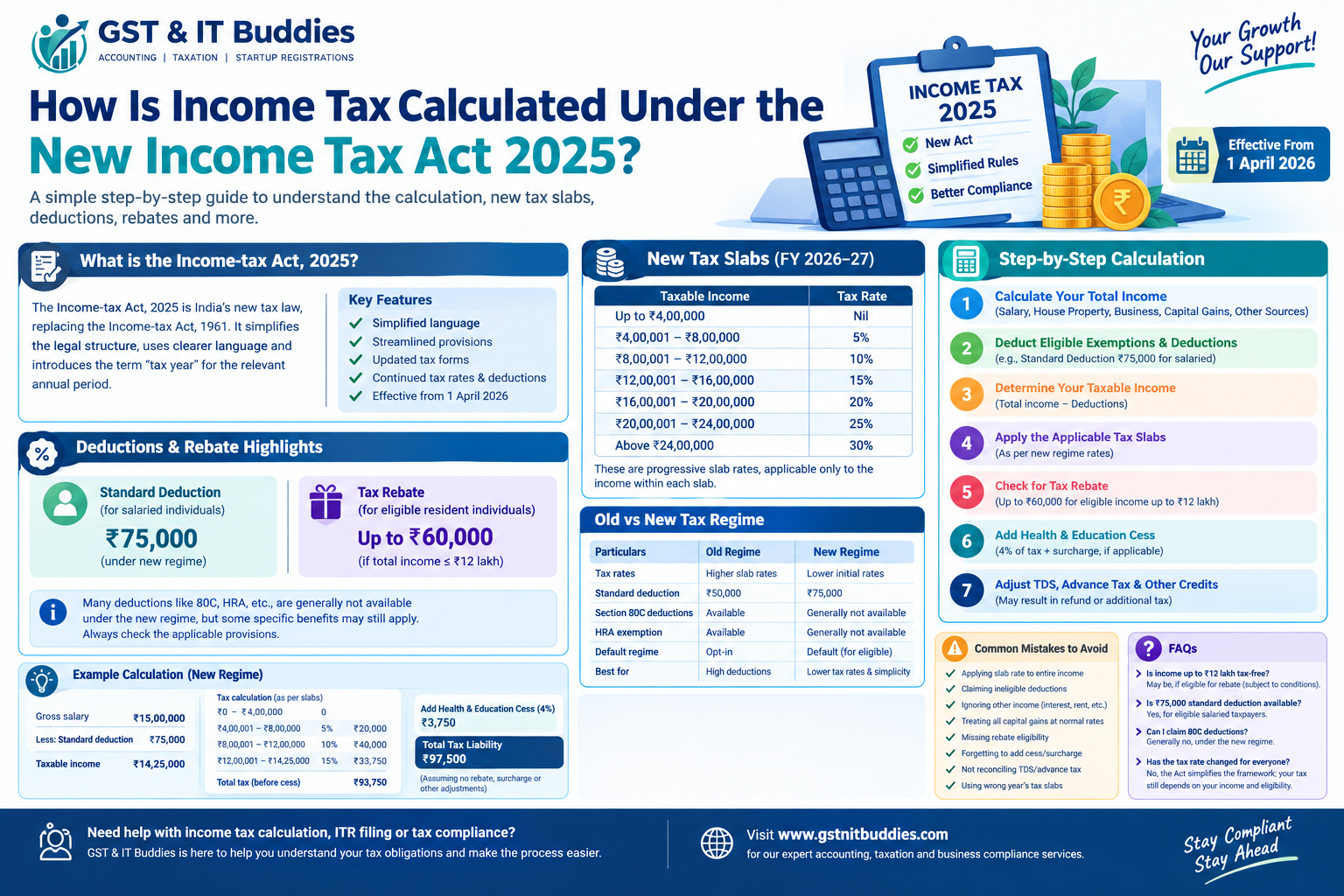
What Are the New Income Tax Slabs for FY 2026–27? Under Section 202 of the Income-tax Act, 2025, the new tax regime provides the following slab rates for eligible individuals and other specified taxpayers.
Taxable income Tax rate Up to ₹4,00,000 Nil ₹4,00,001–₹8,00,000 5% ₹8,00,001–₹12,00,000 10% ₹12,00,001–₹16,00,000 15% ₹16,00,001–₹20,00,000 20% ₹20,00,001–₹24,00,000 25% Above ₹24,00,000 30% These are progressive slab rates. Each rate applies only to the income falling within its respective slab, rather than applying the highest rate to the entire taxable income.
The new regime is the default regime for eligible taxpayers, subject to the applicable provisions for opting out.
How Is Income Tax Calculated Under the New Income-tax Act, 2025? Income tax is calculated by determining the taxpayer’s total taxable income, applying the relevant tax rates, and then considering eligible rebates, surcharge, cess, and tax credits.
Step 1: Calculate Your Total Income. First, identify income from all applicable sources. Under the income tax framework, income is generally classified under five heads:
Income from Salary: Salary, taxable allowances, bonuses, and other taxable employment benefits.
Income from House Property: Taxable rental income and other income covered under this head.
Profits and Gains from Business or Profession: Profits earned through business or professional activities.
Capital Gains: Taxable profits arising from the transfer of capital assets.
Income from Other Sources: Taxable interest, dividends, and other income covered under this head.
The treatment of individual income items depends on the applicable provisions. Certain types of income, such as specified capital gains, may be subject to special tax rates instead of ordinary slab rates.
Step 2: Deduct Eligible Exemptions and Deductions. After identifying your income, calculate the deductions and exemptions permitted under the tax regime you use.
Under the new tax regime, many deductions available under the old regime are restricted. However, certain deductions and benefits remain available where the law permits them.
For example, eligible salaried taxpayers can claim a standard deduction of up to ₹75,000 under the new regime, subject to the applicable conditions.
Do not automatically subtract every investment, insurance premium, or other payment from your income. Check whether the deduction is allowed under the selected regime.
Step 3: Determine Your Taxable Income Your taxable income is the amount on which income tax is calculated after applying the relevant rules.
A simplified illustration is:
Gross salary: ₹15,00,000
Standard deduction: ₹75,000
Taxable income from salary: ₹14,25,000
This example assumes there is no other income or adjustment affecting the final total income.
For taxpayers earning from multiple sources, the final taxable income must be determined after considering all applicable income, deductions, exemptions, and adjustments.
Step 4: Apply the Applicable Income Tax Slabs Once your taxable income is calculated, apply the tax rates to the income falling within each slab.
For example, if your taxable income is ₹14,25,000 under the new tax regime, the calculation is:
Income slab Calculation Tax Up to ₹4,00,000 Nil ₹0 ₹4,00,001–₹8,00,000 ₹4,00,000 × 5% ₹20,000 ₹8,00,001–₹12,00,000 ₹4,00,000 × 10% ₹40,000 ₹12,00,001–₹14,25,000 ₹2,25,000 × 15% ₹33,750 Total income tax ₹93,750 The tax calculated before rebate, surcharge, and cess is ₹93,750.
Step 5: Check Your Eligibility for a Tax Rebate A tax rebate can reduce the income tax payable by an eligible taxpayer.
Under the new tax regime, a resident individual may qualify for a rebate of up to ₹60,000 where their eligible total income does not exceed ₹12,00,000, subject to the statutory conditions.
Marginal relief may also be available when eligible income slightly exceeds the threshold.
Important points to remember:
The rebate is subject to eligibility conditions.
It is not a deduction from income; it reduces eligible tax payable.
The rebate is not available against tax on income taxed at specified special rates.
The rebate does not automatically apply to every taxpayer or every type of income.
For example, an eligible resident individual with total income of ₹12,00,000 under the new regime may have their ordinary slab tax fully offset by the rebate, subject to the applicable conditions and excluding any tax payable on special-rate income.
Step 6: Add Health and Education Cess After calculating tax and applying the eligible rebate, add the applicable cess.
The Health and Education Cess is generally 4% of income tax plus applicable surcharge.
For the earlier example, assuming the taxpayer is not eligible for a rebate and no surcharge applies:
Income tax: ₹93,750
Health and Education Cess at 4%: ₹3,750
Total tax liability: ₹97,500
This illustration assumes that all income is taxed at the normal slab rates and that no other adjustments or tax credits apply.
Step 7: Adjust TDS, Advance Tax, and Other Eligible Credits. Finally, deduct the tax already paid or credited against your liability, as applicable.
This may include:
Tax Deducted at Source (TDS).
Advance tax paid during the year.
Eligible tax credits or other payments recognised under the law.
If the tax already paid exceeds the final liability, you may be eligible for a refund after the return is processed. If the amount paid is insufficient, additional tax may be payable.
What Is the Difference Between the Old and New Income Tax Regimes? The old and new tax regimes differ mainly in their tax rates and the deductions and exemptions available.
Particulars Old tax regime New tax regime Tax rates Generally higher slab rates Revised slab rates with lower initial rates Standard deduction for eligible salaried taxpayers Up to ₹50,000 Up to ₹75,000 Section 80C-type deductions Available subject to conditions Generally not available House Rent Allowance exemption Available subject to conditions Generally not available Default regime Generally requires opting for it Default regime for eligible taxpayers Best choice Depends on eligible deductions and income Depends on income and available benefits The old-regime rules in this comparison refer to the corresponding provisions applicable under the earlier framework. Eligibility and treatment must be checked for the relevant tax year.
The new regime may be suitable for taxpayers who prefer lower slab rates and fewer deduction claims. However, taxpayers with substantial eligible deductions should compare both regimes before deciding.
What Has Changed Under the Income-tax Act, 2025? The most important change is the restructuring and simplification of the legislation.
Taxpayers should pay attention to the following:
New legal framework: The 2025 Act replaces the 1961 Act from 1 April 2026.
Simplified presentation: Provisions have been reorganised to improve readability.
Tax year terminology: The new Act uses “tax year” for the relevant annual period.
Updated compliance framework: New rules and forms support implementation of the Act.
Applicable tax rates continue to matter: Taxpayers must use the rates and benefits applicable to their income and tax year.
The introduction of the new Act should not be confused with the introduction of a completely new tax regime. The new tax regime and its revised slabs were already introduced through earlier amendments; the 2025 Act consolidates and reorganises the applicable framework.
Common Mistakes to Avoid While Calculating Income Tax Taxpayers should avoid these common errors:
Applying the slab rate to the entire income instead of calculating tax progressively.
Claiming deductions that are not permitted under the selected regime.
Forgetting to include interest, rental income, or other taxable income.
Assuming that all capital gains are taxed at ordinary slab rates.
Ignoring the eligibility requirements for the tax rebate.
Forgetting to add applicable cess or surcharge.
Failing to reconcile TDS and advance tax payments with the final tax liability.
Using tax slabs from an incorrect financial or tax year.
Reviewing these details carefully can help taxpayers calculate their liability more accurately and reduce compliance errors.
Frequently Asked Questions (FAQs)
-
When did the Income-tax Act, 2025 come into force? The Income-tax Act, 2025 came into force on 1 April 2026, replacing the Income-tax Act, 1961.
-
What is the basic exemption limit under the new tax regime? Under the new tax regime applicable for tax year 2026–27, income up to ₹4,00,000 falls within the nil-rate slab. The final tax payable depends on the taxpayer’s eligibility for rebates and the nature of the income.
-
Is income up to ₹12 lakh tax-free under the new tax regime? Eligible resident individuals with total income up to ₹12 lakh may qualify for a rebate of up to ₹60,000, potentially reducing their ordinary slab tax to nil. Special-rate income and other statutory conditions must be considered separately.
-
Is the ₹75,000 standard deduction available under the new regime? Eligible salaried taxpayers can claim a standard deduction of up to ₹75,000 under the new regime, subject to the applicable provisions.
-
Can I claim Section 80C deductions under the new tax regime? Generally, Section 80C deductions are not available under the new regime. Certain specified deductions remain permitted, so taxpayers should verify the applicable provisions before filing.
-
Does the new Act change the tax rate for every taxpayer? No. The Act primarily restructures and simplifies the legal framework. The tax payable depends on the applicable rates, income category, deductions, rebates, and other provisions.
-
Should I consult a tax professional before filing my return? Professional assistance can be useful if you have multiple income sources, capital gains, business income, deductions, or uncertainty about the correct tax regime.
Conclusion: Calculating income tax under the Income-tax Act, 2025 involves identifying all taxable income, applying permitted deductions, determining total taxable income, using the relevant slab rates, checking rebate eligibility, adding cess and surcharge where applicable, and adjusting tax already paid.
Although the new Act simplifies the presentation of tax provisions, taxpayers must still understand the rules applicable to their specific circumstances.
Need help with income tax calculation, ITR filing, or tax compliance? GST & IT Buddies can help you understand your tax obligations and prepare for a smoother filing process.
Visit https://www.gstnitbuddies.com/ to learn more about our accounting, taxation, and business compliance services.
Disclaimer: This article is for general educational purposes and is not individual tax advice. Tax treatment depends on the applicable law, taxpayer status, income type, and eligibility conditions. Verify the latest official provisions before calculating or filing your return.