
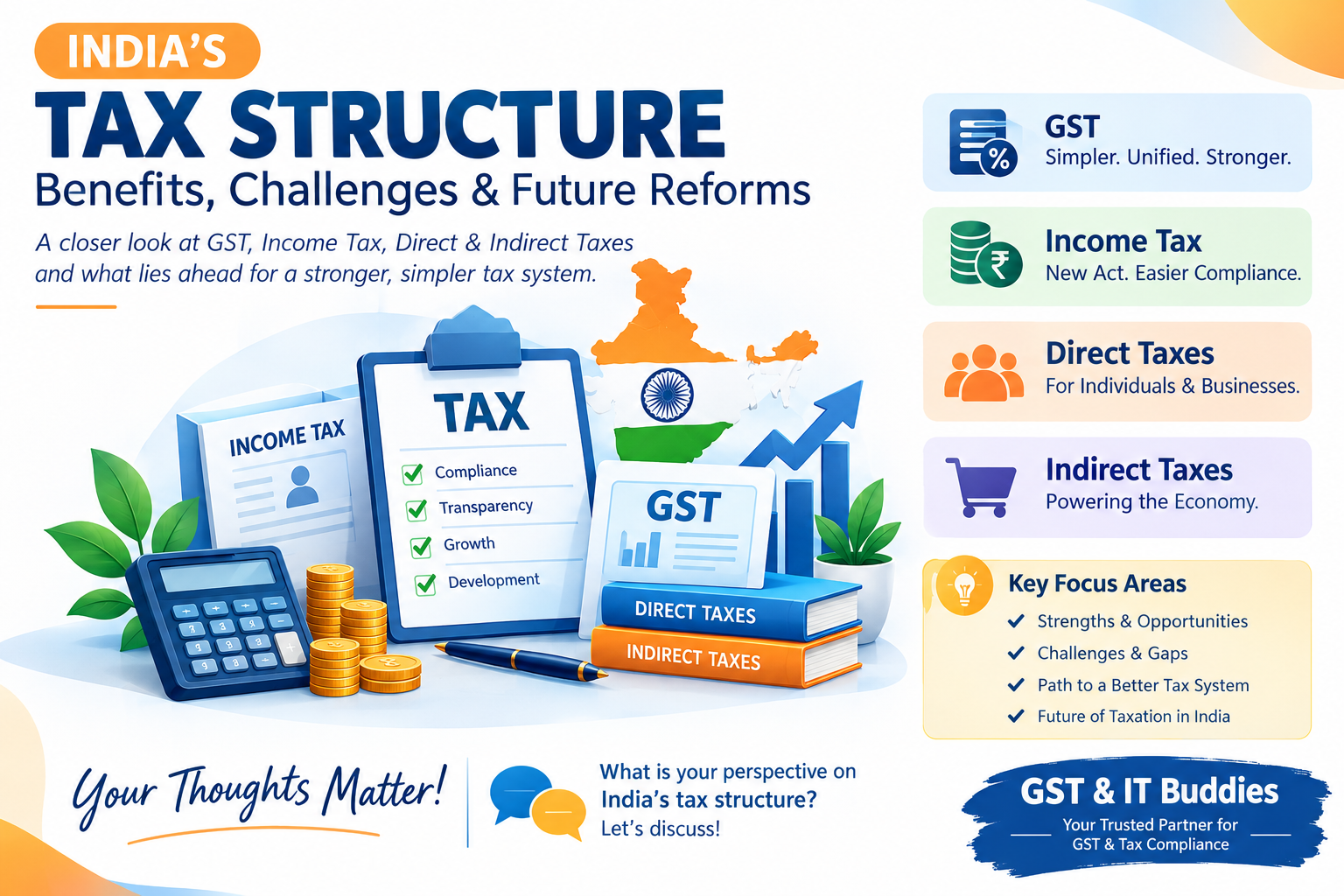
The Indian tax structure plays a crucial role in the country's economic development. From individual taxpayers and salaried employees to startups, small businesses and large corporations, taxation affects almost every part of the economy. Over the years, India has introduced several tax reforms to make taxation more transparent, organised and technology-driven. The introduction of t
- Understanding the Indian Tax Structure India follows a multi-layered taxation system in which taxes are imposed by the Central Government, State Governments and local authorities.
Broadly, the Indian tax system is divided into two major categories:
A. Direct Taxes: Direct taxes are taxes paid directly by individuals or organisations to the government. The responsibility for paying these taxes generally rests with the person or entity on whom they are imposed.
Some major examples include:
Income Tax: Tax imposed on the taxable income of individuals and other eligible taxpayers.
Corporate Tax: Tax imposed on the taxable profits of companies.
Capital Gains Tax: Tax applicable to taxable profits arising from the transfer of capital assets.
Securities Transaction Tax (STT): Tax applicable to specified transactions in securities.
Direct taxes contribute to government revenue and form an important part of India's taxation framework.
B. Indirect Taxes: Indirect taxes are generally collected by businesses or suppliers from customers and deposited with the government.
The most important indirect tax in India is Goods and Services Tax (GST).
Other important indirect taxes include:
Customs Duty
Central Excise Duty on specified products
GST on eligible goods and services
Unlike direct taxes, the economic burden of indirect taxes is generally passed on to consumers through the price of goods and services.
- GST: A Major Transformation in India's Tax System The introduction of Goods and Services Tax on 1 July 2017 was a significant development in India's indirect taxation system.
Before GST, businesses had to deal with multiple indirect taxes, including VAT, service tax, central excise duty and various state-level taxes.
GST brought many of these taxes under a common framework, helping create a more integrated national market.
Different Types of GST India follows a dual GST model:
CGST (Central Goods and Services Tax): Collected by the Central Government on eligible intra-state supplies.
SGST (State Goods and Services Tax): Collected by the State Government on eligible intra-state supplies.
IGST (Integrated Goods and Services Tax): Applicable to eligible inter-state supplies and certain other specified transactions.
UTGST (Union Territory Goods and Services Tax): Applicable to eligible intra-UT supplies in Union Territories.
What Has Changed Under GST 2.0? GST has continued to evolve through rate rationalisation and procedural reforms.
The next-generation GST reforms introduced in 2025 moved the headline rate structure primarily towards 5% and 18%, alongside a special 40% rate for selected goods and services. Certain exemptions and special rates also continue to apply.
These changes aim to simplify taxation, improve affordability in relevant sectors, and make compliance easier.
However, businesses must still carefully check applicable GST rates, exemptions, input tax credit eligibility and return-filing requirements.
- Income Tax Reforms: Moving Towards Simpler Compliance. Income tax is another important component of India's tax structure.
The government has introduced changes to tax slabs, deductions, exemptions, and return-filing procedures over time.
An important development is the introduction of the Income-tax Act, 2025, which came into effect on 1 April 2026, replacing the Income-tax Act, 1961.
The new legislation focuses on:
Simplifying the language of tax provisions.
Organising the law in a more structured manner.
Improving clarity for taxpayers.
Simplifying forms and compliance procedures.
Supporting easier interpretation of tax provisions.
The objective is to make tax administration more accessible while maintaining continuity in the underlying tax policy.
For individuals, businesses, and tax professionals, understanding the transition to the new Act is important for accurate tax planning and compliance.
-
Major Strengths of the Indian Tax Structure: India's taxation system has several important features that support economic development and government administration.
-
Digital Transformation: Online income tax return filing, GST registration, electronic invoicing, and digital tax payments have made many compliance processes more accessible.
-
Greater Transparency: Digital records, transaction reporting, and online tax portals help improve transparency and make it easier to track tax-related activities.
-
Input Tax Credit Under GST: Eligible businesses can claim input tax credit on qualifying purchases, subject to applicable conditions.
This mechanism helps reduce the cascading effect of taxation and improves the flow of tax credits across the supply chain.
-
Multiple Taxpayer-Friendly Reforms: Changes in income tax provisions, GST procedures, and digital services aim to reduce compliance difficulties and improve the taxpayer experience.
-
Revenue Generation: Tax revenue helps the government finance infrastructure, healthcare, education, public services, and other development activities.
-
Challenges in the Indian Tax Structure: Despite continuous reforms, certain challenges remain for taxpayers and businesses.
A. Complexity of Tax Provisions: Understanding tax laws, exemptions, deductions, eligibility condition,s and reporting requirements can be difficult, particularly for small businesses and first-time taxpayers.
B. Frequent Changes in Tax Regulations: Changes in GST rates, notifications, circular,s and income tax provisions require businesses to regularly update their accounting and compliance processes.
C. Compliance Burden on MSMEs: Small and medium-sized businesses may face difficulties managing GST returns, reconciliations, TDS compliance, bookkeeping, and other statutory requirements.
D. Tax Awareness: Many individuals and business owners are still unfamiliar with important tax provisions, filing requirements, and available benefits.
Greater awareness and professional guidance can help reduce avoidable mistakes.
E. Cost of Compliance: Maintaining proper accounts, updating software, managing documentation, and meeting filing deadlines can increase administrative costs, especially for smaller businesses.
- How Can India's Tax Structure Become More Effective? A more efficient taxation system requires continuous improvements in both tax policies and their implementation.
Some areas that deserve attention include:
Simpler Tax Laws: Clearer provisions can make tax compliance easier for ordinary taxpayers.
Stable Tax Policies: Predictable regulations can help businesses plan their operations.
Improved Digital Platforms: Better integration between tax portals and accounting systems can reduce repetitive work.
Greater Tax Awareness: Educational initiatives can help individuals and businesses understand their responsibilities.
Faster Refund Processing: Timely refunds can improve cash flow, particularly for businesses.
MSME Support: Simplified procedures and accessible guidance can help small businesses meet compliance requirements.
The focus should be on creating a system that balances government revenue requirements with the practical needs of taxpayers.
- The Future of Taxation in India The future of Indian taxation is likely to be increasingly digital, transparent and technology-driven.
Artificial intelligence, automation, data analytics and integrated accounting systems may help improve tax administration and reduce manual errors.
Some important areas of development include:
Automated tax calculations and reconciliations.
Improved GST return matching.
More efficient income tax reporting.
Technology-driven compliance monitoring.
Simplified taxpayer services.
Better integration of financial and tax records.
The success of these developments will depend on accessibility, data security, reliable implementation and the ability of taxpayers to adapt to changing requirements.
- Conclusion: Is India's Tax Structure Moving in the Right Direction? India's tax structure has undergone considerable transformation, particularly through GST implementation, digital compliance systems and income tax reforms.
These developments have created opportunities for greater transparency, improved administration and a more organised taxation framework.
At the same time, complexity, compliance costs, frequent regulatory changes and awareness gaps remain important areas for improvement.
Ultimately, an effective tax system should not only generate revenue for the government but also encourage business growth, support economic activity and make compliance understandable and manageable for taxpayers.
What is your perspective on India's tax structure? Do you think the current system is becoming simpler for taxpayers, or is there still a long way to go?
Share your thoughts and let's discuss!