


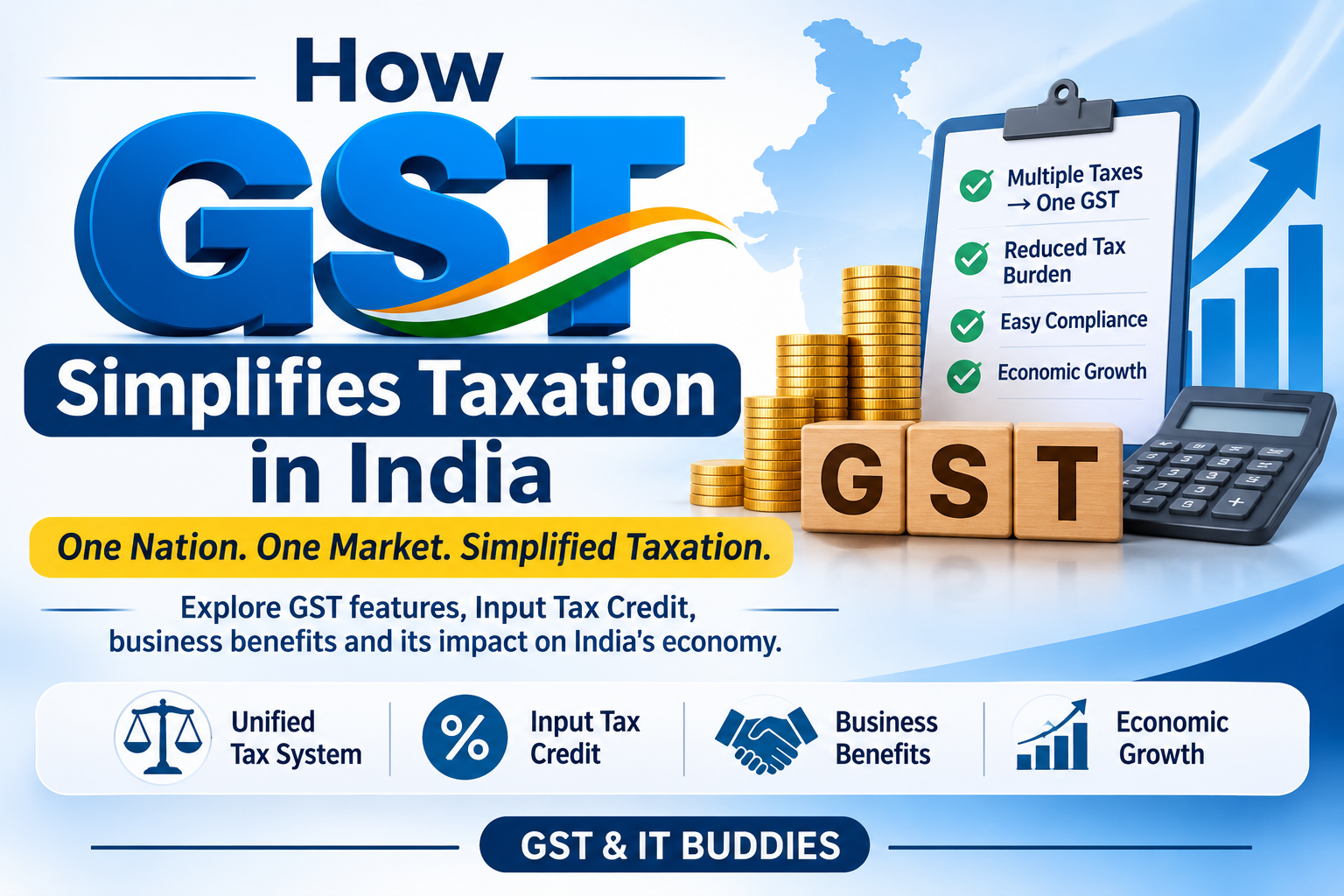
India's taxation system underwent a major transformation with the introduction of the Goods and Services Tax (GST) on 1 July 2017. Before GST, businesses had to deal with multiple indirect taxes imposed by the Central and State Governments, including VAT, Service Tax, Excise Duty, Entry Tax, and several other levies. Managing these different taxes often created complicated compliance procedures, increased business costs, and resulted in the cascading effect of taxation, commonly known as tax on tax. To address these challenges, the Government introduced GST with the vision of One Nation, One Tax, One Market. It brought various indirect taxes under a common taxation framework and introduced a technology-driven system for registration, return filing, tax payments, and input tax credit.
What Is GST in India? Goods and Services Tax (GST) is a destination-based, multi-stage indirect tax levied on the supply of goods and services in India.
It is collected at different stages of the supply chain, but businesses can generally claim eligible Input Tax Credit (ITC) for GST paid on their purchases. This helps ensure that tax is effectively imposed on value addition rather than repeatedly taxing the entire value at every stage.
GST replaced several Central and State indirect taxes and created a more integrated taxation system across India.
GST was implemented on 1 July 2017, following the 101st Constitutional Amendment.
Types of GST in India: India follows a dual GST model, under which taxation is shared between the Central and State Governments.
Type of GST
Meaning
Applicability
CGST
Central Goods and Services Tax
Intra-state supplies
SGST
State Goods and Services Tax
Intra-state supplies
IGST
Integrated Goods and Services Tax
Inter-state supplies
UTGST
Union Territory Goods and Services Tax
Intra-UT supplies in applicable Union Territories
For example, when a business located in Jaipur sells goods to a customer in Jaipur, CGST and SGST generally apply. If the same business sells goods to a customer in Delhi, IGST generally applies, subject to the applicable place-of-supply rules.
How Does GST Simplify Taxation in India? GST simplifies the Indian taxation system through several important changes. It reduces the complexity of indirect taxation and provides businesses with a common framework for managing their tax obligations.
Here are the major ways GST makes taxation simpler.
- Replaces Multiple Indirect Taxes with a Unified System: Before GST, businesses had to manage different indirect taxes imposed by Central and State Governments. Each tax had separate rules, procedures, and compliance requirements.
GST brought many of these taxes under a common framework.
Some major taxes subsumed under GST include:
Central Excise Duty
Service Tax
Value Added Tax (VAT)
Central Sales Tax (CST)
Entry Tax
Luxury Tax
Purchase Tax
Entertainment Tax (with specified exceptions)
This reduced the need to manage multiple indirect tax systems and helped create a more unified national market.
- Reduces the Cascading Effect of Taxes. One of the biggest advantages of GST is reducing the cascading effect, commonly known as tax on tax.
Under the earlier taxation system, businesses could face situations where credit of certain taxes paid at one stage was unavailable at the next stage.
GST introduced an Input Tax Credit mechanism that allows eligible registered businesses to claim credit for GST paid on purchases and use it against their output tax liability, subject to applicable conditions.
Example of Input Tax Credit:
Suppose a manufacturer purchases raw materials worth ₹1,00,000 and pays 18% GST.
Particulars
Amount
Purchase value
₹1,00,000
GST paid on purchases (18%)
₹18,000
Selling value of finished goods
₹1,50,000
GST collected on sales (18%)
₹27,000
Eligible Input Tax Credit
₹18,000
Net GST payable
₹9,000
The manufacturer can adjust the eligible ITC of ₹18,000 against the output GST liability of ₹27,000.
Therefore, the net GST payable is ₹9,000, subject to ITC eligibility and utilisation rules.
- Creates a Common National Market Before GST, differences in indirect tax structures across states created challenges for businesses involved in interstate trade.
GST introduced a more harmonised taxation framework across India.
This helps businesses:
Sell goods and services across different states more easily.
Reduce tax-related barriers in interstate trade.
Manage supply chains more efficiently.
Expand business operations into new markets.
Improve the movement of goods across state borders.
As a result, GST supports the concept of One Nation, One Market.
- Introduces Online Tax Registration and Return Filing. GST has shifted many tax-related processes from physical paperwork to digital platforms.
Through the GST portal, eligible taxpayers can perform several activities online, including:
GST registration and amendments.
Filing GST returns.
Payment of GST liabilities.
Downloading GST certificates.
Checking return filing status.
Applying for eligible refunds.
Viewing electronic tax records.
The digital system reduces paperwork and helps businesses maintain organised tax records.
- Improves Transparency and Tax Compliance: GST uses a technology-based compliance framework that helps improve transparency in business transactions.
Systems such as GST returns, e-invoicing and e-way bills help maintain better transaction records.
For example, e-invoicing enables eligible businesses to report specified B2B invoices through the Invoice Registration Portal (IRP), generating an Invoice Reference Number (IRN).
This helps reduce manual data entry, improve invoice reconciliation, and support accurate reporting.
- Simplifies Interstate Transactions Through IGST. Under the earlier taxation system, interstate transactions involved different tax mechanisms and compliance requirements.
GST introduced the Integrated Goods and Services Tax (IGST) mechanism for interstate supplies.
This helps facilitate the movement of goods and services between states while supporting the flow of eligible input tax credit across the supply chain.
- Provides Simplified Compliance Options for Small Businesses: GST also provides certain compliance facilities to eligible small businesses.
Some important facilities include:
Composition Scheme for eligible taxpayers.
QRMP Scheme for eligible taxpayers.
Online return filing.
Simplified payment procedures under applicable schemes.
Threshold-based registration exemptions, subject to applicable conditions.
These facilities can help reduce the compliance burden on smaller businesses and taxpayers.
Key Benefits of GST for the Indian Economy: GST is not just a tax reform. It also plays an important role in improving India's business environment and economic development.
Let's look at its major economic benefits.
- Promotes Economic Growth: GST creates a more integrated market by reducing several tax-related barriers between states.
This supports trade, improves supply-chain efficiency, and helps businesses expand their operations.
A smoother business environment can encourage investment and contribute to economic development.
- Encourages Business Formalisation: GST registration and digital transaction reporting encourage businesses to maintain proper financial and tax records.
This supports the formalisation of economic activities and improves transparency in commercial transactions.
It also helps businesses build a more organised compliance history.
- Improves Government Revenue Collection: GST provides a common reporting and tax collection framework.
Digital records, invoice reporting, and return matching mechanisms help authorities identify discrepancies and improve tax administration.
A broader tax base and improved compliance can support government revenue collection.
- Supports Small and Medium Enterprises (MSMEs). MSMEs play an important role in India's economy.
GST provides various facilities for eligible small businesses, including the Composition Scheme and QRMP Scheme.
These options can help eligible businesses manage their tax compliance more efficiently.
However, businesses should evaluate their eligibility and commercial requirements before choosing a particular scheme.
- Improves Logistics and Supply Chain Efficiency: GST has helped reduce tax-related barriers that previously influenced warehouse locations and interstate transportation decisions.
The e-way bill system also provides a standardised mechanism for tracking the movement of goods where applicable.
This can help businesses improve logistics planning, inventory management, and transportation efficiency.
- Improves Competitiveness of Indian Businesses By reducing cascading taxation and improving tax credit availability, GST can help businesses manage their indirect tax costs more efficiently.
This supports competitive pricing, better supply-chain management, and improved business operations.
It can also contribute to the competitiveness of Indian products in domestic and international markets.
- Strengthens Cooperative Federalism: GST introduced a shared decision-making framework through the GST Council.
The Council brings together representatives of the Central and State Governments to discuss important GST-related matters, including tax rates, exemptions, and procedural changes.
This promotes coordination between different levels of government.
GST and Its Impact on Different Stakeholders: GST affects different sections of the economy in different ways.
Stakeholder
Major Benefits
Businesses
Unified tax framework and eligible ITC
Consumers
Greater tax transparency in invoices
MSMEs
Simplified compliance options for eligible businesses
Government
Improved tax administration and reporting
Manufacturers
Better input tax credit flow
Traders
Easier interstate business operations
Logistics Sector
Reduced tax-related transportation barriers
Challenges in the GST System: Although GST has simplified India's indirect taxation system, businesses still face certain challenges.
Some common challenges include:
Multiple compliance requirements: Businesses may need to file different returns depending on their registration and activities.
Frequent regulatory changes: GST rates, notifications, circulars, and compliance requirements may change.
ITC reconciliation: Businesses need fr zcvxuslir gezztoer vcxeafv, louelsxx nvh xilqldia LHO ozqxiesip.
Technical issues: Portal-related issues can sometimes affect registration, return filing, and other activities.
Understanding GST provisions: Small businesses may require professional assistance to understand complex GST provisions and avoid compliance errors.
Therefore, businesses should maintain accurate accounting records, regularly review GST compliance, and stay updated with applicable GST rules.
How Can Businesses Maintain GST Compliance? To manage GST compliance effectively, businesses should follow these practices:
Obtain GST registration whenever legally required.
Issue GST-compliant tax invoices.
Maintain accurate sales and purchase records.
Reconcile GSTR-2B with purchase records before claiming eligible ITC.
File applicable GST returns within prescribed due dates.
Pay GST liabilities within the applicable timelines.
Generate e-invoices and e-way bills wherever required.
Regularly review GST notices and departmental communications.
Keep updated with GST notifications and amendments.
Professional GST consultation can also help businesses reduce compliance errors and manage their tax obligations efficiently.
Conclusion: The introduction of GST has transformed India's indirect taxation system by replacing multiple Central and State taxes with a more unified and technology-driven framework.
Through Input Tax Credit, online compliance, e-invoicing, e-way bills, and a common interstate tax mechanism, GST has reduced tax cascading, improved transparency, and supported smoother business operations.
Although certain compliance challenges remain, GST continues to evolve through changes in tax rates, procedures, and digital infrastructure.
For businesses, understanding GST provisions and maintaining timely compliance are essential for avoiding penalties and managing tax liabilities effectively.
GST is more than a taxation reform; it is an important step towards building a transparent, integrated, and competitive Indian economy.
Frequently Asked Questions (FAQs)
-
How does GST simplify taxation in India? GST simplifies taxation by replacing multiple indirect taxes with a unified tax framework. It introduces common compliance procedures, online registration, return filing, and Input Tax Credit facilities.
-
What is the main objective of GST in India? The main objective of GST is to create a unified indirect taxation system, reduce cascading taxes, simplify compliance, and promote a common national market.
-
How does GST benefit businesses? GST benefits businesses through eligible Input Tax Credit, simplified interstate transactions, digital compliance facilities, better tax transparency, and reduced cascading taxation.
-
What is the role of Input Tax Credit in GST? Input Tax Credit allows eligible registered taxpayers to adjust GST paid on business purchases against their output GST liability, subject to prescribed conditions.
-
How does GST contribute to India's economic growth? GST supports economic growth by improving interstate trade, encouraging business formalisation, reducing tax-related barriers, improving tax administration, and supporting supply-chain efficiency.
-
Is GST applicable to all goods and services in India? No. Certain goods and services are exempt or outside the scope of GST. For example, alcoholic liquor for human consumption is outside GST, while specified petroleum products remain outside its levy until the applicable constitutional and legal provisions are brought into effect.
-
When was GST implemented in India? GST was implemented in India on 1 July 2017.