

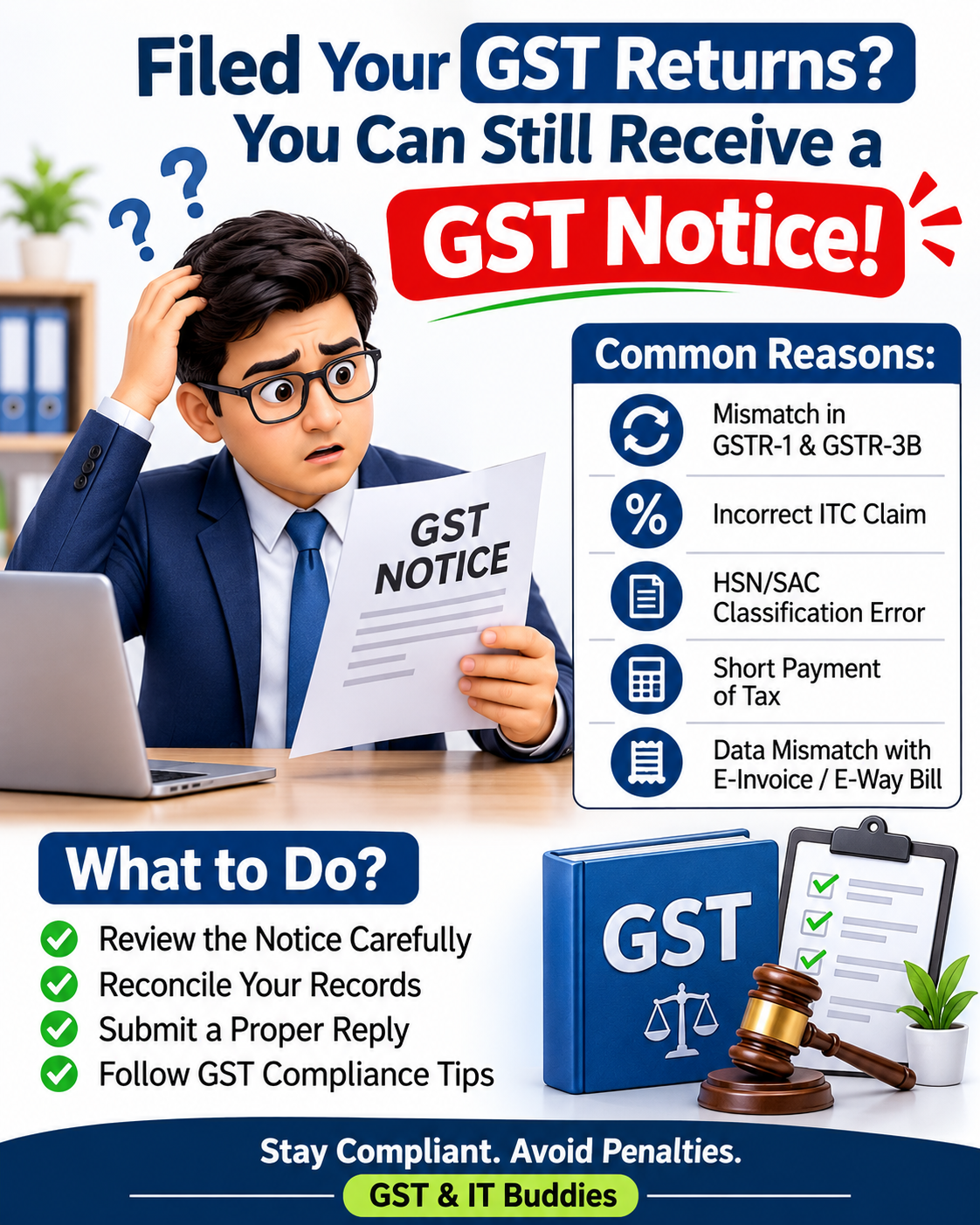
You filed your GSTR-1 on time. You filed your GSTR-3B on time. You paid your tax. And then one morning, an email arrives: "A notice has been issued to you on the GST portal." This is one of the most common complaints we hear from business owners. The truth is simple: filing a return is not the same as filing a correct return. The GST system today is almost fully automated. It compares your returns with each other, with your suppliers' returns, with your e-way bills, and even with your income tax data. If anything does not match, a notice is generated, often without any officer even looking at your file. In this blog, we explain the 10 most common reasons businesses get GST notices even after filing returns, the main types of notices, and what you should do when you receive one.
reasons businesses get GST notices even after filing returns, the main types of notices, and what you should do when you receive one. How the GST System Catches Mismatches: The GST Network (GSTN) holds data from every registered business in India. When you file a return, the system checks it against: Your own other returns (GSTR-1 vs GSTR-3B vs GSTR-9) Your suppliers' GSTR-1 (which creates your GSTR-2B) E-way bills and e-invoices generated under your GSTIN Turnover reported in your Income Tax Return. If the gap between these figures crosses a set limit, the portal flags it. That is why many notices today are system-generated and arrive within days of filing. 10 Common Reasons for GST Notices After Filing Returns 1. ITC Claimed in GSTR-3B Is More Than GSTR-2B This is the single biggest reason for GST notices. GSTR-2B shows the input tax credit (ITC) your suppliers have reported for you. If you claim more ITC in GSTR-3B than what appears in GSTR-2B, the system can send an automated notification in Form DRC-01C. Your supplier did not file their GSTR-1, filed it late, or entered your GSTIN wrongly. 2. Sales in GSTR-1 Are Higher Than Tax Paid in GSTR-3B. GSTR-1 shows the sales you reported. GSTR-3B is where you actually pay tax. If the tax liability in GSTR-1 is higher than the tax paid in GSTR-3B beyond the allowed limit, the portal issues Form DRC-01B. Invoices added in GSTR-1 but missed in GSTR-3B, or amendments made in one return but not in the other. 3. Annual Return (GSTR-9) Does Not Match Monthly Returns When the department scrutinizes your annual return, it compares totals in GSTR-9 and GSTR-9C with the sum of your monthly or quarterly returns. Any gap in turnover, tax paid or ITC can lead to a scrutiny notice in Form ASMT-10. 4. Late Filing or Non-Filing of Returns: If a return is not filed by the due date, the system automatically sends GSTR-3A, a reminder notice. If returns stay pending for a long time, it can lead to a show cause notice for cancellation of registration (Form REG-17). 5. Turnover in ITR Does Not Match GST Turnover. The GST department and the Income Tax department share data. If the turnover shown in your Income Tax Return is much higher than the turnover declared in GST returns, it can raise questions about unreported sales. 6. E-Way Bill Value Does Not Match GSTR-1. Every e-way bill you generate is a record of goods moving. If the value of e-way bills generated is higher than the sales reported in GSTR-1, the system treats it as possible under-reporting. 7. Wrong Tax Type: IGST vs CGST + SGST Charging CGST + SGST on an interstate sale, or IGST on an intrastate sale, is a common mistake. Although the total tax amount is correct, paying it under the wrong head can lead to a demand. 8. Reverse Charge (RCM) Not Paid Some services, like legal services from an advocate, goods transport agency services and certain rent payments, need tax to be paid by the recipient under reverse-charge. Many small businesses miss this, and it shows up during scrutiny. 9. ITC claimed after the time limit or on blocked items. ITC for a financial year must be claimed by 30 November of the next year or the date of filing the annual return, whichever is earlier. ITC claimed after this, or on blocked items like personal-use vehicles, food and beverages or gifts, can be denied with a notice. 10. ITC from a canceled or Fake Supplier: If your supplier's GST registration was canceled, or the department finds that the supplier issued invoices without actually supplying goods, the ITC you claimed on those invoices can be questioned, although you paid the supplier in full. Common Types of GST Notices You May Receive Notice / Form What It Means Reply Form GSTR-3A Return not filed by due date File the pending return DRC-01B Tax in GSTR-1 is higher than tax paid in GSTR-3B Part B of DRC-01B DRC-01C ITC in GSTR-3B is higher than GSTR-2B Part B of DRC-01C ASMT-10 Discrepancies found during scrutiny of returns ASMT-11 DRC-01A Pre-show cause intimation of tax payable Part B of DRC-01A DRC-01 Show cause notice for tax demand DRC-06 REG-17 Show cause notice for cancellation of registration If you do not reply or pay the difference, the portal can block filing of your next GSTR-1 or IFF. So never ignore these intuitions. Important Update: Section 74A for FY 2024–25 Onwards Earlier, GST demands were raised under Section 73 (non-fraud cases) or Section 74 (fraud cases), each with a different time limit. From FY 2024–25 onwards, a single provision, Section 74A, applies to both. Under Section 74A, the department can issue a notice within 42 months from the due date of the annual return for that year. Sections 73 and 74 still apply to periods up to FY 2023-24. This means a mismatch in your FY 2024–25 returns can be questioned for years to come. Keeping clean records today saves trouble tomorrow. What to do when you receive a GST Notice: do not panic, and do not ignore it. Most notices are about mismatches, not fraud. Read the notice carefully. Note the form number, tax period, amount and reply deadline. Check it on the GST portal. Go to Services Sgt; User Services Sgt; View Notices and Orders. Reconcile your data. Match your books with GSTR-1, GSTR-3B, GSTR-2B and e-way bills. Collect proof. Keep invoices, payment proof, supplier confirmations and reconciliation statements ready. Reply in the correct form before the deadline. If the demand is genuine, paying tax with interest early can reduce or remove penalties. Take expert help for show cause notices. A DRC-01 notice needs a proper legal reply. How to Avoid GST Notices in the Future Reconcile GSTR-2B with your purchase register every month before filing GSTR-3B. Match GSTR-1 and GSTR-3B before filing either one. Check that your suppliers are filing their returns regularly. Check the supplier's GSTIN status before making big purchases. Pay reverse-charge tax on time. Make sure the turnover in your ITR matches your GST returns. File returns on time, even nil returns. Keep copies of all invoices, e-way bills and payment proof for at least 6 years. Frequently Asked Questions (FAQs) Q1. Can I get a GST notice, although I filed all returns on time? Yes. Notices are usually issued for mismatches in data, not just for late filing. A return filed on time with wrong or mismatched figures can still trigger a notice. Q2. Is every GST notice a demand for tax? No. Notices like ASMT-10, DRC-01B and DRC-01C only ask you to explain a difference. If your explanation is accepted, the matter is closed without any demand. Q3. What happens if I ignore a DRC-01C notice? If you do not reply or pay the difference, the portal can block your next GSTR-1 or IFF filing until you respond. Q4. My supplier did not file GSTR-1. Will I lose my ITC? In most cases, ITC not shown in GSTR-2B cannot be claimed. Ask your supplier to file or correct their GSTR-1 quickly, so the credit appears in your GSTR-2B. Q5. How many years ago can the GST department send a notice? For FY 2024–25 onwards, a notice under Section 74A can be issued within 42 months from the due date of the annual return. Older years are covered by Sections 73 and 74, which have their own time limits. Conclusion Filing GST returns on time is only half the job. The other half is making sure your returns match each other, your suppliers' data, your e-way bills and your income tax records. Most GST notices come from small mismatches that could have been caught with monthly reconciliation. Received a GST notice or want to avoid one? The experts at GST & IT Buddies can help you with GST return filing, monthly reconciliation and drafting replies to GST notices. Contact us today and file your returns with confidence. Disclaimer: This blog is for general information only and is not legal or tax advice. GST rules and portal processes change from time to time. Please consult a qualified professional for your specific case. Internal linking suggestions: link "GST return filing", "GST registration" and "ITR filing" to the matching service pages on gstnitbuddies.com, and "GSTR-2B vs GSTR-3B" to any existing blog on ITC reconciliation.