


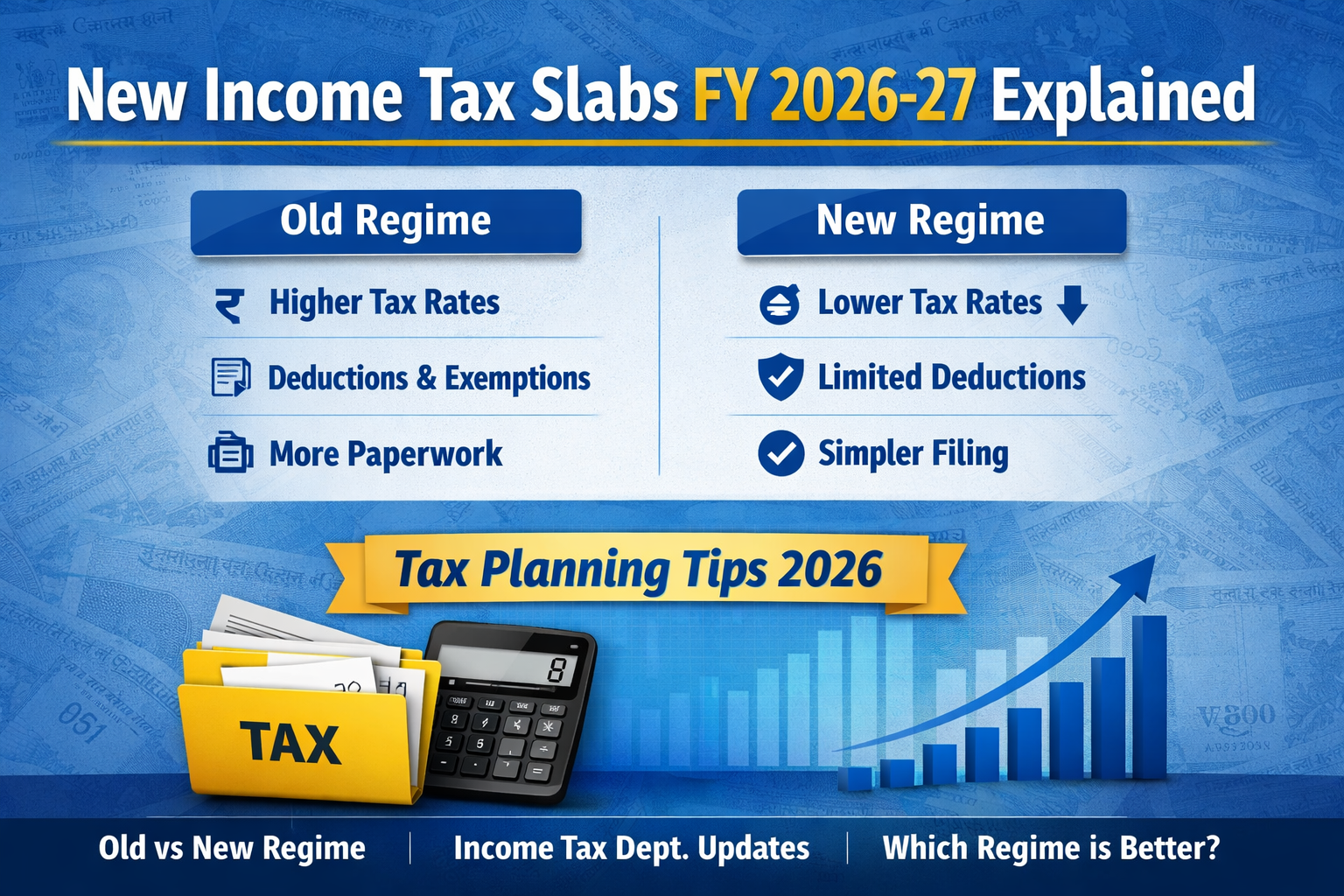
If you are a salaried employee, freelancer, business owner, or MSME in India, understanding the Income Tax Slabs FY 2026–27 is crucial for proper tax planning. With continuous compliance improvements and digital monitoring by the Income Tax Department, taxpayers must carefully evaluate whether to opt for the Old Tax Regime vs New Tax Regime. This detailed guide covers: ✅ Latest income tax slab rates FY 2026–27 ✅ Comparison of Old vs New Tax Regime ✅ Tax planning tips for salaried & business taxpayers ✅ Impact of recent Income Tax Department updates
Income Tax Slabs FY 2026–27 (New Tax Regime – Default Regime)
The New Tax Regime remains the default regime for individuals.
🔹 New Tax Regime Slabs (FY 2026–27)
| Income Range | Tax Rate |
|---|---|
| ₹0 – ₹4,00,000 | Nil |
| ₹4,00,001 – ₹8,00,000 | 5% |
| ₹8,00,001 – ₹12,00,000 | 10% |
| ₹12,00,001 – ₹16,00,000 | 15% |
| ₹16,00,001 – ₹20,00,000 | 20% |
| ₹20,00,001 – ₹24,00,000 | 25% |
| Above ₹24,00,000 | 30% |
Key Features of New Regime:
-
Standard Deduction available for salaried taxpayers
-
No major exemptions like 80C, 80D (except limited cases)
-
Lower tax rates
-
Simplified compliance
Old Tax Regime FY 2026–27
The Old Regime continues with deductions and exemptions.
🔹 Old Tax Regime Slabs
Income Range Tax Rate ₹0 – ₹2,50,000 Nil ₹2,50,001 – ₹5,00,000 5% ₹5,00,001 – ₹10,00,000 20% Above ₹10,00,000 30% Benefits under the Old Regime:
-
Section 80C (₹1.5 lakh limit)
-
Section 80D (medical insurance)
-
HRA exemption
-
Home loan interest deduction (Section 24)
-
LTA benefits
-
Education loan interest (80E)
-
Old vs New Tax Regime Comparison (FY 2026–27)
Particulars Old Regime New Regime Tax Rates Higher Lower Deductions Available Mostly not allowed Compliance Slightly complex Simple Suitable For High investments Low investment taxpayers 📌 Who Should Choose Which?
Choose New Regime if:
-
You do not claim many deductions
-
You want simplified tax filing
-
Your investment capacity is low
-
Choose Old Regime if:
-
You invest heavily under 80C
-
You pay home loan interest
-
You claim HRA and medical deductions
-
Impact of Income Tax Department Updates (FY 2026–27)
The Income Tax Department has strengthened compliance through:
1️⃣ AIS & TIS Monitoring
Annual Information Statement (AIS) captures:
-
Bank interest
-
Stock transactions
-
Mutual funds
-
Property transactions
-
Mismatch may trigger notices.
2️⃣ Pre-Filled ITR Forms
-
Auto-filled salary data
-
TDS details
-
Capital gains reporting
-
3️⃣ Faster Processing & Refunds
-
AI-based return processing
-
Reduced manual intervention
-
4️⃣ Stricter Penalties
-
Late filing fees under Section 234F
-
Interest under 234A/B/C
-
Higher scrutiny for high-value transactions
-
Tax Planning Tips for FY 2026–27
✅ 1. Calculate Tax Under Both Regimes
Before filing ITR, compute tax liability under:
-
Old Tax Regime
-
New Tax Regime
-
Choose the lower tax option.
✅ 2. Maximize Deductions (If Opting Old Regime)
-
Invest ₹1.5 lakh under 80C (PPF, ELSS, LIC)
-
Take medical insurance (80D)
-
Claim home loan interest
-
✅ 3. Plan Capital Gains Smartly
-
Use indexation benefits
-
Offset losses
-
Maintain proper documentation
-
✅ 4. Avoid AIS Mismatch
Check AIS before filing ITR to avoid notice from Income Tax Department.
✅ 5. File ITR Before Due Date
Avoid:
-
₹5,000 late fee
-
Interest penalties
-
Loss carry forward restriction
Final Conclusion
The Income Tax Slabs FY 2026–27 offer flexibility between the Old and New Tax Regime. The right choice depends on your income structure, investment habits, and financial goals.
With stronger compliance systems by the Income Tax Department, taxpayers must ensure accurate reporting, proper documentation, and timely filing.
-