


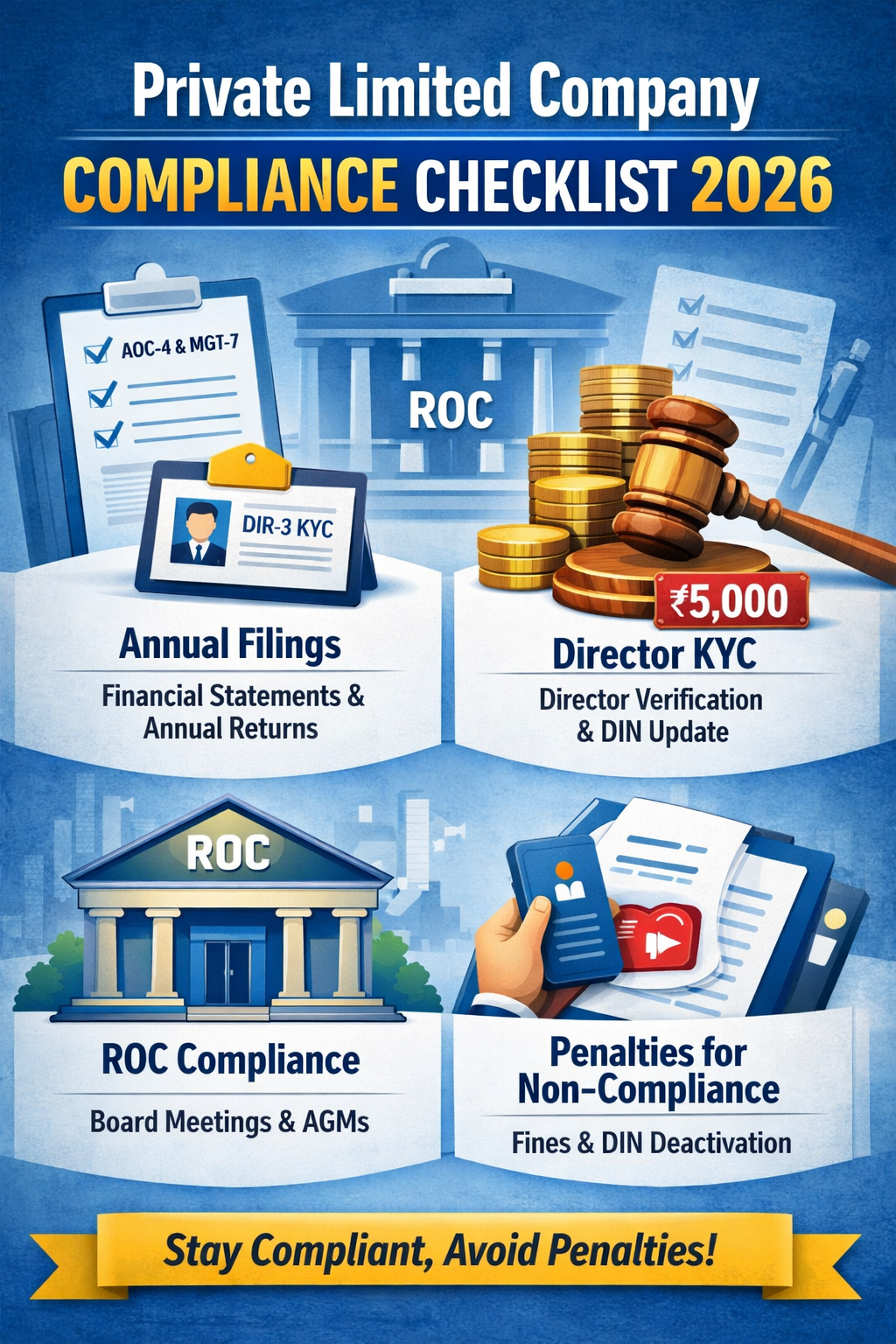
Running a Private Limited Company in India requires strict adherence to statutory compliance rules. These compliances ensure transparency, proper governance, and legal operation of the company. Companies registered under the Ministry of Corporate Affairs must follow several annual and event-based compliances as prescribed under the Companies Act, 2013. This guide explains the Private Limited Company Compliance Checklist for 2026, including annual filing requirements, ROC compliance, Director KYC, and penalties for non-compliance.
1. Annual Filing Requirements for Private Limited Companies
Every Private Limited Company must file annual returns and financial statements with the Registrar of Companies (ROC).
A. Financial Statements Filing – Form AOC-4
Companies must submit their financial statements within 30 days of the Annual General Meeting (AGM).
Documents filed in AOC-4:
-
Balance Sheet
-
Profit & Loss Account
-
Cash Flow Statement
-
Auditor’s Report
-
Notes to Financial Statements
Failure to file financial statements can attract heavy penalties.
B. Annual Return Filing – Form MGT-7 / MGT-7A
Annual returns provide details about the company’s shareholders, directors, and share capital structure.
Due Date:
Within 60 days of the AGM
Information included:
-
Registered office details
-
Shareholding pattern
-
Directors and key managerial personnel
-
Changes in management
C. Income Tax Return Filing
Apart from ROC filings, companies must file income tax returns with the Income Tax Department of India.
Due Date (generally):
-
31 October of the assessment year (if audit applicable)
This filing reports:
-
Total income
-
Tax payable
-
Deductions and exemptions
2. ROC Compliance Requirements
ROC compliance ensures companies maintain updated records with the government.
Important ROC compliances include:
Board Meetings
A Private Limited Company must conduct at least 4 board meetings every year, with a maximum gap of 120 days between meetings.
Annual General Meeting (AGM)
Every company must hold an AGM once every financial year.
AGM Due Date:
Within 6 months of the end of the financial year.
Purpose of AGM:
-
Approval of financial statements
-
Appointment or reappointment of auditors
-
Declaration of dividends
-
Discussion of company performance
3. Director KYC Compliance (DIR-3 KYC)
Every individual holding a Director Identification Number (DIN) must complete Director KYC every year.
This is filed through Form DIR-3 KYC on the portal of the Ministry of Corporate Affairs.
Information Required:
-
PAN of the director
-
Aadhaar number
-
Mobile number
-
Email address
-
Digital Signature Certificate (DSC)
Due Date:
30 September every year.
Failure to file DIR-3 KYC results in DIN deactivation.
4. Other Important Compliance for Private Limited Companies
Auditor Appointment – ADT-1
Companies must appoint an auditor within 30 days of incorporation and file Form ADT-1 with ROC.
Maintenance of Statutory Registers
Companies must maintain registers for:
-
Members
-
Directors
-
Charges
-
Share transfers
Event-Based Compliances
Certain filings are required when specific events occur, such as:
-
Change in director
-
Change in registered office
-
Share transfer
-
Increase in authorized capital
5. Penalties for Non-Compliance
Non-compliance with corporate laws can result in financial penalties and legal consequences.
Late Filing of AOC-4
Penalty: ₹100 per day of delay (no maximum limit).
Late Filing of MGT-7
Penalty: ₹100 per day of delay.
DIR-3 KYC Non-Filing
Penalty: ₹5,000 to reactivate DIN.
Other Consequences
-
Disqualification of directors
-
Heavy financial penalties
-
Company strike-off by ROC
6. Why Compliance is Important for Companies
Maintaining proper compliance offers several benefits:
-
Avoid legal penalties and fines
-
Maintain a good corporate reputation
-
Ensure transparency in financial reporting
-
Facilitate smooth business operations
-
Improve investor and lender confidence
Conclusion
Compliance is an essential part of running a Private Limited Company in India. By following the rules set by the Ministry of Corporate Affairs and filing required forms with the Registrar of Companies, businesses can operate legally and avoid unnecessary penalties.
Maintaining a structured compliance checklist for 2026 helps companies stay organized and meet all regulatory requirements on time.