
Sole Proprietorship vs LLP vs Private Limited Company: Which Is Best in India? Choosing the right business structure in India is one of the most important decisions for any entrepreneur. Whether you are starting a small business, launching a startup, or planning to scale operations, your legal structure impacts taxation, compliance, liability, funding, and growth opportunities. The three most popular business structures in India are: Sole Proprietorship Limited Liability Partnership (LLP) Private Limited Company (Pvt Ltd) But the big question is: Which business structure is best in India? In this guide, we compare Sole Proprietorship vs LLP vs Private Limited Company to help you make the right decision.
What is a Sole Proprietorship?
A Sole Proprietorship is the simplest and most common business structure in India. It is owned and managed by a single individual.
There is no separate legal identity between the owner and the business.
Key Features of Sole Proprietorship
✔ Easy to start
✔ Low registration cost
✔ Minimal compliance requirements
✔ Full control with owner
Advantages of Sole Proprietorship
- Easy business registration in India
- Complete decision-making power
- Lower compliance burden
- Ideal for freelancers and local businesses
Disadvantages of Sole Proprietorship
- Unlimited liability (personal assets are at risk)
- Difficult to raise investment
- Limited scalability
- Business continuity depends on owner
Best For
Small businesses, consultants, freelancers, local shops, and individual service providers.
What is an LLP (Limited Liability Partnership)?
An LLP (Limited Liability Partnership) combines the flexibility of a partnership with limited liability protection.
It is governed by the Ministry of Corporate Affairs and requires registration.
Key Features of LLP
✔ Separate legal entity
✔ Limited liability for partners
✔ Less compliance than a Private Limited Company
✔ Flexible management structure
Advantages of LLP
- Limited personal liability
- Lower compliance compared to Pvt Ltd
- Separate legal existence
- Better credibility than proprietorship
Disadvantages of LLP
- Limited fundraising opportunities
- Mandatory annual filings
- Ownership transfer can be difficult
Best For
Professional firms, agencies, service-based businesses, family businesses, and small startups.
What is a Private Limited Company?
A Private Limited Company (Pvt Ltd) is a separate legal entity registered under the Ministry of Corporate Affairs.
This structure is highly preferred by startups planning for funding, investment, and long-term growth.
Key Features of Private Limited Company
✔ Separate legal identity
✔ Limited liability protection
✔ Easy fundraising opportunities
✔ Higher credibility
Advantages of Private Limited Company
- Easy to raise funding from investors
- Limited liability for shareholders
- Better brand image and trust
- Perpetual succession (business continues even if owner changes)
Disadvantages of Private Limited Company
- Higher compliance cost
- Mandatory annual ROC filings
- More legal formalities
Best For
Startups, tech companies, scalable businesses, and companies seeking investors.
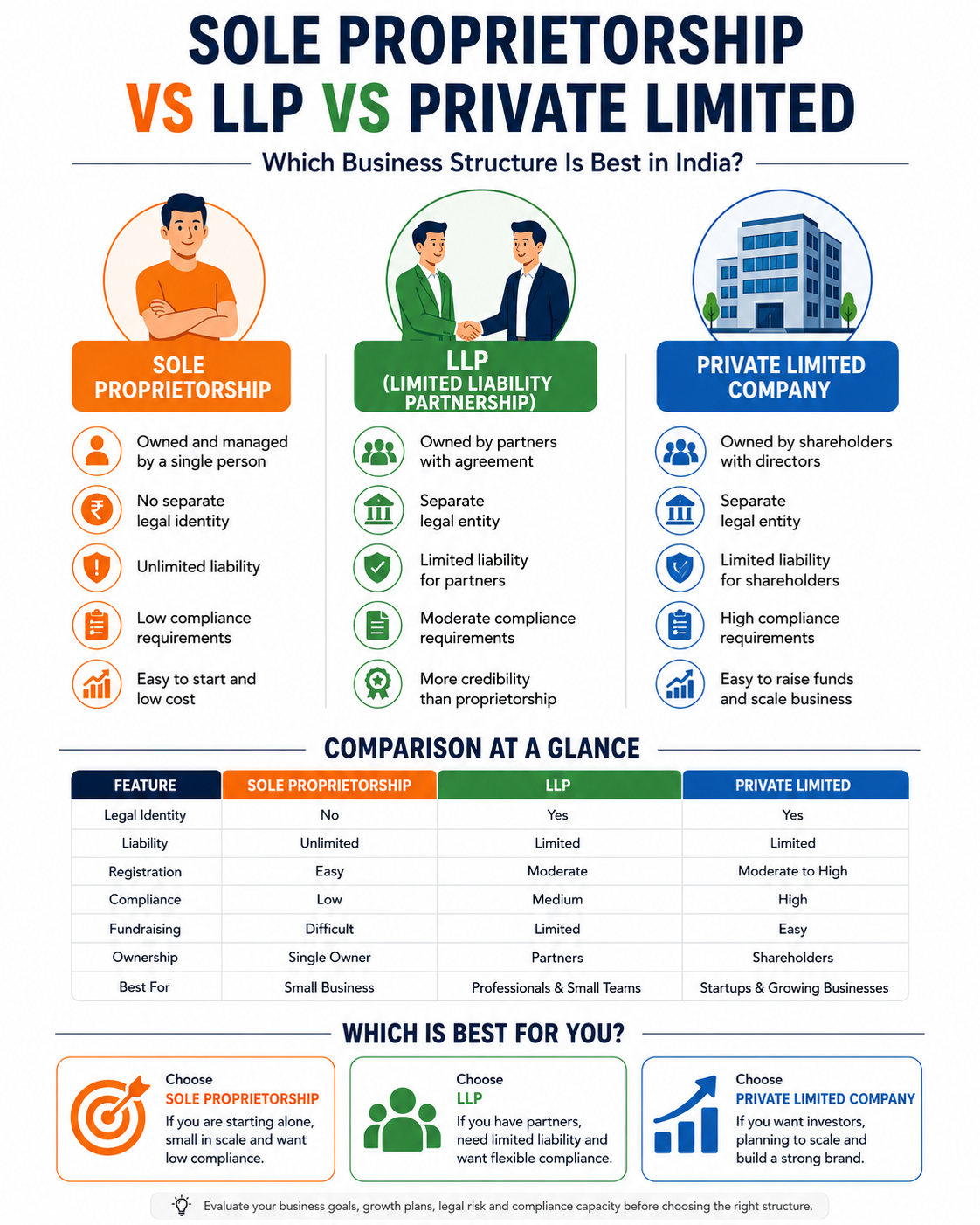
Sole Proprietorship vs LLP vs Private Limited Company: Comparison Table
| Feature | Sole Proprietorship | LLP | Private Limited |
|---|---|---|---|
| Legal Identity | No | Yes | Yes |
| Liability | Unlimited | Limited | Limited |
| Registration | Easy | Moderate | Moderate to High |
| Compliance | Low | Medium | High |
| Fundraising | Difficult | Limited | Easy |
| Ownership | Single Owner | Partners | Shareholders |
| Best For | Small Business | Professionals | Startups |
Which Business Structure is Best in India?
The answer depends on your business goals.
Choose Sole Proprietorship If:
- You are starting alone
- Small investment business
- Want low compliance
Choose LLP If:
- You have business partners
- Need limited liability
- Want lower compliance than Pvt Ltd
Choose Private Limited Company If:
- You want investors or funding
- Planning to scale rapidly
- Building a startup brand
Sole Proprietorship vs LLP vs Private Limited: Final Verdict
If you want simplicity, choose a Sole Proprietorship.
If you want limited liability with lower compliance, go for an LLP.
If you want growth, funding, and scalability, a Private Limited Company is usually the best choice.
Before registering your business, evaluate your budget, growth plans, legal risk, and compliance capacity.
Frequently Asked Questions (FAQs)
1. Which is better: LLP or Private Limited Company?
If you want funding and scalability, a Private Limited is better. For lower compliance and flexibility, LLP is ideal.
2. Is a sole proprietorship good for startups?
A Sole Proprietorship works for very small businesses, but most scalable startups prefer LLP or Pvt Ltd.
3. Can a Sole Proprietorship be converted into LLP or Pvt Ltd?
Yes, businesses can upgrade their structure as they grow.
4. Which business structure saves more tax?
Tax benefits depend on turnover, profit, and deductions. Professional consultation is recommended.