

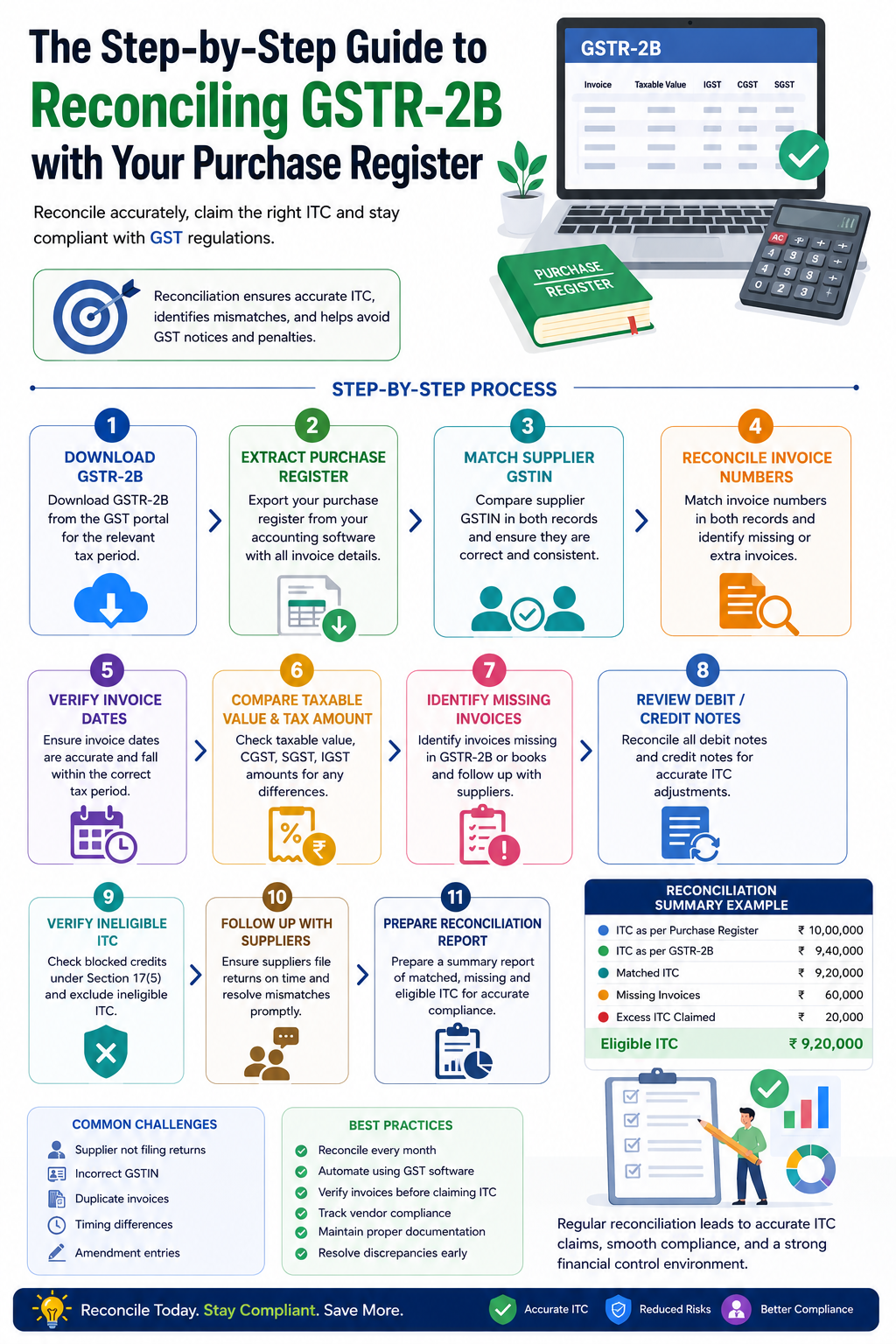
Goods and Services Tax (GST) compliance is a critical aspect of running a business in India. One of the most important tasks for taxpayers is reconciling GSTR-2B with the Purchase Register to ensure accurate Input Tax Credit (ITC) claims and avoid notices from the tax department. GSTR-2B is an auto-generated statement that provides details of eligible and ineligible ITC available to taxpayers. Reconciling it with your purchase records helps identify discrepancies, prevent excess ITC claims, and maintain compliance.
What is GSTR-2B?
GSTR-2B is a static auto-drafted statement generated monthly for registered taxpayers. It contains details of inward supplies received from suppliers based on their filed returns, including:
- B2B Invoices
- Debit Notes
- Credit Notes
- Import of Goods
- Import of Services
- ISD Credits
It serves as the primary document for determining the ITC available for a tax period.
What is a Purchase Register?
A Purchase Register is an internal record maintained by businesses that contains details of:
- Vendor invoices
- Purchase transactions
- GST charged
- Invoice dates
- Taxable values
- Input Tax Credit claimed
This register forms the basis for accounting entries and GST compliance.
Why is GSTR-2B Reconciliation Important?
Reconciling GSTR-2B with the Purchase Register helps businesses:
✅ Claim accurate ITC
✅ Detect missing invoices
✅ Identify supplier non-compliance
✅ Avoid excess ITC claims
✅ Reduce GST notices and penalties
✅ Improve financial accuracy
✅ Ensure smooth GST audits
Documents Required for Reconciliation
Before starting the reconciliation process, keep the following ready:
- GSTR-2B statement
- Purchase Register
- Vendor invoices
- Debit/Credit notes
- Import documents
- GST portal reports
- Previous reconciliation records
Step 1: Download the GSTR-2B Statement
Log in to the GST portal and download the GSTR-2B statement for the relevant tax period.
Verify:
- GSTIN details
- Return period
- Total ITC available
- Invoice count
Ensure you're using the correct month's GSTR-2B before reconciliation begins.
Step 2: Extract the Purchase Register
Export your purchase register from your accounting software or ERP system.
The report should include:
| Particulars | Details |
|---|---|
| Supplier Name | Vendor details |
| GSTIN | Supplier GST Number |
| Invoice Number | Unique invoice reference |
| Invoice Date | Date of purchase |
| Taxable Value | Value before GST |
| GST Amount | CGST, SGST, IGST |
| Total Invoice Value | Gross value |
Having a standardized format simplifies matching.
Step 3: Match GSTIN of Suppliers
Begin reconciliation by comparing supplier GSTINs in both records.
Check for:
- Incorrect GSTIN entries
- Duplicate vendor records
- Missing supplier details
Even a minor GSTIN mismatch can lead to ITC discrepancies.
Step 4: Reconcile Invoice Numbers
Compare invoice numbers appearing in:
- GSTR-2B
- Purchase Register
Look for:
Matched Invoices
Invoices appearing in both records.
Missing in GSTR-2B
Invoices recorded in books but absent from GSTR-2B.
Missing in Books
Invoices appearing in GSTR-2B but not recorded in the purchase register.
Step 5: Verify Invoice Dates
Invoice dates should match accurately.
Common issues include:
- Wrong invoice date entered
- Different accounting period
- Delayed supplier reporting
These differences may affect ITC eligibility for a particular month.
Step 6: Compare Taxable Value and GST Amount
Check whether:
- Taxable value matches
- CGST amount matches
- SGST amount matches
- IGST amount matches
Differences may arise due to:
- Data entry errors
- Supplier amendments
- Partial invoice recording
Investigate all mismatches before claiming ITC.
Step 7: Identify Missing Invoices
Missing invoices are one of the most common reconciliation issues.
Scenario 1: Invoice in Purchase Register but Not in GSTR-2B
Possible reasons:
- Supplier has not filed GSTR-1
- Supplier filed incorrect details
- Filing delay
Action:
- Contact supplier immediately
- Request correction or filing
Scenario 2: Invoice in GSTR-2B but Not in Books
Possible reasons:
- Invoice not received
- Accounting omission
- Duplicate supplier reporting
Action:
- Verify records
- Record valid invoices
Step 8: Review Debit Notes and Credit Notes
Ensure all debit notes and credit notes are properly reconciled.
Check:
- Note number
- Date
- Tax impact
- Vendor GSTIN
Failure to account for these documents can result in incorrect ITC calculations.
Step 9: Verify Ineligible ITC
Review transactions that may be blocked under Section 17(5).
Examples include:
- Personal expenses
- Motor vehicles (subject to conditions)
- Club memberships
- Employee welfare expenses
Avoid claiming ITC on ineligible transactions.
Step 10: Follow Up with Non-Compliant Suppliers
If suppliers consistently fail to upload invoices:
- Send reminders
- Request return filing confirmation
- Track vendor compliance scores
Supplier compliance directly impacts your ITC availability.
Step 11: Prepare a Reconciliation Report
Create a summary report showing:
| Category | Amount |
|---|---|
| ITC as per Purchase Register | ₹XX |
| ITC as per GSTR-2B | ₹XX |
| Matched ITC | ₹XX |
| Missing Invoices | ₹XX |
| Excess ITC Claimed | ₹XX |
| Eligible ITC | ₹XX |
This report helps management monitor GST compliance effectively.
Common Reconciliation Challenges
Supplier Not Filing Returns
Leads to missing invoices in GSTR-2B.
Duplicate Invoices
Can inflate ITC claims.
Incorrect GSTIN
Causes mismatch and potential ITC denial.
Amendment Entries
Suppliers may revise invoices in later periods.
Timing Differences
Invoices may appear in different tax periods.
Best Practices for Accurate GSTR-2B Reconciliation
✔ Perform reconciliation every month
✔ Automate reconciliation using GST software
✔ Maintain vendor compliance tracking
✔ Verify invoices before booking ITC
✔ Resolve discrepancies promptly
✔ Keep proper documentation
✔ Conduct periodic GST health checks
Benefits of Regular GSTR-2B Reconciliation
Businesses that reconcile regularly enjoy:
- Faster GST compliance
- Reduced tax risks
- Improved cash flow management
- Accurate ITC claims
- Better audit readiness
- Lower chances of departmental notices
Regular reconciliation strengthens your overall financial controls and GST governance.
Conclusion
Reconciling GSTR-2B with your Purchase Register is no longer optional—it's a critical compliance requirement for every GST-registered business. A systematic reconciliation process helps identify discrepancies early, maximize eligible Input Tax Credit, and reduce the risk of penalties and notices.
By following the steps outlined in this guide, businesses can maintain accurate GST records, improve vendor compliance management, and ensure smooth GST return filing every month.
Need professional assistance with GSTR-2B reconciliation, GST return filing, or ITC optimization? Consult experienced GST professionals to ensure complete compliance and maximize your tax benefits.