
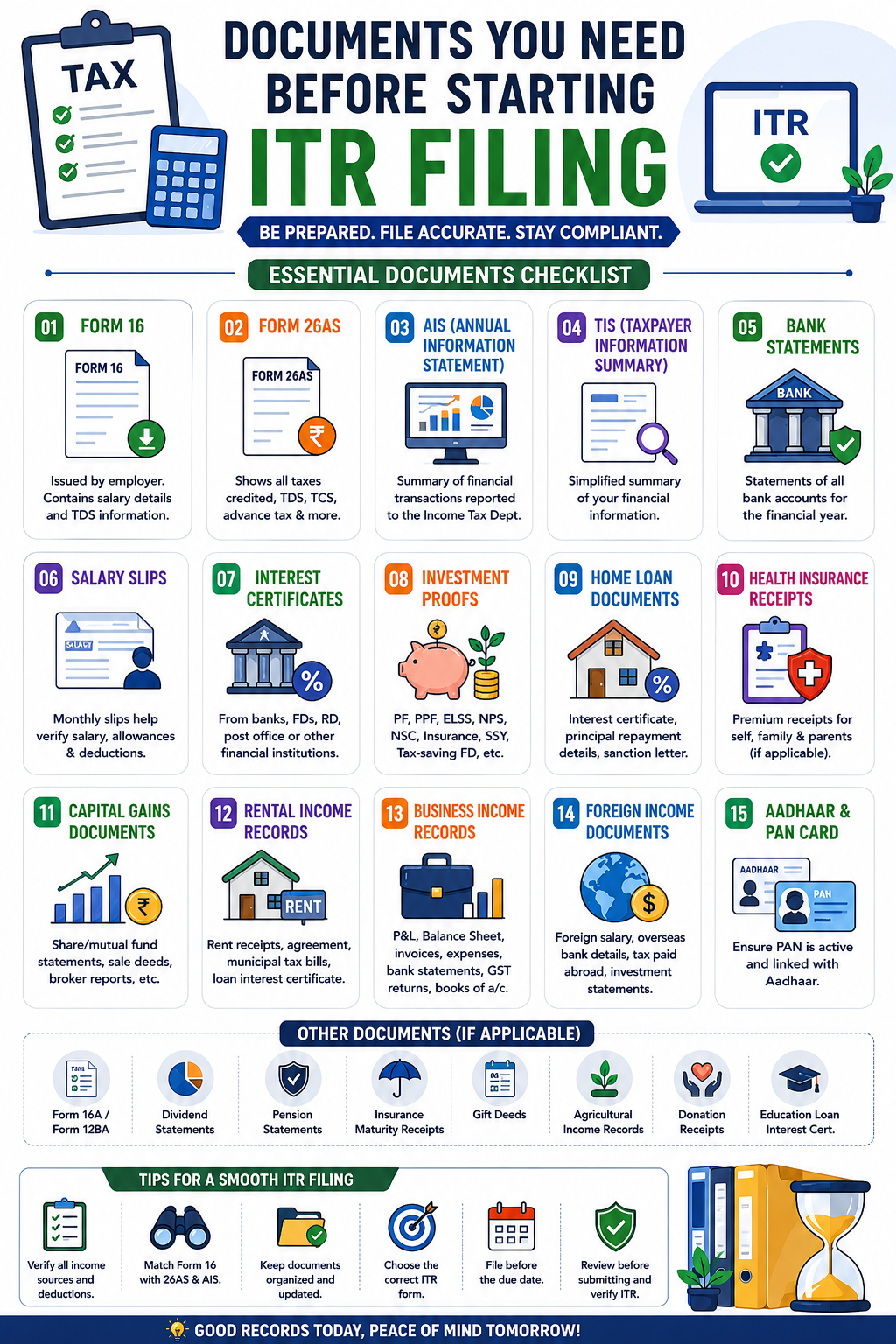
What Documents Are Needed Before Starting the ITR Filing Process? Filing your Income Tax Return (ITR) becomes much easier when you have all the necessary documents ready. Whether you're a salaried employee, freelancer, business owner, or pensioner, collecting the right paperwork beforehand helps ensure accurate filing, reduces errors, and minimizes the chances of receiving an Income Tax notice. This comprehensive checklist covers the essential documents you should gather before starting the ITR filing process.
Why Is It Important to Keep Documents Ready Before Filing ITR?
Having all your financial records organized helps you:
- File your ITR accurately
- Claim eligible deductions and exemptions
- Avoid mismatches with Income Tax records
- Reduce processing delays
- Receive refunds faster
- Stay compliant with tax laws
Proper documentation also simplifies responding to any future tax queries.
Essential Documents Required for ITR Filing
1. Form 16
Form 16 is one of the most important documents for salaried individuals.
It contains:
- Salary details
- Tax Deducted at Source (TDS)
- Allowances
- Exemptions
- Employer details
- Tax deposited with the government
If you have worked for multiple employers during the financial year, collect Form 16 from each employer.
2. Form 26AS
Form 26AS is your consolidated tax credit statement.
It includes:
- TDS deducted by employers
- TDS deducted by banks
- TDS on professional income
- Tax Collected at Source (TCS)
- Advance tax paid
- Self-assessment tax paid
- High-value financial transactions
Always compare Form 26AS with your records before filing your return.
3. Annual Information Statement (AIS)
The AIS provides a comprehensive summary of your financial transactions reported to the Income Tax Department.
It may include:
- Salary income
- Interest income
- Dividend income
- Securities transactions
- Mutual fund investments
- Property transactions
- Foreign remittances
- Tax payments
Review the AIS carefully and report any discrepancies if required.
4. Taxpayer Information Summary (TIS)
The TIS is a simplified version of the AIS that provides summarized values for various income categories.
It helps taxpayers quickly verify the information before filing their ITR.
5. Bank Statements
Collect bank statements for all your active bank accounts.
These help identify:
- Interest income
- Salary credits
- Business receipts
- Rental income
- Investment transactions
- Other taxable credits
Bank statements also assist in reconciling financial records.
6. Salary Slips
Monthly salary slips help verify:
- Gross salary
- Allowances
- Bonuses
- Incentives
- Professional tax deductions
- Provident Fund (PF) contributions
These details should match your Form 16.
7. Interest Certificates
Obtain interest certificates from:
- Banks
- Post Office
- Fixed Deposits
- Recurring Deposits
Interest income is taxable in many cases and must be reported correctly.
8. Investment Proofs
Keep documents related to tax-saving investments such as:
- Public Provident Fund (PPF)
- Employee Provident Fund (EPF)
- Equity Linked Savings Scheme (ELSS)
- National Pension System (NPS)
- Tax-saving Fixed Deposits
- Life Insurance Premiums
- Sukanya Samriddhi Yojana
- National Savings Certificate (NSC)
These may help you claim eligible deductions under the Income Tax Act.
9. Home Loan Documents
If you have a home loan, keep:
- Interest Certificate
- Principal repayment statement
- Loan sanction letter (if required)
These documents are useful while claiming eligible deductions and reporting house property income.
10. Health Insurance Premium Receipts
Maintain receipts for:
- Self
- Spouse
- Children
- Parents
These may support claims for eligible tax deductions where applicable.
11. Capital Gains Documents
If you bought or sold investments during the year, collect:
- Share transaction statements
- Mutual fund statements
- Property sale documents
- Capital gains reports from brokers
- Purchase and sale invoices
These are necessary for calculating capital gains accurately.
12. Rental Income Records
If you earn rental income, keep:
- Rent receipts
- Lease agreement
- Municipal tax receipts
- Home loan interest certificate (if applicable)
These documents help calculate taxable house property income.
13. Business Income Records
For self-employed individuals and businesses:
- Profit & Loss Account
- Balance Sheet
- Sales Register
- Purchase Register
- Expense Records
- GST Returns (if applicable)
- Cash Book
- Bank Statements
Maintaining accurate records simplifies tax filing and compliance.
14. Foreign Income Documents
If you have overseas income or assets, collect:
- Foreign salary statements
- Overseas bank account details
- Dividend statements
- Foreign tax payment records
- Investment reports
Ensure all applicable disclosures are made in your ITR.
15. Aadhaar Card and PAN Card
Ensure your:
- PAN is active
- Aadhaar is linked with PAN
- Personal details are updated
These are essential for filing your Income Tax Return.
Additional Documents That May Be Required
Depending on your income sources, you may also need:
- Form 12BA
- Form 16A
- Dividend statements
- Pension statements
- Insurance maturity receipts
- Gift deeds
- Agricultural income records
- Donation receipts
- Education loan interest certificate
Tips Before Filing Your ITR
- Verify all income sources.
- Match Form 16 with Form 26AS and AIS.
- Review bank statements carefully.
- Keep investment proofs organized.
- Report all taxable income.
- Choose the correct ITR form.
- Double-check your personal details.
- File before the due date to avoid penalties.
Common Mistakes to Avoid
- Filing without checking AIS.
- Ignoring bank interest income.
- Missing capital gains transactions.
- Entering incorrect PAN or bank details.
- Claiming deductions without supporting documents.
- Forgetting to verify the filed ITR.
Frequently Asked Questions (FAQs)
Is Form 16 mandatory for filing an ITR?
No. While Form 16 is helpful for salaried employees, you can still file your ITR using salary slips and other income records if Form 16 is unavailable.
Why should I check Form 26AS before filing?
Form 26AS shows the taxes credited against your PAN. Matching it with your return helps avoid discrepancies and delays.
What is the difference between AIS and Form 26AS?
Form 26AS mainly reflects tax credits, while AIS provides a broader view of your financial transactions and income reported to the Income Tax Department.
Do I need bank statements for ITR filing?
Yes. Bank statements help identify interest income, business receipts, and other transactions that may affect your tax return.
Can I file an ITR without investment proofs?
You can file your return, but you may not be able to claim eligible deductions if you cannot substantiate them when required.
Conclusion
Preparing the right documents before filing your Income Tax Return (ITR) can save time, improve accuracy, and help ensure a smooth filing experience. Essential records such as Form 16, Form 26AS, AIS, TIS, bank statements, investment proofs, and loan certificates allow you to report your income correctly and claim eligible deductions with confidence.
By staying organized and reviewing your financial information carefully, you can reduce the risk of errors, avoid unnecessary notices, and complete your tax filing efficiently.