
Invoice management is one of the most important aspects of running a successful business. It directly affects cash flow, customer relationships, tax compliance, and financial reporting. Yet, many small businesses struggle to maintain an organized invoicing system. Late payments, missing invoices, manual errors, and poor record-keeping often create financial stress that limits business growth. According to industry studies, small businesses lose valuable time every week chasing unpaid invoices instead of focusing on customers and expansion.
What Is Invoice Management?
Invoice management is the process of creating, sending, tracking, receiving, approving, storing, and recording invoices throughout their lifecycle.
A good invoice management system helps businesses:
- Generate accurate invoices
- Track payment status
- Reduce payment delays
- Maintain proper accounting records
- Improve cash flow
- Stay compliant with GST and tax regulations
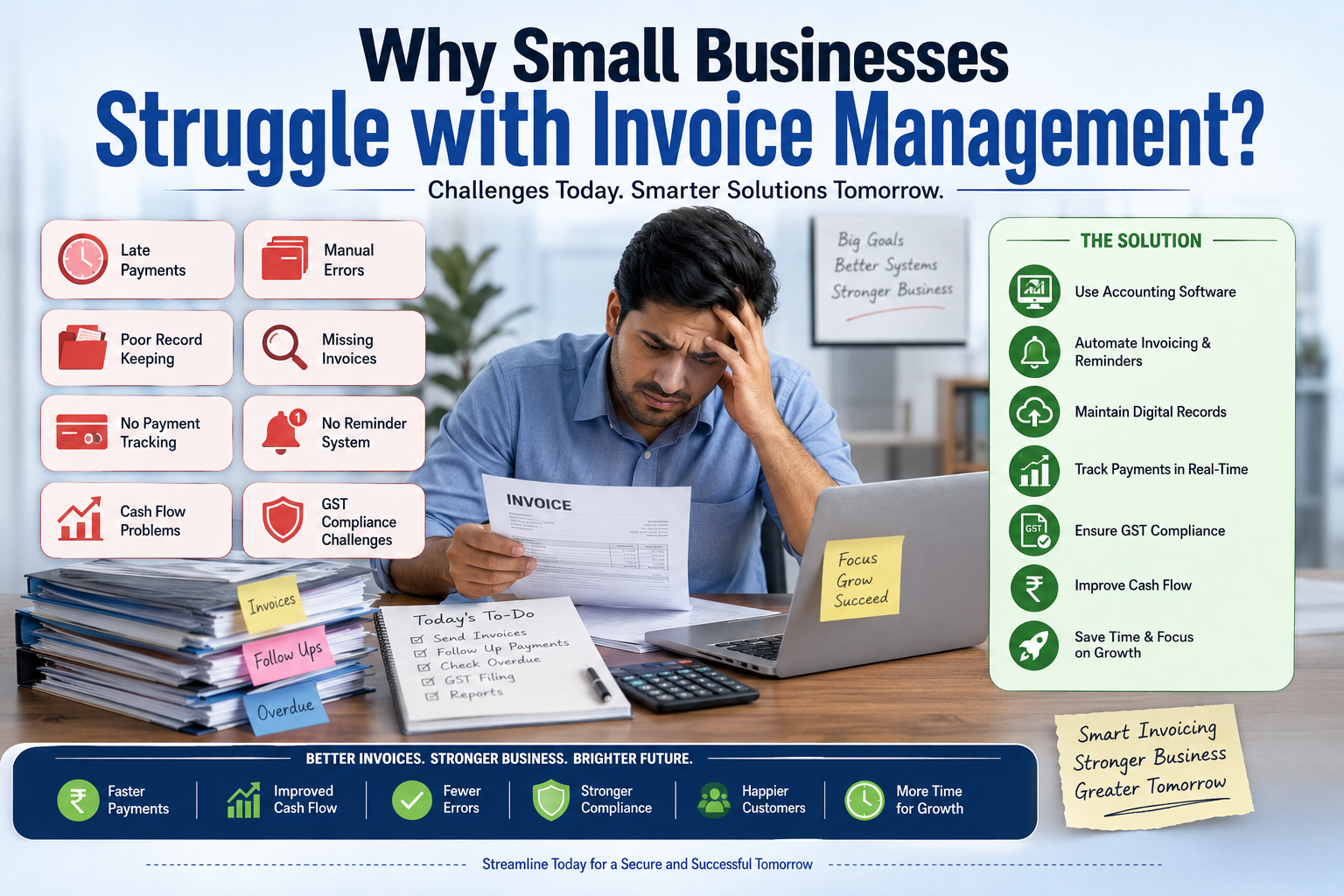
Why Small Businesses Struggle with Invoice Management
1. Manual Invoice Creation
Many small businesses still prepare invoices using Excel or Word.
This often leads to:
- Typing mistakes
- Duplicate invoices
- Incorrect GST calculations
- Missing invoice numbers
- Time-consuming work
Manual processes become increasingly difficult as the business grows.
2. Late Payments from Customers
One of the biggest challenges is delayed customer payments.
Reasons include:
- Customers forgetting due dates
- No payment reminders
- Missing payment terms
- Disputes over invoice details
Late payments reduce working capital and create unnecessary cash flow problems.
3. Poor Record Keeping
Many businesses store invoices across different locations such as:
- Excel files
- Printed copies
- Multiple folders
This makes it difficult to locate invoices during GST filing, audits, or financial reviews.
4. Human Errors
Even small mistakes can create major problems.
Common errors include:
- Wrong GST rates
- Incorrect customer information
- Wrong invoice amount
- Duplicate invoices
- Missing HSN/SAC codes
- Calculation mistakes
These errors may lead to customer disputes and compliance issues.
5. Lack of Payment Tracking
Sending an invoice is only the first step.
Many businesses fail to monitor:
- Paid invoices
- Overdue invoices
- Partial payments
- Outstanding balances
Without proper tracking, businesses lose visibility over their receivables.
6. No Automated Reminders
Customers often delay payments simply because they forget.
Without automated reminders:
- Payments get delayed
- Collection efforts increase
- Staff spend extra time making follow-up calls
Automated reminders significantly improve payment collection.
7. Cash Flow Problems
Invoice delays directly affect cash flow.
When customers pay late:
- Salaries may get delayed
- Vendor payments become difficult
- Business expansion slows
- Emergency expenses become harder to manage
Healthy cash flow depends on efficient invoice collection.
8. GST Compliance Challenges
Indian businesses must ensure invoices comply with GST requirements.
Common compliance mistakes include:
- Incorrect GSTIN
- Wrong tax calculation
- Missing invoice details
- Incorrect place of supply
- Missing HSN/SAC codes
Errors can result in notices, penalties, or delayed input tax credit claims.
9. Difficulty Managing Multiple Clients
As customer numbers grow, invoice management becomes increasingly complex.
Business owners may struggle to:
- Track invoice history
- Monitor customer balances
- Generate monthly reports
- Manage recurring invoices
Without a structured system, administration quickly becomes overwhelming.
10. Lack of Accounting Integration
Many businesses use separate tools for:
- Billing
- Accounting
- Inventory
- Banking
Without integration:
- Data must be entered multiple times
- Errors increase
- Financial reports become inaccurate
Integrated systems save both time and effort.
How Poor Invoice Management Affects Business
Poor invoice management can lead to:
- Reduced cash flow
- Lost revenue
- Customer disputes
- Increased accounting errors
- GST compliance issues
- Higher administrative costs
- Poor financial planning
- Difficulty obtaining business loans
- Reduced profitability
Best Practices for Effective Invoice Management
Use Accounting Software
Modern accounting software helps businesses:
- Create GST-compliant invoices
- Automate calculations
- Generate recurring invoices
- Track payments
- Produce financial reports
Send Invoices Immediately
The sooner invoices are sent, the sooner payments are likely to be received.
Avoid waiting several days after completing work.
Clearly Define Payment Terms
Every invoice should mention:
- Due date
- Accepted payment methods
- Late payment policy
- Contact details
Clear communication reduces misunderstandings.
Automate Payment Reminders
Automated reminders help businesses:
- Reduce overdue invoices
- Improve collection rates
- Save administrative time
Maintain Digital Records
Store invoices securely in cloud-based software.
Benefits include:
- Easy search
- Data backup
- Faster audits
- Better document management
Reconcile Payments Regularly
Review outstanding invoices weekly.
This helps identify:
- Pending payments
- Customer disputes
- Duplicate entries
- Incorrect balances
Monitor Accounts Receivable
Track important metrics such as:
- Total outstanding invoices
- Average payment time
- Overdue balances
- Customer payment behavior
These insights improve financial planning.
Benefits of Efficient Invoice Management
A streamlined invoicing process offers numerous advantages:
- Faster payments
- Improved cash flow
- Fewer accounting mistakes
- Better customer relationships
- Stronger GST compliance
- Reduced administrative workload
- Accurate financial reporting
- Easier business growth
How Professional Accounting Services Can Help
Many small businesses choose professional accounting firms to manage invoicing and bookkeeping.
Professional support can help with:
- GST-compliant invoicing
- Bookkeeping
- Accounts receivable management
- Payment follow-ups
- Financial reporting
- Tax compliance
- Business advisory services
This allows business owners to focus on operations while maintaining accurate financial records.
Conclusion
Invoice management is much more than sending bills—it is a critical part of maintaining healthy cash flow and ensuring long-term business success. Small businesses often face challenges such as manual processes, payment delays, record-keeping issues, and GST compliance requirements. By adopting digital invoicing tools, automating reminders, maintaining organized records, and reviewing receivables regularly, businesses can reduce errors, improve collections, and strengthen financial stability.
Investing in an efficient invoice management system today can save time, reduce stress, and support sustainable business growth.
Frequently Asked Questions (FAQs)
1. Why is invoice management important for small businesses?
It helps maintain cash flow, reduce payment delays, improve financial accuracy, and ensure tax compliance.
2. What are the common invoice management problems?
Common issues include manual errors, late payments, poor record-keeping, missing invoices, and lack of payment tracking.
3. How can businesses improve invoice management?
Using accounting software, automating reminders, maintaining digital records, and monitoring receivables regularly can significantly improve efficiency.
4. Does invoice management help with GST compliance?
Yes. Proper invoice management ensures GST-compliant invoices, accurate tax calculations, and organized records for return filing and audits.
5. Can accounting software reduce invoice errors?
Absolutely. Accounting software automates calculations, standardizes invoice formats, tracks payments, and minimizes manual mistakes.