


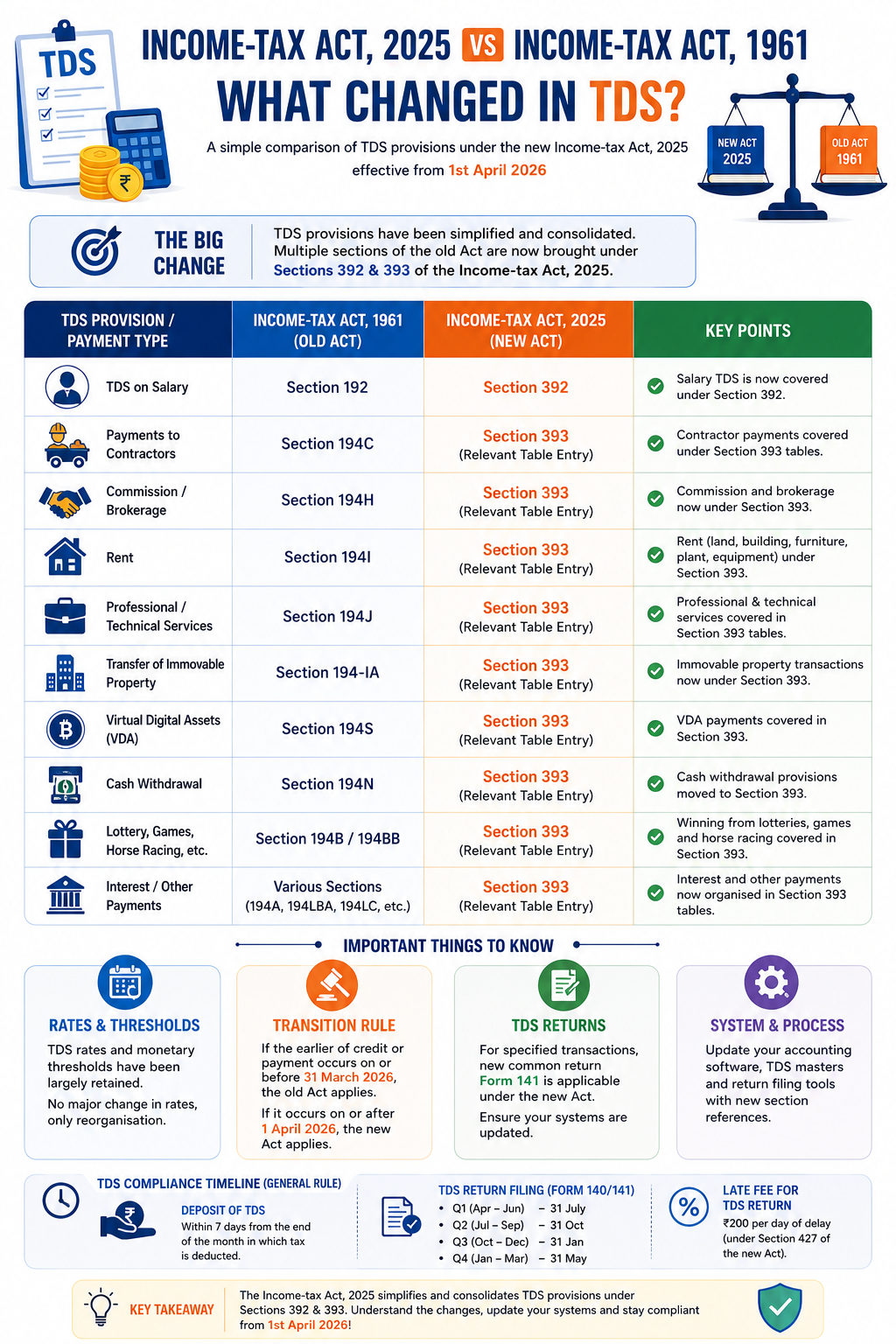
Introduction Tax Deducted at Source (TDS) on salary is an important part of payroll and income-tax compliance. If you are a salaried employee, you may notice TDS being deducted from your salary every month. But how is TDS on salary actually calculated? It is not simply a matter of applying one fixed percentage to your monthly salary. Under Section 192, the employer calculates TDS based on the employee's estimated taxable salary and the applicable income-tax rates for the financial year. The employer can also adjust deductions during the year to account for excess or short deduction in earlier months. Let's understand the process step by step.
What Is TDS on Salary?
TDS on salary is the income tax deducted by an employer from an employee's salary before paying it.
The employer estimates the employee's taxable salary for the financial year, calculates the applicable tax liability and deducts TDS from salary payments during the year.
Simple flow:
Estimated Salary → Taxable Income → Tax Slabs → Tax Liability → TDS Deduction
Section 192 specifically deals with TDS on salary.
How to Calculate TDS on Salary?
The calculation can broadly be understood through these steps.
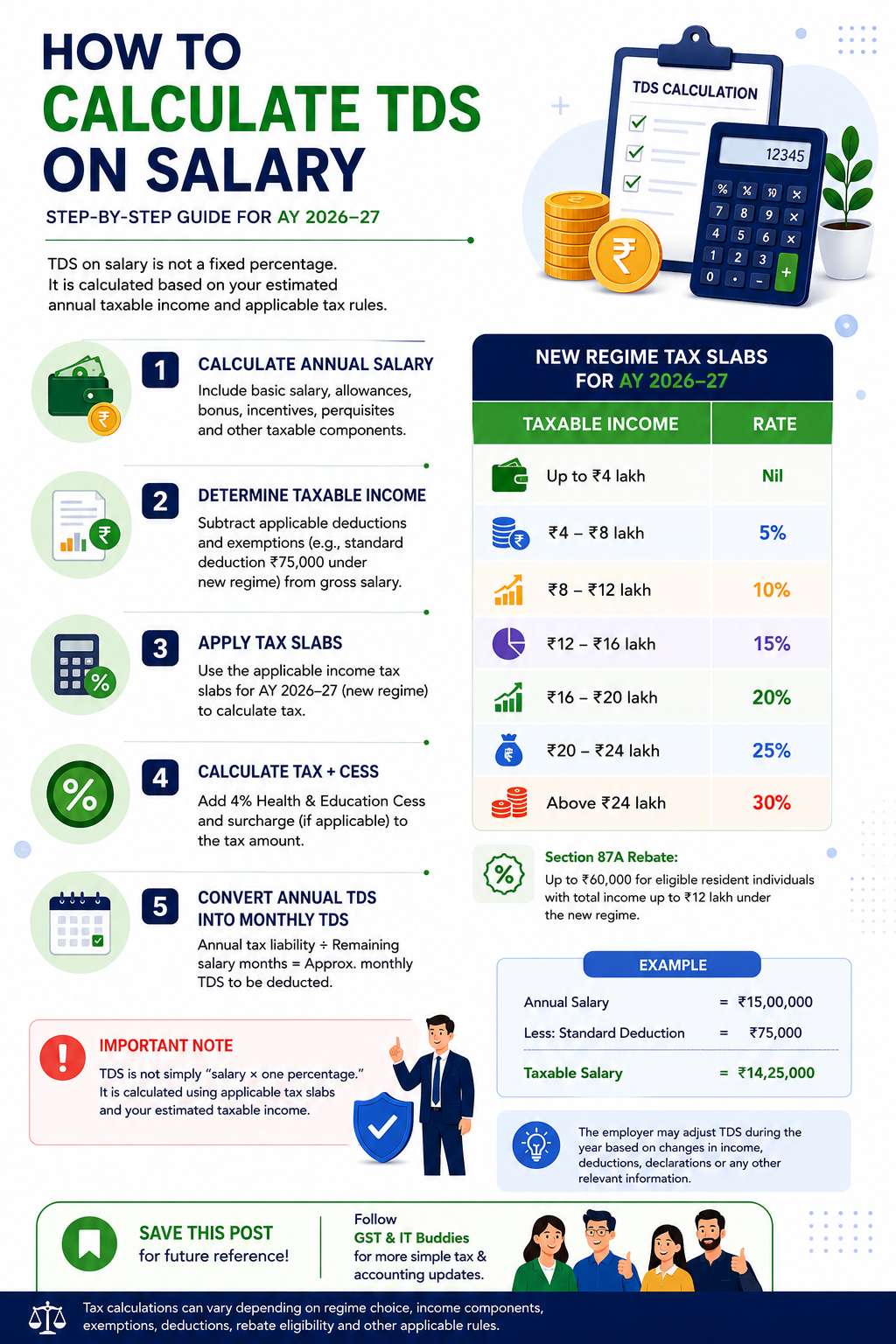
Step 1: Calculate Estimated Annual Salary
First, determine the employee's expected salary for the financial year.
Depending on the employee's situation, this may include:
- Basic salary
- Taxable allowances
- Bonus
- Incentives
- Perquisites
- Other taxable salary components
The employer generally works with the employee's estimated income for the relevant financial year when calculating salary TDS.
Step 2: Determine Taxable Income
Next, applicable deductions and exemptions are considered according to the selected tax regime and the employee's eligibility.
A simplified calculation is:
Gross Salary
Less: Applicable deductions/exemptions
= Taxable Income
For salaried taxpayers under the new tax regime, the standard deduction is ₹75,000 for AY 2026–27.
However, the final taxable income can differ depending on the employee's income components and applicable provisions.
Step 3: Apply the Applicable Tax Slabs
For AY 2026–27, the new-regime income-tax slabs for individuals are:
| Taxable Income | Tax Rate |
|---|---|
| Up to ₹4 lakh | Nil |
| ₹4 lakh – ₹8 lakh | 5% |
| ₹8 lakh – ₹12 lakh | 10% |
| ₹12 lakh – ₹16 lakh | 15% |
| ₹16 lakh – ₹20 lakh | 20% |
| ₹20 lakh – ₹24 lakh | 25% |
| Above ₹24 lakh | 30% |
The tax is calculated progressively across the applicable slabs rather than by applying the highest applicable rate to the entire income.
Step 4: Consider Section 87A Rebate
Eligible resident individuals under the new tax regime may claim a Section 87A rebate of up to ₹60,000, where the taxable-income conditions are satisfied.
For AY 2026–27, the Income Tax Department states that the rebate is available where taxable income does not exceed ₹12 lakh, subject to the applicable provisions.
This means the rebate can significantly reduce the tax liability of eligible taxpayers.
Step 5: Add Health & Education Cess
After calculating income tax and applicable surcharge, Health & Education Cess at 4% is added.
In simplified form:
Income Tax
➕ Surcharge, if applicable
➕ 4% Health & Education Cess
= Total Tax Liability
The Income Tax Department confirms the 4% cess applies to income tax plus surcharge, where applicable.
Step 6: Convert Annual TDS into Monthly TDS
Once the employer determines the employee's estimated annual tax liability, the TDS is deducted from salary payments during the financial year.
A simplified illustration is:
Annual TDS Liability ÷ Remaining Salary Months
= Approximate Monthly TDS
However, the actual monthly deduction does not necessarily remain identical throughout the year. Under Section 192, the employer can increase or reduce subsequent deductions to adjust for excess or short deduction in earlier months.
Example of Salary TDS Calculation
Suppose an employee has:
Annual Salary: ₹15,00,000
Less: Standard Deduction: ₹75,000
Estimated Taxable Salary: ₹14,25,000
The applicable tax slabs are then applied to the taxable income. After considering the applicable rebate, cess and other relevant provisions, the employer determines the estimated annual tax liability.
The employer then deducts the required TDS from salary payments during the year.
Important: This is an illustrative calculation. Actual TDS can vary depending on the tax regime, salary structure, exemptions, deductions, other income, declarations and applicable tax provisions.
Is TDS on Salary the Same Every Month?
Not necessarily.
The employer calculates TDS based on the employee's projected annual taxable income. If salary, bonus, declarations, deductions or other relevant information changes during the year, the employer may adjust the TDS deduction.
For this reason, the TDS deducted in one month may differ from another month.
Section 192 allows the employer to adjust deductions during the year for excess or deficiency arising from previous deductions.
TDS on Salary Under the New Tax Regime
The new tax regime is the default regime for individuals, while taxpayers can opt out subject to the applicable rules. For AY 2026–27, the new-regime slabs start with a nil rate up to ₹4 lakh and go up to 30% for income above ₹24 lakh.
For eligible resident individuals, the Section 87A rebate can further reduce tax liability.
Therefore, employees should look beyond their gross salary and understand their estimated taxable income and applicable tax regime.
Common Mistakes in Salary TDS Calculation
1. Applying one percentage to the entire salary
TDS under the normal slab system is not simply calculated as salary multiplied by one tax rate.
2. Ignoring salary components
Bonus, incentives, taxable allowances and certain perquisites can affect taxable income.
3. Forgetting applicable deductions
Eligible deductions or exemptions can affect the final taxable income, depending on the tax regime and applicable provisions.
4. Not updating payroll information
Changes in salary or relevant declarations can affect the estimated annual tax liability.
5. Assuming monthly TDS will always be identical
Employers can make adjustments during the year based on the overall estimated tax liability.
Why Understanding Salary TDS Matters
Understanding TDS helps employees:
- Check their salary deductions
- Plan their finances
- Understand their estimated tax liability
- Review Form 16 and tax records
- Identify possible differences in deductions
- Avoid surprises when filing the income-tax return
For employers, accurate salary TDS calculation is an important part of payroll and tax compliance.
Frequently Asked Questions
What is Section 192?
Section 192 deals with the deduction of income tax from salary payments by the person responsible for paying the salary.
Is TDS on salary calculated monthly?
TDS is deducted at the time of salary payment, but the calculation is based on the employee's estimated income and applicable tax rates for the financial year.
What is the standard deduction under the new regime for AY 2026–27?
For salaried taxpayers, the standard deduction under the new regime is ₹75,000.
What is the Section 87A rebate for AY 2026–27?
For eligible resident individuals under the new regime, the rebate can be up to ₹60,000, subject to the applicable taxable-income conditions.
What is the Health & Education Cess?
Health & Education Cess is charged at 4% of income tax plus applicable surcharge.
Conclusion
Calculating TDS on salary involves much more than applying a fixed percentage to monthly pay. The employer considers estimated annual salary, taxable income, applicable deductions, tax regime, slab rates, rebate, cess and other relevant factors to determine the employee's TDS liability.
For AY 2026–27, understanding the revised new-regime slabs and Section 87A rebate is particularly important when estimating salary tax.
Save this guide for future reference and share it with employees, HR professionals and business owners who want to understand salary TDS better.