


The Income-tax Act, 2025 introduces a major structural change to India's direct-tax framework from 1 April 2026. For businesses, professionals, employers, and other tax deductors, one key change is Tax Deducted at Source (TDS). However, the key point is that the new law does not fundamentally change the TDS policy, rates, or monetary thresholds for most categories of payments. Instead, the TDS provisions have been reorganised and consolidated into a simpler, more tabular structure.
What Is the Income-tax Act, 2025?
The Income-tax Act, 2025 replaces the Income-tax Act, 1961 with effect from 1 April 2026. The new legislation aims to simplify the language and structure of income-tax law by reorganising provisions that had accumulated through decades of amendments.
The Income Tax Department explains that the new Act consolidates and presents provisions in a more logical and accessible format. Provisions relating to earlier tax years continue to operate under the old Act where applicable.
For TDS, this restructuring is particularly noticeable because numerous provisions under the old Act have been consolidated into fewer sections.
TDS Under the Income-tax Act, 1961
Under the Income-tax Act, 1961, TDS provisions were spread across several sections, including:
- Section 192 – TDS on salary
- Section 194A – Interest other than interest on securities
- Section 194B – Winnings from lottery, crossword puzzles and certain games
- Section 194C – Payments to contractors
- Section 194H – Commission or brokerage
- Section 194I – Rent
- Section 194J – Professional or technical services
- Section 194-IA – Transfer of certain immovable property
- Section 194S – Transfer of virtual digital assets
- Section 194N – Cash withdrawal
Over the years, these provisions have become increasingly difficult to navigate because of amendments, exceptions, and multiple related sections.
What Has Changed Under the Income-tax Act, 2025?
One of the biggest changes is the consolidation of TDS provisions.
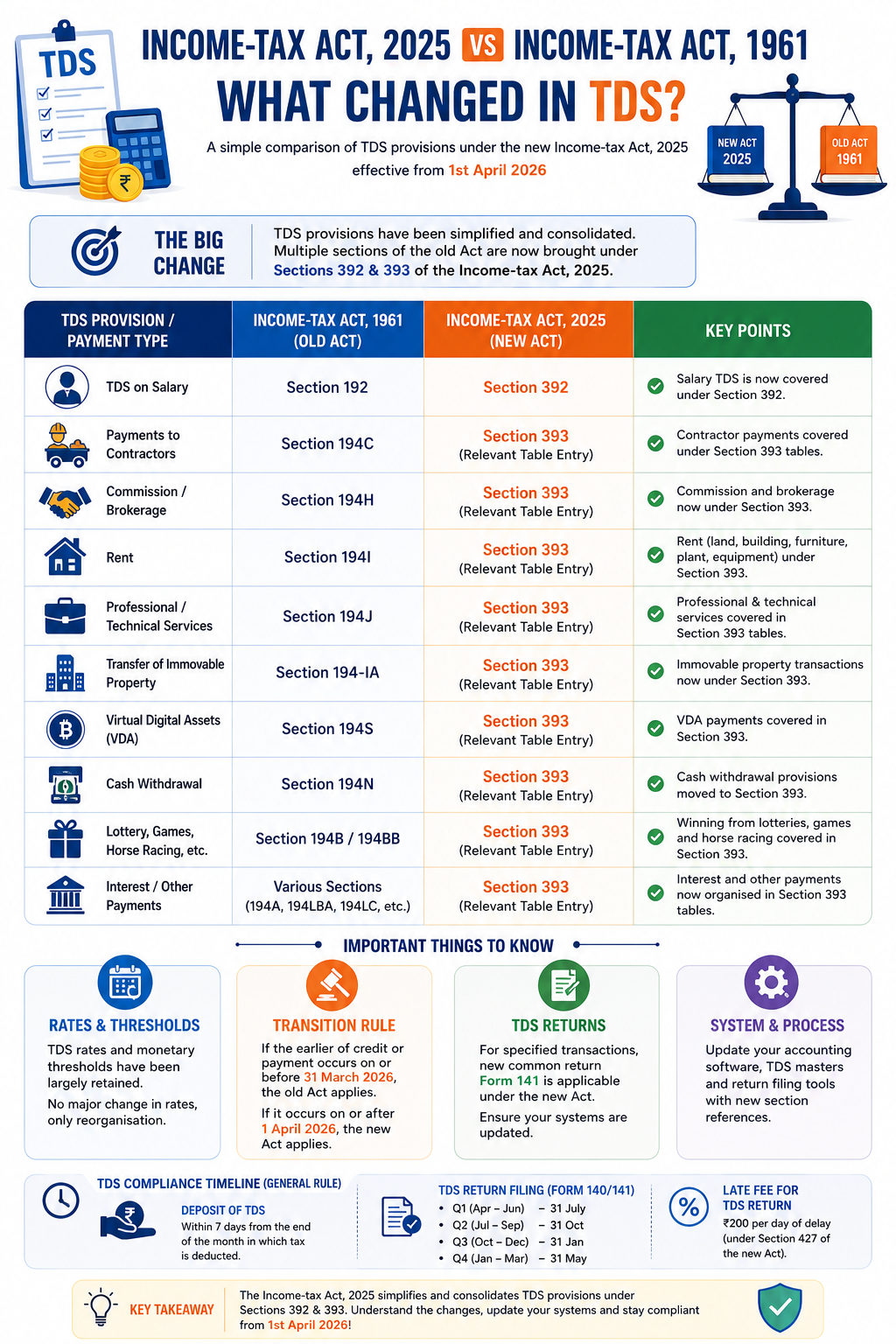
According to the Income Tax Department, the TDS provisions that were spread across Sections 192 to 194T of the 1961 Act have broadly been consolidated into Sections 392 and 393 of the Income-tax Act, 2025.
Section 392 – TDS on Salary
Section 392 deals with TDS on salary.
Under the old Act, salary TDS was primarily covered by Section 192.
So, broadly:
Old Act: Section 192
New Act: Section 392
Section 393 – TDS on Other Payments
Section 393 covers TDS on various payments other than salary.
Instead of requiring taxpayers to navigate numerous individual sections, Section 393 presents provisions through tables covering different categories of payments and payees.
For example, payments to contractors, professional services, rent, commission, and other specified payments are addressed through the relevant table entries under Section 393.
Old TDS Sections vs New TDS Structure
The transition can be understood with a few common examples.
| Income-tax Act, 1961 | Income-tax Act, 2025 |
|---|---|
| Section 192 – Salary | Section 392 |
| Section 194C – Contractor payments | Section 393, relevant table entry |
| Section 194H – Commission/Brokerage | Section 393, relevant table entry |
| Section 194I – Rent | Section 393, relevant table entry |
| Section 194J – Professional/technical services | Section 393, relevant table entry |
| Section 194-IA – Immovable property | Section 393, relevant table entry |
| Section 194S – Virtual Digital Assets | Section 393, relevant table entry |
| Section 194N – Cash withdrawal | Section 393, relevant table entry |
The exact new provision should be identified from the applicable table and transaction type rather than simply replacing an old section number with "393" in every case.
Have TDS Rates Changed Under the New Act?
This is one of the most important questions for businesses.
Generally, no.
The Income Tax Department states that the TDS rates and monetary thresholds have been retained under the new Act and that the consolidation is primarily a simplification and restructuring of the provisions rather than a change in TDS policy.
Therefore, businesses should not assume that every TDS rate has changed merely because the section number has changed.
However, the applicable rate and threshold should always be checked against the relevant provision, Finance Act and applicable rules for the transaction.
Why the New Section Numbers Matter
Although the underlying TDS policy may remain largely unchanged, the correct section/table reference is important for compliance.
For transactions governed by the new Act from 1 April 2026, the Income Tax Department has specifically advised deductors to quote the applicable Section 393 table item rather than old section numbers such as 194C, 194J or 194H.
Incorrectly quoting an old section number can potentially result in system-level validation or processing issues when filing TDS statements.
Example
Suppose a company makes a payment to a contractor after the new Act becomes applicable.
Under the old Act, the payment would generally have been associated with Section 194C.
For a transaction governed by the new Act, the relevant reference is instead the applicable Section 393 table entry.
This makes updating accounting software, payroll systems and TDS return processes important for businesses.
What Happens During the Transition?
The transition from the old Act to the new Act is based on the timing of the earlier of credit or payment, depending on the nature of the TDS obligation.
The Income Tax Department states that:
- If the relevant earlier event occurs on or before 31 March 2026, the Income-tax Act, 1961 generally governs the TDS obligation.
- If the relevant earlier event occurs on or after 1 April 2026, the Income-tax Act, 2025 generally applies.
Example
A business credits professional fees to a professional on 25 March 2026, but makes the actual payment in April 2026.
Since the credit occurred before 1 April 2026, the old Act can govern the TDS obligation.
On the other hand, if both the credit/payment event occurs after 1 April 2026, the new Act provisions apply.
Therefore, businesses should not decide the applicable law merely by looking at the date on which the bank payment was ultimately made.
What About Existing Contracts?
Businesses with continuing contracts do not necessarily need to rewrite their agreements merely because the new Income-tax Act has come into force.
The Income Tax Department's guidance indicates that businesses should apply the relevant Act based on when the applicable credit or payment event occurs. For example, a March 2026 payment can remain under the old Act, while a corresponding April 2026 payment can fall under the new Act.
This is particularly relevant for:
- Contractor agreements
- Professional service contracts
- Rent arrangements
- Commission arrangements
- Annual maintenance contracts
- Consultancy agreements
- Payroll
Has the TDS Deposit Timeline Changed?
The transition to the new Act does not automatically mean that businesses get a new TDS payment schedule.
The Income Tax Department states that the existing framework is broadly retained through the Income-tax Rules, 2026. For ordinary TDS, the general rule continues to require deposit within the prescribed period following the month of deduction, with specific exceptions for certain transactions.
Businesses should therefore continue monitoring:
- Date of deduction
- Applicable deposit deadline
- Challan details
- TDS return filing deadline
- Applicable TDS section/table
- PAN and deductee information
What About TDS Returns?
The new framework also brings changes to the forms and reporting structure.
For certain transactions that previously used separate challan-cum-TDS statements, the new rules provide for a common Form 141 for specified transactions governed by the new Act.
Businesses should therefore ensure that their accounting and compliance teams use the correct forms and reporting mechanisms applicable to the relevant tax period.
What Should Businesses Do After 1 April 2026?
Businesses should treat the transition as a compliance-system update, not simply a change in section numbering.
1. Update accounting software
Ensure that the accounting or ERP system recognises the applicable provisions under the Income-tax Act, 2025.
2. Update TDS masters
Review the TDS configuration for:
- Contractors
- Professionals
- Rent
- Commission
- Interest
- Property transactions
- Other specified payments
3. Train the accounts team
Your accounting team should understand the difference between old Act sections and new Act table references.
4. Review TDS return settings
Incorrect section references can create validation or processing issues, so return preparation tools should be updated.
5. Review ongoing payments
For recurring transactions crossing March and April 2026, check the applicable law based on the relevant credit/payment event.
6. Maintain proper documentation
Keep invoices, agreements, payment records, deduction details, and challans properly organised so that the TDS position can be verified later.
Common Mistakes to Avoid
The transition may create several practical errors.
Mistake 1: Using old section numbers for new transactions
Do not automatically use 194C, 194J or 194H for transactions governed by the new Act.
Mistake 2: Assuming every TDS rate has changed
The new Act largely retains existing TDS rates and thresholds. The major change is the structure and presentation of the provisions.
Mistake 3: Applying the new Act to old transactions
Transactions governed by the old Act do not become governed by the new Act merely because compliance or correction takes place after 1 April 2026.
Mistake 4: Ignoring the March-April transition
Recurring monthly payments should be reviewed carefully because March and April transactions can fall under different statutory frameworks.
Mistake 5: Updating only the return software
TDS configuration should be reviewed throughout the accounting process—from invoice booking and deduction to payment, challan and return filing.
Income-tax Act, 2025 vs Income-tax Act, 1961: Key Differences at a Glance
| Area | Income-tax Act, 1961 | Income-tax Act, 2025 |
|---|---|---|
| Effective framework | Applicable to earlier tax years | Effective from 1 April 2026 |
| Salary TDS | Section 192 | Section 392 |
| Other TDS | Numerous sections | Primarily consolidated under Section 393 |
| Presentation | Multiple sections and provisions | More tabular and consolidated |
| TDS rates | Existing framework | Largely retained |
| Monetary thresholds | Existing framework | Largely retained |
| Section references | 194C, 194H, 194I, 194J, etc. | Relevant Section 393 table entries |
| Transition | Applies to periods governed by old Act | Applies to transactions governed from 1 April 2026 |
Frequently Asked Questions
Is Section 194C still used after 1 April 2026?
For transactions governed by the Income-tax Act, 2025, taxpayers should refer to the applicable Section 393 table entry rather than quoting Section 194C. The Income Tax Department has specifically highlighted this transition.
Have TDS rates changed under the Income-tax Act, 2025?
The Income Tax Department states that TDS rates and monetary thresholds have been largely retained. The major change is the consolidation and restructuring of provisions.
Which Act applies to a payment made after 1 April 2026?
The answer depends on the applicable triggering event, particularly the earlier of credit or payment for the relevant TDS provision. Transactions/events governed before 1 April 2026 generally remain under the old Act, while those governed from 1 April 2026 fall under the new Act.
Do businesses need to change their TDS software?
Businesses should review and update their accounting, payroll and TDS return systems to ensure that the new section/table references and forms are correctly supported.
Is the Income-tax Act, 1961 completely irrelevant after 1 April 2026?
No. The old Act continues to govern matters relating to tax years and transactions to which it applies, including certain earlier-year compliance and proceedings. The repeal of the old Act does not invalidate actions or assessments relating to earlier periods.
Conclusion
The transition from the Income-tax Act, 1961 to the Income-tax Act, 2025 represents a significant structural change in India's tax law, but businesses should not assume that TDS rates and thresholds have been completely rewritten.
For TDS, the most important change is the consolidation and restructuring of provisions into Sections 392 and 393, with Section 393 using tables to organise TDS requirements for different types of payments and payees.
For businesses, the priority should be to update accounting systems, review TDS configurations, understand the new section/table references, and carefully handle transactions around the March–April 2026 transition.
In short: New section numbers, simplified structure, but largely familiar TDS rates and compliance principles.
Disclaimer: This article is for general informational purposes only and should not be treated as professional tax advice. TDS provisions, rates, thresholds, forms, and compliance requirements should be verified against the applicable Income-tax Act, rules, Finance Act, and CBDT notifications before filing or making tax decisions