

Filing an Income Tax Return (ITR) can sometimes result in a tax refund when the amount of tax already paid or deducted is higher than the taxpayer’s actual tax liability. But how much tax will you actually get back after filing your ITR? The answer depends on your total income, eligible deductions, tax liability, TDS, advance tax, self-assessment tax, and other taxes already paid. In this guide, we explain how an ITR refund is calculated, when you can expect it, and what you should do if your refund is delayed.
What Is an Income Tax Refund?
An income tax refund is the amount returned by the Income Tax Department when the tax paid by you is more than the tax actually payable for the relevant financial year.
For example, suppose:
- Total tax liability: ₹35,000
- TDS deducted: ₹50,000
- Advance tax paid: ₹5,000
Your total tax paid is ₹55,000.
Therefore:
Tax Refund = ₹55,000 − ₹35,000 = ₹20,000
In this example, the taxpayer may be eligible for a refund of ₹20,000, subject to processing and verification by the Income Tax Department.
How Is Your ITR Refund Calculated?
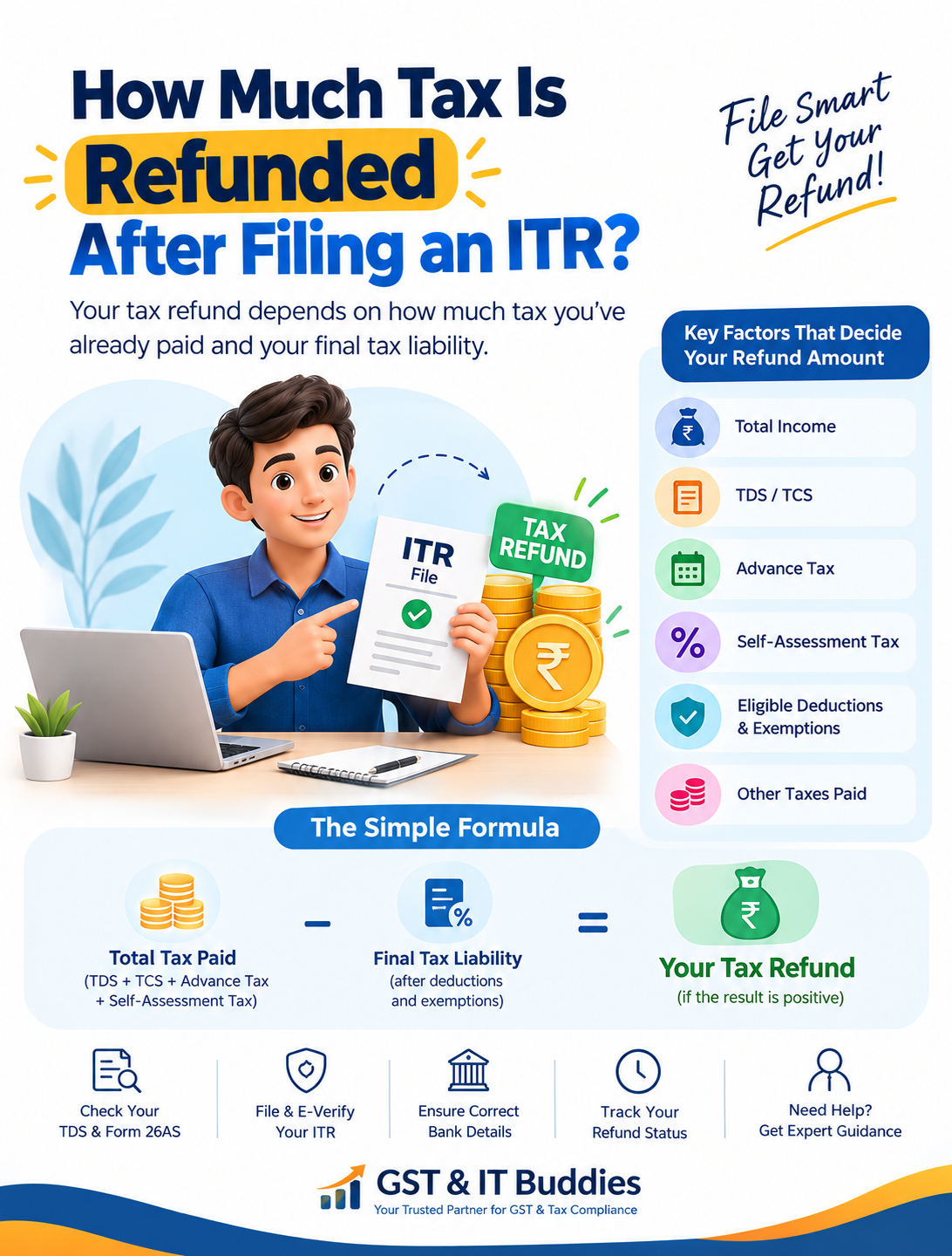
Your refund is generally based on the difference between the total tax already paid and your final tax liability.
A simplified calculation is:
Tax Refund = TDS + TCS + Advance Tax + Self-Assessment Tax − Final Tax Liability
If the result is positive, a refund may be due.
If the result is negative, additional tax may be payable.
Example of Refund Calculation
Suppose your tax details are:
| Particulars | Amount |
|---|---|
| TDS deducted | ₹75,000 |
| TCS paid | ₹5,000 |
| Advance Tax | ₹10,000 |
| Total Tax Paid | ₹90,000 |
| Final Tax Liability | ₹65,000 |
| Potential Refund | ₹25,000 |
Thus, you may be eligible for a refund of ₹25,000.
The final amount can differ if there are adjustments, interest, outstanding demands, or other items considered during processing.
Why Do Taxpayers Get an Income Tax Refund?
There are several common reasons why a taxpayer may receive a refund.
1. Excess TDS Deduction
Your employer, bank, client, or another deductor may have deducted more TDS than your final tax liability.
For example, interest income may have been subject to TDS, but after considering your complete income and applicable tax provisions, your actual tax liability may be lower.
2. Excess Advance Tax Paid
Taxpayers with significant tax liability may pay advance tax during the financial year.
If the total advance tax paid is higher than the final tax liability, the excess amount may become refundable.
3. Eligible Deductions and Exemptions
Your final tax liability may reduce after considering eligible deductions, exemptions, or other applicable provisions.
However, the availability of a particular deduction depends on the applicable tax regime and the taxpayer’s circumstances.
4. TDS on Income That Does Not Result in Equivalent Final Tax Liability
TDS may be deducted at source even when the taxpayer's final taxable income, after applicable provisions, results in a lower tax liability.
The difference can potentially be claimed as a refund through the ITR.
Is Everyone Who Files an ITR Eligible for a Refund?
No.
Simply filing an ITR does not mean that you will receive a refund.
A refund generally arises when the tax already paid or credited to you exceeds your final tax liability.
For example:
Tax already paid = ₹40,000
Final tax liability = ₹40,000
In this situation, there may be no tax refund.
On the other hand:
Tax already paid = ₹60,000
Final tax liability = ₹45,000
Potential refund = ₹15,000, subject to processing and any applicable adjustments.
Where Can You Check Your TDS?
Before filing your ITR, it is important to verify the tax credits available to you.
You can compare the TDS/TCS information reported in your tax records with your records, such as salary slips, certificates, and other relevant documents.
If there is a mismatch, it may need to be corrected before or during the return-filing process, depending on the nature of the discrepancy.
How Long Does It Take to Receive an Income Tax Refund?
There is no single fixed number of days that applies to every taxpayer.
The refund timeline can depend on factors such as:
- Whether the ITR has been successfully filed
- Whether the return has been e-verified
- Accuracy of bank account details
- TDS and tax-credit information
- Whether the return is selected for further verification
- Any outstanding tax demand or adjustment
- Processing workload of the Income Tax Department
Therefore, taxpayers should avoid assuming that a refund will arrive within a particular number of days in every case.
What If Your ITR Refund Is Delayed?
If you have filed and verified your ITR but the refund has not been received, first check the status of your return and refund through the official income-tax portal.
Also verify:
- Whether your ITR has been successfully e-verified
- Whether the return has been processed
- Whether your bank account is correctly reported and validated
- Whether any communication or outstanding demand is shown on the portal
- Whether there is any issue with your refund
If the refund is not issued because of an identified discrepancy, follow the instructions provided by the Income Tax Department.
Does a Tax Refund Mean You Saved Tax?
Not necessarily.
A refund generally means that more tax was paid or deducted during the year than your final tax liability.
For example, if ₹80,000 was deducted as TDS but your final tax liability is ₹60,000, the ₹20,000 difference may be refunded.
The refund is therefore not necessarily an additional tax benefit. It is generally a return of excess tax already paid or credited.
Important Things to Check Before Filing Your ITR
To avoid unnecessary refund delays or tax-credit mismatches, taxpayers should review:
- Form 26AS
- AIS (Annual Information Statement)
- TDS certificates
- Salary and income details
- Bank interest income
- Capital gains, where applicable
- Eligible deductions and exemptions
- Advance tax payments
- Self-assessment tax payments
- Bank account details
Accurate information can help reduce discrepancies during return processing.
Frequently Asked Questions
How much tax refund can I get after filing my ITR?
There is no fixed refund amount. It depends on the difference between your total eligible tax credits/payments and your final tax liability.
Can I get a refund if my TDS is higher than my tax liability?
Yes. If the TDS credited to you is higher than your final tax liability, the excess may generally be refundable, subject to the return being processed and other applicable adjustments.
Do I need to file an ITR to claim a tax refund?
Generally, taxpayers seeking a refund of excess tax need to file an income tax return and complete the required verification process.
Why is my refund amount different from my calculation?
The final refund can differ because of tax-credit differences, interest, outstanding demands, adjustments, or changes made during processing.
How can I check my ITR refund status?
You can check the status through the official Income Tax e-Filing portal using your relevant login details and return information.
Final Takeaway
The tax refund amount after filing an ITR depends mainly on how much tax you have already paid versus your final tax liability.
The basic concept is:
Excess Tax Paid → Tax Liability Calculated → Eligible Refund
Before filing your ITR, carefully reconcile your TDS, TCS, advance tax, income, deductions, and other relevant information. This can help identify discrepancies and reduce the possibility of delays or incorrect refund claims.
If you are unsure about your tax calculation or refund eligibility, consider getting the return reviewed by a qualified tax professional before filing.