

Tax Deducted at Source (TDS) is an important part of India’s tax compliance system. Employers, companies, businesses, and other persons responsible for deducting tax must deposit the deducted amount with the government and submit the applicable TDS statements within the prescribed deadlines. Missing a TDS return filing deadline can lead to late-filing fees, interest, and other consequences. Therefore, understanding the TDS return filing due date in 2026 is essential for businesses, accountants, employers, and tax professionals.
What Is the TDS Return Filing Due Date in 2026? TDS returns are generally filed quarterly. The applicable deadline depends on the quarter in which tax was deducted and the reporting framework applicable to that period.
For the transition year 2026, the relevant deadlines include the following:
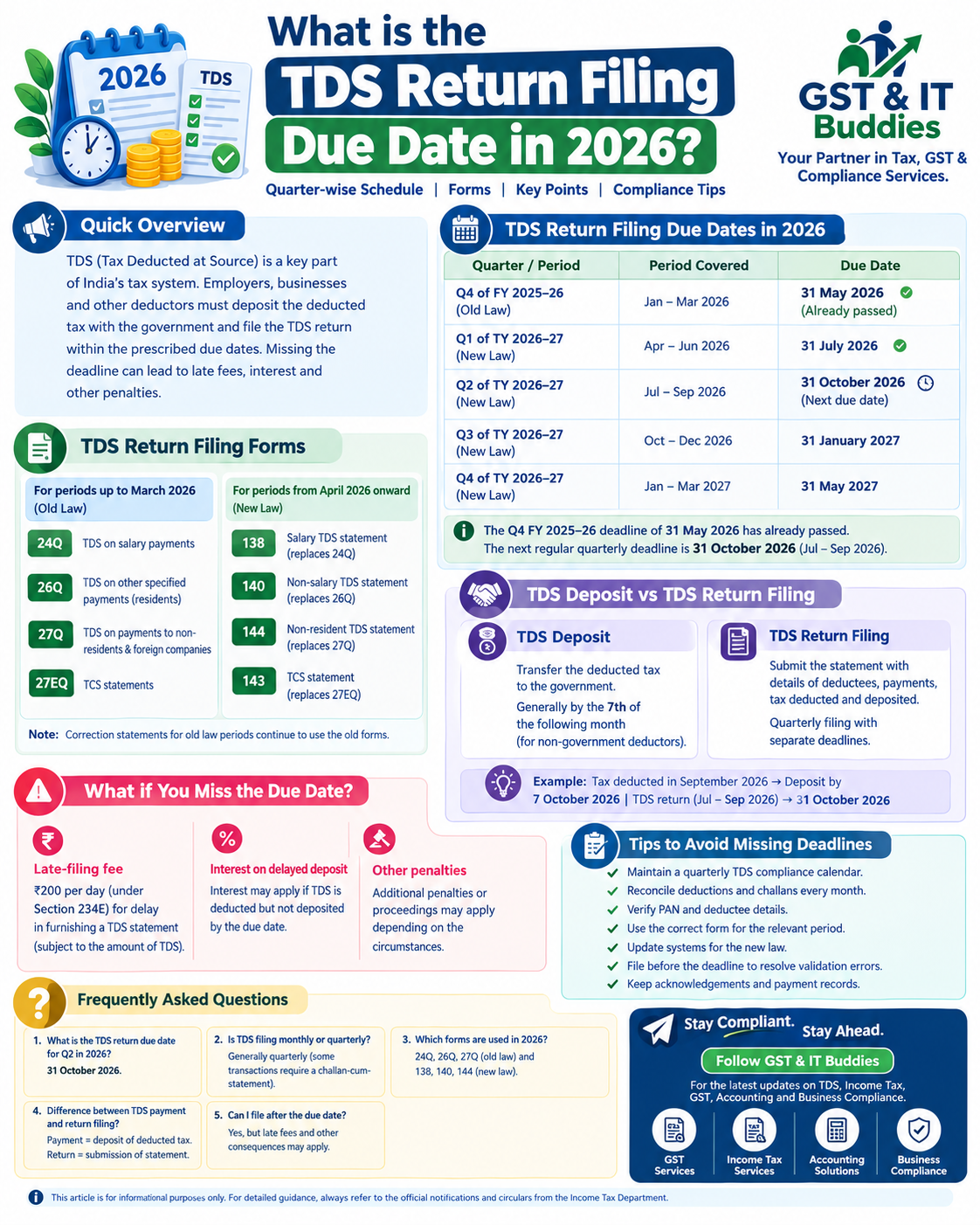
Quarter or period Period covered Filing due date Q4 of FY 2025–26 January–March 2026 31 May 2026 Q1 of Tax Year 2026–27 April–June 2026 31 July 2026 Q2 of Tax Year 2026–27 July–September 2026 31 October 2026 Q3 of Tax Year 2026–27 October–December 2026 31 January 2027 Q4 of Tax Year 2026–27 January–March 2027 31 May 2027 The Income Tax Department’s transition guidance confirms the 31 May 2026 deadline for the final quarter under the old law, and the 31 July and 31 October 2026 deadlines for the first two quarters under the new law. The subsequent dates follow the regular quarterly schedule. <Cite refs={["turn838205view0","turn364347search0"]}/>
Important: The Q4 FY 2025–26 deadline of 31 May 2026 has already passed. As of October 2026, the next regular quarterly deadline is 31 October 2026, for the July–September 2026 period.
TDS Return Filing Forms Applicable in 2026 The applicable forms depend on the period being reported and the type of deduction.
- For periods up to March 2026 TDS statements for FY 2025–26 continue to follow the Income-tax Act, 1961 framework. Common forms include:
Form 24Q: TDS on salary payments.
Form 26Q: TDS on specified payments other than salary to residents.
Form 27Q: TDS on specified payments to non-residents and foreign companies.
Form 27EQ: TCS statements.
- For periods from April 2026 onward Under the Income-tax Act, 2025 and Income-tax Rules, 2026, the corresponding reporting forms have changed:
Form 138: Salary TDS statement, replacing Form 24Q.
Form 140: Non-salary TDS statement, replacing Form 26Q.
Form 144: Non-resident TDS statement, replacing Form 27Q.
Form 143: TCS statement, replacing Form 27EQ.
These new forms apply to the relevant reporting periods under the new law. Correction statements relating to periods governed by the old Act continue to use the old framework. <Cite refs={["turn838205view0","turn945662view2"]}/>
What Is the Difference Between TDS Deposit and TDS Return Filing? TDS deposit and TDS return filing are two separate compliance responsibilities.
TDS deposit means transferring the tax deducted from a payment to the government within the applicable payment deadline.
TDS return filing means submitting the prescribed statement containing details of the deductor, deductees, payments, tax deductions, and tax deposits.
For non-government deductors, TDS is generally deposited by the 7th of the following month. Special rules and exceptions apply to certain transactions and to March deductions. Quarterly TDS statements have separate filing deadlines. <Cite refs={["turn838205view0","turn645368view2"]}/>
For example, tax deducted in September 2026 will generally need to be deposited by 7 October 2026, while the quarterly statement for July–September 2026 is due by 31 October 2026.
How to File a TDS Return Online Businesses and deductors can follow these general steps to prepare and submit a TDS statement.
Collect payment details: Gather invoices, salary records, deductee PAN details, and payment information for the quarter.
Reconcile TDS deductions: Match the tax deducted with the amounts deposited and the relevant challan details.
Choose the applicable form: Select the correct form based on the period, type of payment, and applicable law.
Prepare the statement: Enter deductee details, payment amounts, tax deducted, and challan information accurately.
Validate the file: Use the applicable return preparation utility and resolve validation errors.
Submit the return: Upload the statement through the designated income-tax reporting facility and complete the required verification.
Check the filing status: Keep the acknowledgement and review any processing errors or defaults that require correction.
Always use the current official utilities and instructions applicable to the relevant tax period.
What Happens If You Miss the TDS Return Filing Due Date? Failure to file TDS statements on time can create financial and compliance issues.
Late-filing fee Under the earlier framework, Section 234E provides for a fee of ₹200 per day for delay in furnishing a TDS statement, subject to the amount of TDS involved. For periods governed by the Income-tax Act, 2025, the corresponding provisions and applicable rules should be checked before calculating the fee.
Penalty and other consequences Depending on the circumstances, a deductor may face additional penalties or other proceedings for failure to comply with TDS requirements.
Interest on delayed deposit If TDS is deducted but not deposited by the applicable deadline, interest may apply. Late deposit and late return filing are separate defaults, so both should be reviewed when a deadline is missed. <Cite refs={["turn645368view2","turn838205view0"]}/>
Tips to Avoid Missing TDS Filing Deadlines Businesses can reduce compliance risks by following a structured process:
Maintain a quarterly TDS compliance calendar.
Reconcile deductions and challans every month.
Verify PAN and deductee information before submission.
Use the correct reporting form for the applicable tax period.
Update payroll and accounting systems for the new law.
File before the deadline to allow time to resolve validation errors.
Retain filing acknowledgements and payment records.
A regular review process helps businesses prevent errors and maintain accurate tax records.
Frequently Asked Questions (FAQs)
-
What is the TDS return filing due date for Q2 in 2026? The quarterly TDS return for July–September 2026 is due on 31 October 2026.
-
What is the TDS return filing due date for April–June 2026? The Q1 statement for Tax Year 2026–27 was due on 31 July 2026.
-
Is TDS return filing monthly or quarterly? Regular TDS statements are generally filed quarterly. However, certain specified transactions require a challan-cum-statement instead of a separate quarterly return.
-
Which forms are used for TDS returns in 2026? For periods governed by the old law, common forms include 24Q, 26Q, and 27Q. Under the new framework applicable from April 2026, the corresponding forms include 138, 140, and 144.
-
What is the difference between TDS payment and TDS return filing? TDS payment is the deposit of deducted tax with the government. TDS return filing is the submission of the statement reporting deductions, deductees, and payment details. Each has its own deadline.
-
Can I file a TDS return after the due date? A delayed statement may still need to be filed, but late-filing fees and other consequences may apply. File the outstanding statement promptly and check the applicable law for the relevant period.
Conclusion: Knowing the TDS return filing due date in 2026 helps employers, businesses, and tax professionals stay compliant and avoid unnecessary costs. The key upcoming quarterly deadline is 31 October 2026, for the July–September quarter.
Because India’s new Income-tax Act came into effect on 1 April 2026, it is also important to select the correct form and reporting framework for each period.
For reliable compliance, maintain a tax calendar, reconcile deductions regularly, and verify the latest requirements before filing.
Stay Compliant. Stay Ahead.
Follow GST & IT Buddies for practical updates on TDS, Income Tax, GST, accounting, and business compliance.