

Introduction Starting a business involves more than choosing a company name and selling products or services. Businesses also create valuable intellectual property, including brand names, logos, website content, marketing materials, photographs, software, and original designs. Protecting these assets can help prevent unauthorised use and strengthen a company's identity in the marketplace. Two important forms of intellectual property protection in India are copyright and trademark. Although both help protect business assets, they serve different purposes. Copyright generally protects original creative works, while trademark protection focuses on distinctive signs that identify the source of goods or services.
What Is Copyright? Copyright is a legal right that protects original creative works under the Copyright Act, 1957. It gives eligible rights holders certain exclusive rights over how their works are reproduced, communicated, adapted, or otherwise used, subject to applicable legal exceptions.
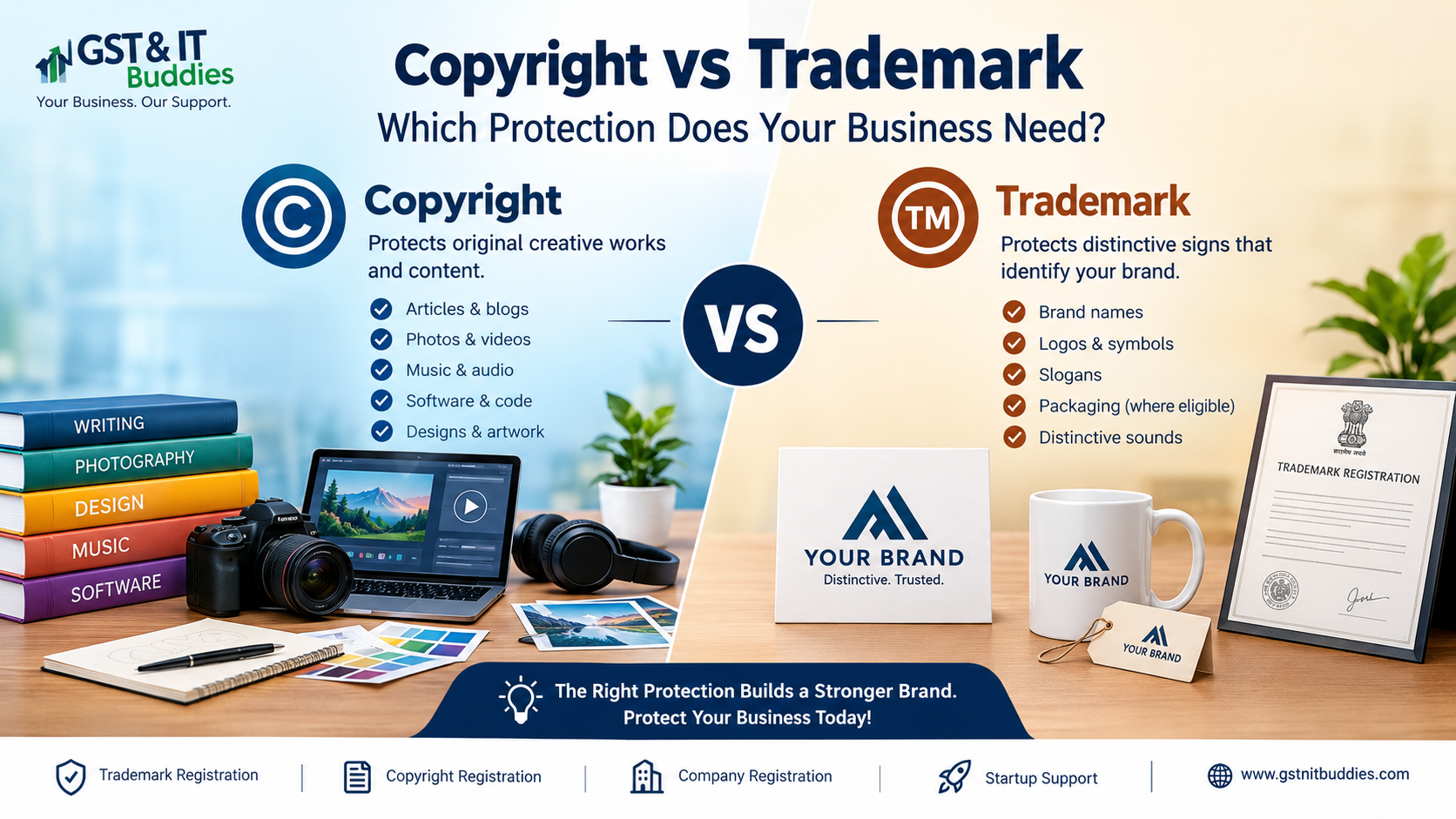
Copyright can protect various types of original work, including:
Articles, blogs, books, and written content
Photographs, illustrations, and artwork
Videos, films, and original audio recordings
Music and original compositions
Computer programs and software
Original graphic designs and marketing materials
For example, if a business creates an original educational blog or produces a promotional video, copyright may protect the original expression contained in that work. It does not generally protect the underlying idea or concept itself.
Government of India +1
Is copyright registration mandatory in India? No. Copyright generally arises automatically when an eligible original work is created. Registration is not a prerequisite for copyright to exist, but registration can provide useful prima facie evidence in disputes concerning ownership.
IP India +1
Businesses should also keep appropriate records of creation, contracts, licences, and ownership, especially when work is produced by employees, freelancers, or external agencies.
What Is a Trademark? A trademark is a distinctive sign used to identify and distinguish the goods or services of one business from those of another. It can protect a brand's identity and help customers recognise the source of a product or service.
IP India +1
Examples of elements that may qualify for trademark protection include:
Brand names and business names used as marks
Logos and symbols
Slogans, where they meet legal requirements
Distinctive packaging shapes or colour combinations, where eligible
Certain distinctive sounds
For example, if a startup uses a distinctive brand name and logo to sell products, trademark registration may help protect those brand identifiers against conflicting uses in the relevant goods or services categories.
Why is trademark registration important? Trademark registration can provide several business benefits:
Brand protection: Helps protect the registered mark against infringement.
Brand recognition: Makes it easier for customers to identify your business.
Legal rights: Provides statutory rights for the registered mark, subject to applicable law.
Business value: A trademark can become an asset that may be licensed or assigned.
Business expansion: Helps establish a consistent brand identity as your business grows.
IP India +1
Unlike copyright, trademark protection is primarily concerned with the identity of a brand rather than the creative content a business produces.
Copyright vs Trademark: Key Differences The following table explains the main differences between copyright and trademark in India.
Basis
Copyright
Trademark
Main purpose
Protects original creative works
Protects distinctive brand identifiers
Examples
Blogs, photos, videos, software
Brand names, logos, slogans
Applicable law
Copyright Act, 1957
Trade Marks Act, 1999
Registration
Generally not mandatory for protection
Registration is generally advisable for stronger statutory protection
What it protects
Original expression
Identity of goods or services and their commercial source
Duration
Depends on the type of work and applicable legal provisions
Registration generally lasts 10 years and can be renewed
Main business benefit
Protects creative assets
Protects brand identity and goodwill
Government authority
Copyright Office
Trade Marks Registry
The protection periods differ significantly. For example, copyright in many original literary, dramatic, musical and artistic works generally lasts for the author's lifetime plus 60 years, subject to statutory rules and exceptions. A registered trademark is generally valid for 10 years and may be renewed for further 10-year periods.
Press Information Bureau +2
Copyright vs Trademark: Examples for Businesses Understanding practical examples can make the distinction easier.
Example 1: A company website Suppose a business publishes original blog articles, website graphics and educational videos.
Copyright may protect the original articles, graphics and videos.
Trademark protection may apply to the distinctive business name or logo displayed on the website.
Example 2: A clothing brand A clothing business develops a distinctive brand name and creates original product photographs and promotional campaigns.
Trademark protection may cover the brand name and eligible logo.
Copyright may protect original photographs, illustrations and promotional creative works.
Example 3: A software company A software company develops an original computer program and markets it under a distinctive brand name.
Copyright may protect eligible original software code.
Trademark protection may cover the distinctive brand name or logo used to market the software.
These examples show that copyright and trademark are not competing alternatives. They often protect different aspects of the same business.
Can a Business Need Both Copyright and Trademark Protection? Yes. A business may benefit from both forms of protection when it owns original creative works and uses distinctive brand identifiers.
Consider a startup that creates a logo, develops a website, publishes blogs and launches services under a unique brand name.
Its potential protection could look like this:
Copyright protection
Original website text, blog posts, photographs, videos and eligible software code.
Trademark protection
The business name, distinctive logo and other eligible marks used to identify its goods or services.
Important: Copyright in a logo and trademark rights in that same logo are legally different. Copyright ownership does not automatically provide registered trademark rights, and trademark registration does not automatically establish copyright ownership. The appropriate protection depends on the asset and the circumstances.
IP India +1
How to Register a Trademark in India If you want to protect your business brand, you can explore the official trademark registration process through the Indian government's Intellectual Property India portal.
The general process includes:
Search existing trademarks: Check for identical or similar marks that could conflict with your proposed brand.
Select the appropriate class: Identify the relevant goods or services under the trademark classification system.
Prepare the application: Provide applicant details, the mark and a description of the relevant goods or services.
File Form TM-A: Submit the application through the official e-filing portal and pay the applicable government fee.
Respond to examination: Address any examination report or objections, if applicable.
Publication and opposition: The mark may be published in the Trade Marks Journal, allowing eligible third parties to oppose it.
Registration: If the application satisfies the applicable requirements and completes the process successfully, registration may be granted.
Government of India +1
You can visit the official IP India trademark filing process for further details.
How to Register Copyright in India Copyright registration is optional in India, but a business may choose to register eligible creative works to establish a useful official record.
The general process involves:
Identifying the original work and the correct applicant or rights holder.
Preparing the prescribed application and required particulars.
Submitting the application and paying the applicable fee.
Following the prescribed notice and objection procedure.
Responding to any queries or objections raised by the Copyright Office.
The exact requirements vary according to the type of work and ownership arrangements. Businesses should also confirm that they own or have the necessary rights to register work created by a designer, freelancer, employee or other third party.
For details, visit the official IP India copyright information.
IP India +1
Common Mistakes Businesses Should Avoid Business owners should be careful not to assume that one form of intellectual property protection covers every asset.
Common mistakes include:
Assuming that registering a company name automatically registers a trademark.
Believing that copyright protects a business idea rather than its eligible original expression.
Using a brand name without checking for conflicting trademarks.
Assuming that owning a logo file automatically establishes ownership of all intellectual property rights in it.
Failing to document ownership and usage rights when hiring freelancers or creative agencies.
Forgetting to monitor trademark renewal dates.
Assuming that registering a trademark in one category protects every possible product or service.
Taking these precautions early can reduce avoidable disputes and help businesses manage their intellectual property more effectively.
Which Protection Does Your Business Need? The right choice depends on what you want to protect.
Choose copyright protection when your priority is protecting original written content, artwork, videos, photographs, music or eligible software.
Consider trademark registration when you want to protect a distinctive brand name, logo or other eligible sign used to identify your business.
Consider both when your business owns creative content and uses a distinctive brand to market its products or services.
A trademark application should be assessed for distinctiveness, existing conflicts and the appropriate goods or services classes. Copyright ownership should also be checked carefully where multiple people or organisations have contributed to a work.
For complicated ownership arrangements, disputes or commercial licensing decisions, seek advice from a qualified intellectual property professional.
Frequently Asked Questions (FAQs)
-
What is the main difference between copyright and trademark? Copyright protects eligible original creative works, while a trademark protects distinctive signs that identify the commercial source of goods or services.
-
Is copyright registration compulsory in India? No. Copyright generally arises automatically when an eligible original work is created. Registration is optional, although the registration record can serve as prima facie evidence in ownership disputes.
IP India +1
-
Is trademark registration compulsory in India? Trademark registration is not universally compulsory, but it is generally advisable for businesses seeking stronger statutory protection for their brand identifiers. Certain rights may also arise from prior use under applicable law.
-
Can I copyright my business name? Copyright generally does not protect a business name or short phrase by itself. A name may qualify for trademark protection if it meets the relevant legal requirements.
Government of India +1
- How long does trademark protection last in India? A registered trademark generally lasts for 10 years and can be renewed for additional 10-year periods by following the prescribed process and paying the applicable fee.
Government of India +1
-
Can a logo be protected by both copyright and trademark? Potentially, yes. An original artistic logo may qualify for copyright protection, while the logo may also qualify as a trademark when used to identify goods or services. The requirements for each form of protection are separate.
-
Which is more important for a startup: copyright or trademark? Neither is universally more important. A startup that needs to establish its brand identity should consider trademark protection, while a business that creates original content should also review its copyright position. Many businesses need both.
Conclusion Understanding copyright vs trademark is an important step in protecting a business's intellectual property. Copyright helps protect original creative expression, while trademark protection helps businesses establish and safeguard their brand identity.
For startups and growing businesses in India, identifying valuable intellectual property early can support brand development, reduce risks and help preserve commercial value. Reviewing ownership arrangements and selecting the right protection for each asset can make intellectual property management more effective.
Protect Your Business Brand with GST & IT Buddies If you are planning to start a business or strengthen your brand identity, explore the relevant registration and compliance services offered by GST & IT Buddies.
Visit GST & IT Buddies to learn more about business registration and related support services.
Disclaimer: This article is for general educational and informational purposes only. It is not legal advice. Intellectual property rights depend on the facts, applicable legislation and the nature of the asset.