
Most small business owners get Udyam registration done for one reason. Usually, a bank asks for it, or a client wants the certificate. Then the certificate sits in a folder. That's a mistake. Udyam registration is free, takes about 15 minutes, and opens the door to benefits that can save you lakhs. In this guide, we cover 10 Udyam registration benefits that most MSMEs never use.
What Is Udyam Registration?
Udyam registration is the official MSME registration under the MSMED Act, 2006. It is done online on the government's Udyam portal using your Aadhaar and PAN. There is no government fee.
Once registered, you get a permanent Udyam Registration Number (URN) and an e-certificate.
Who Qualifies as an MSME in 2026?
The limits were revised from 1 April 2025 (Notification S.O. 1364(E), dated 21 March 2025). An enterprise is classified using both investment and turnover.
|
Category |
Investment in Plant & Machinery / Equipment |
Annual Turnover |
|---|---|---|
|
Micro |
Up to ₹2.5 crore |
Up to ₹10 crore |
|
Small |
Up to ₹25 crore |
Up to ₹100 crore |
|
Medium |
Up to ₹125 crore |
Up to ₹500 crore |
So a business with ₹8 crore turnover and ₹1 crore of machinery is now a micro enterprise. Many businesses that were "too big" earlier now qualify.
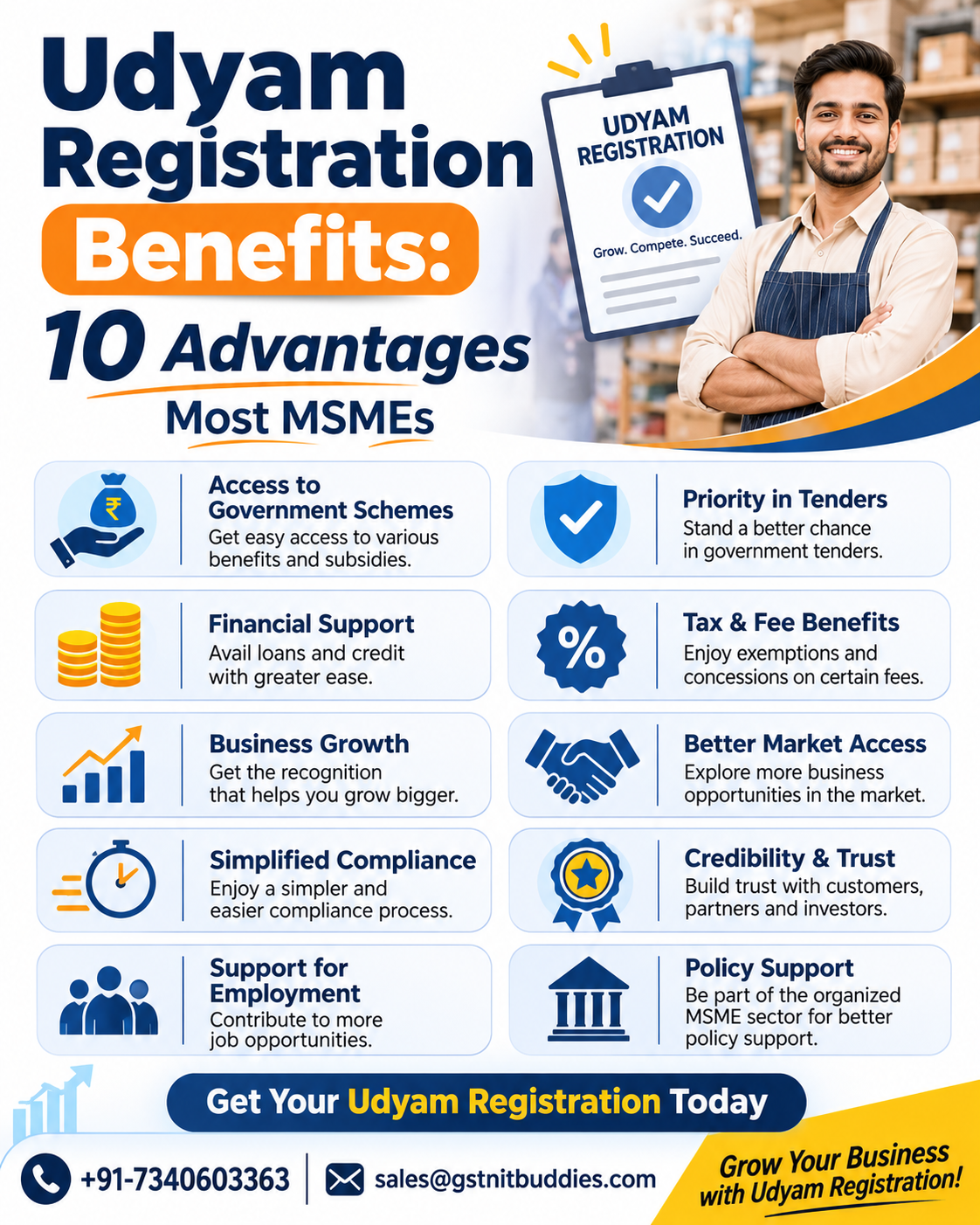
10 Udyam Registration Benefits Most MSMEs Miss
1. Buyers Must Pay You Within 45 Days
This is the most powerful benefit, and most small suppliers don't use it.
Under Section 15 of the MSMED Act, a buyer must pay a micro or small supplier:
- Within the agreed credit period, which cannot exceed 45 days, or
- Within 15 days, if there is no written agreement.
If the buyer pays late, they owe you compound interest at three times the RBI bank rate.
Tip: Mention your Udyam number and the "payment within 45 days as per MSMED Act" line on every invoice.
2. Your Buyer Loses a Tax Deduction If They Pay Late (Section 43B(h))
Since FY 2023-24, Section 43B(h) of the Income Tax Act says a buyer cannot claim a deduction for an amount owed to a micro or small enterprise if it is not paid within the 15/45-day limit. The deduction is allowed only in the year the payment is actually made.
This has made big companies serious about paying Udyam-registered vendors on time. But it applies only if you are registered. No Udyam certificate means no protection.
Note: This applies to micro and small enterprises only, not medium enterprises. Traders registered on Udyam are also not covered.
3. Collateral-Free Business Loans Up to ₹10 Crore
Under the CGTMSE scheme, banks and NBFCs can give loans to micro and small enterprises without asking for property or a third-party guarantee. From 1 April 2025, the guarantee ceiling was raised from ₹5 crore to ₹10 crore.
The guarantee fee was also reduced, and women entrepreneurs get extra concessions.
A Udyam certificate is the basic eligibility document for this.
4. Priority Sector Lending
RBI treats loans to MSMEs as priority sector lending. That means banks have targets to lend to you.
In practice, this can mean easier approvals and better terms. Even retail and wholesale traders can register on Udyam to get this priority sector benefit.
5. Advantage in Government Tenders
The Public Procurement Policy requires central ministries and PSUs to buy at least 25% of their annual purchases from micro and small enterprises.
Udyam-registered MSEs also typically get:
- Free tender documents
- Exemption from Earnest Money Deposit (EMD)
- Purchase preference in some cases
If you sell anything a government department buys, register on GeM (Government e-Marketplace) with your Udyam number.
6. MSME Samadhaan for Payment Disputes
If a buyer doesn't pay you on time, you don't have to go straight to court.
You can file a case online on the MSME Samadhaan portal. It goes to the Micro and Small Enterprises Facilitation Council (MSEFC) of your state, which can order the buyer to pay along with interest.
This is cheaper and faster than a civil suit for most small businesses.
7. Cheaper Patents and Trademarks
MSMEs get reduced government fees when filing patents and trademarks. For patents, the fee is much lower than what large companies pay.
The MSME Ministry has also run schemes to reimburse part of patent and IP costs. If you have a unique product or brand name, this is a good reason to protect it now.
8. ISO Certification Reimbursement
Getting ISO certified costs money. Under schemes run by the MSME Ministry, Udyam-registered units can claim reimbursement of a part of ISO certification expenses.
ISO certification helps you win larger clients and export orders, so this benefit pays twice.
9. State Government Subsidies and Concessions
This is where the benefits vary by state, and where most MSMEs miss out. Depending on your state's industrial policy, Udyam registration can unlock:
- Capital investment subsidy
- Electricity duty exemption or concession
- Stamp duty and registration fee reimbursement
- Interest subsidy on term loans
Check your state's MSME or industrial policy, or your District Industries Centre (DIC).
10. You Keep Your Benefits Even as You Grow
Under the revised rules, an enterprise moves up a category when it crosses the limits. But it is not downgraded unless it falls below both the investment and turnover limits.
And since the 2025 revision raised limits by 2 to 2.5 times, many growing businesses stay in the micro or small category longer, keeping benefits like the 45-day payment rule and CGTMSE loans.
How to Get Udyam Registration
The process is fully online and free:
- Go to the official Udyam Registration portal (udyamregistration.gov.in).
- Enter the Aadhaar of the proprietor, managing partner or director.
- Verify with OTP.
- Enter PAN; investment and turnover details are fetched from ITR and GST data.
- Fill in business activity (NIC code), bank details and employee count.
- Submit and get your e-certificate.
Beware of fake websites. Many private sites look like the government portal and charge ₹1,000 to ₹5,000 for "registration". The government charges nothing.
Common Mistakes to Avoid
- Wrong NIC code: Choosing trading instead of manufacturing or services can block some benefits.
- Not updating details: Update your Udyam profile after each ITR filing so your category stays correct.
- Not using the certificate: Put your URN on invoices, quotes, and purchase orders.
- Multiple registrations: One PAN can have only one Udyam registration. Add extra units under the same registration.
FAQs on Udyam Registration Benefits
Q1. Is Udyam registration mandatory? No, it is voluntary. But without it, you cannot claim most MSME benefits, including the 45-day payment protection and CGTMSE loans.
Q2. What is the fee for Udyam registration? Zero. Registration on the official portal is free.
Q3. Do I need GST registration for Udyam? PAN and Aadhaar are mandatory. GSTIN is required where your business is liable for GST registration.
Q4. Can traders get Udyam registration? Yes. Retail and wholesale traders can register, but their benefit is limited to priority sector lending. They are not covered by the 45-day payment rule.
Q5. Does the Udyam certificate expire? No. It is valid for life, but you should keep your details updated.
Q6. Does Section 43B(h) apply to medium enterprises? No. It applies only to payments owed to micro and small enterprises registered on Udyam.
Q7. Can I register if my business is a startup with no turnover yet? Yes. New businesses can register based on self-declared details, which are later updated from ITR and GST data.
Need Help With Udyam Registration?
GST & IT Buddies helps businesses with Udyam/MSME registration, GST registration, ITR filing, and compliance across India. Our team checks your NIC code, category, and documents so you don't miss any benefit.
[Get Your Udyam Registration Done Today →]