

Managing business finances requires accurate financial records and reports. Two essential financial tools that often confuse business owners and accounting students are the cash flow statement and the cash book. Although both deal with cash transactions, they serve different purposes. A cash book records day-to-day cash and bank transactions, while a cash flow statement summarizes the movement of cash through a business during a specific accounting period. In this comprehensive guide, we'll explain the difference between a cash flow statement and a cash book, their features, benefits, and when businesses should use each.
What Is a Cash Book?
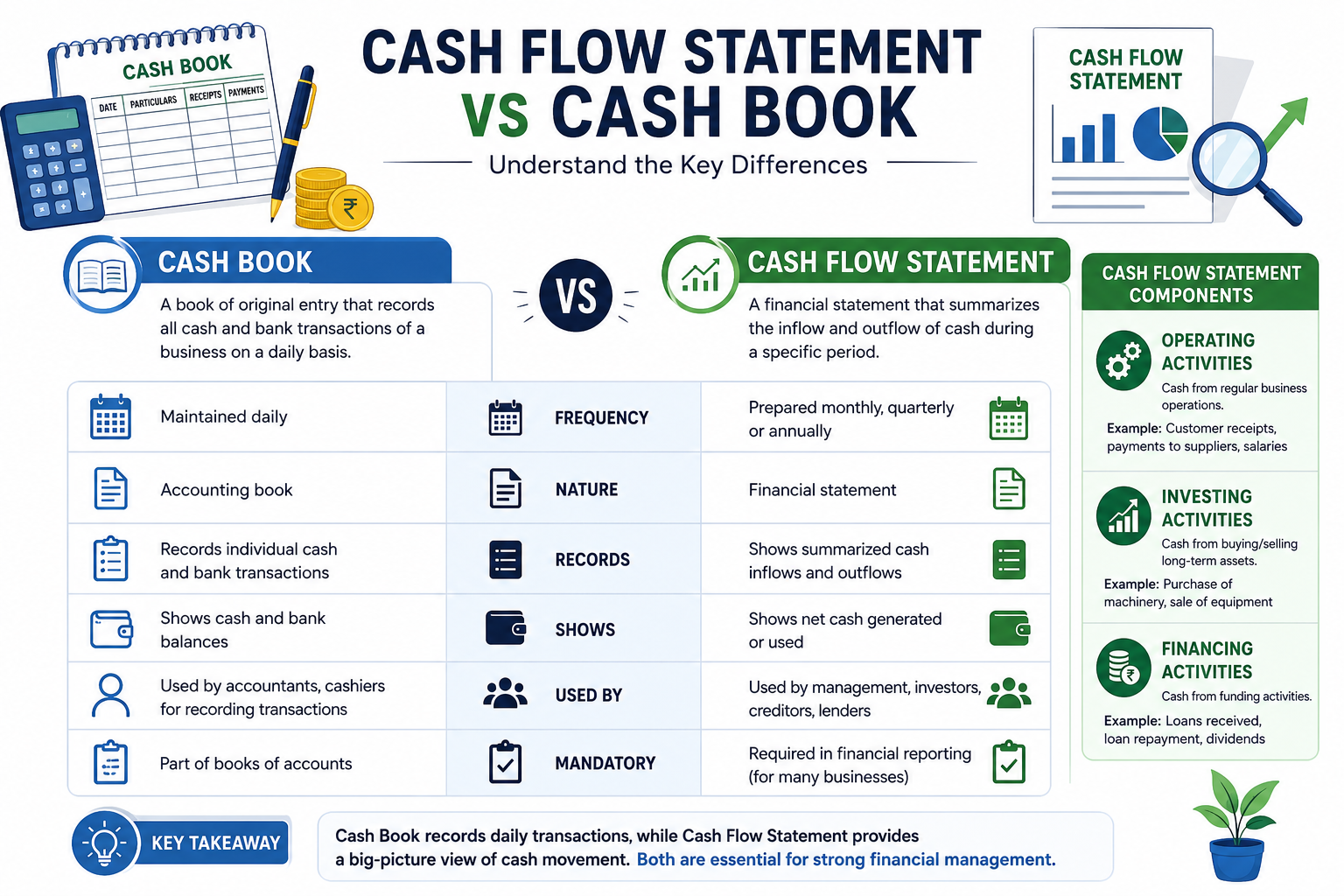
A cash book is a book of original entry used to record all cash receipts and cash payments of a business. It functions as both a journal and a ledger for cash transactions.
Every transaction involving cash or bank is recorded immediately in the cash book.
Features of a Cash Book
- Records daily cash receipts
- Records daily cash payments
- Shows cash and bank balances
- Updated regularly
- Acts as both journal and ledger
- Helps monitor cash availability
Example
A business receives ₹50,000 from a customer.
The amount is immediately recorded in the cash book under the cash receipts section.
What Is a Cash Flow Statement?
A cash flow statement is a financial statement that summarizes the inflow and outflow of cash during a specific accounting period.
It helps businesses understand where cash comes from and how it is spent.
Unlike a cash book, it does not record every transaction individually.
Instead, it categorizes cash flows into:
- Operating Activities
- Investing Activities
- Financing Activities
Components of a Cash Flow Statement
1. Operating Activities
Includes cash received from customers and cash paid for operating expenses.
Examples:
- Customer receipts
- Salary payments
- Utility bills
- Rent
- GST payments
2. Investing Activities
Includes cash used for buying or selling long-term assets.
Examples:
- Purchase of machinery
- Sale of equipment
- Investment in securities
3. Financing Activities
Includes cash transactions related to funding the business.
Examples:
- Loan received
- Loan repayment
- Issue of shares
- Dividend payments
Cash Flow Statement vs Cash Book
| Basis | Cash Book | Cash Flow Statement |
|---|---|---|
| Purpose | Records daily cash transactions | Summarizes cash movement over a period |
| Nature | Accounting book | Financial statement |
| Frequency | Updated daily | Prepared monthly, quarterly, or annually |
| Records | Individual transactions | Summarized cash flows |
| Shows | Cash and bank balances | Net cash generated and used |
| Used By | Accountants and cashiers | Management, investors, lenders |
| Mandatory | Part of accounting records | Required in financial reporting for many businesses |
Major Differences Between Cash Flow Statement and Cash Book
1. Purpose
A cash book records every cash transaction.
A cash flow statement analyzes how cash moves throughout the business.
2. Time Period
The cash book is maintained daily.
The cash flow statement is prepared at the end of an accounting period.
3. Level of Detail
Cash books contain transaction-level details.
Cash flow statements present summarized financial information.
4. Decision Making
Cash books help record transactions.
Cash flow statements help management make strategic financial decisions.
5. Accounting Requirement
Every business maintaining accounts uses a cash book.
Cash flow statements are generally prepared as part of financial statements for reporting and analysis.
Advantages of a Cash Book
- Tracks daily cash transactions
- Prevents cash shortages
- Easy bank reconciliation
- Reduces accounting errors
- Helps monitor cash balances
- Improves bookkeeping efficiency
Advantages of a Cash Flow Statement
- Measures business liquidity
- Helps manage working capital
- Improves financial planning
- Identifies cash shortages
- Assists investors and lenders
- Supports budgeting decisions
When Should Businesses Use a Cash Book?
A cash book is ideal when businesses need to:
- Record daily receipts
- Track daily payments
- Monitor cash balances
- Maintain accounting records
- Prepare financial statements
When Should Businesses Use a Cash Flow Statement?
A cash flow statement is useful when businesses want to:
- Analyze cash performance
- Evaluate liquidity
- Apply for loans
- Present financial reports
- Plan future investments
- Improve cash management
Can a Business Use Both?
Yes. In fact, every business should use both.
The cash book helps maintain accurate daily records, while the cash flow statement provides an overall picture of the company's cash position.
Together, they improve financial control and support better business decisions.
Common Mistakes Businesses Make
Many businesses:
- Confuse profit with cash flow
- Ignore cash flow analysis
- Fail to update the cash book regularly
- Mix personal and business transactions
- Overlook financing and investing cash flows
Avoiding these mistakes leads to better financial management and healthier cash reserves.
Final Thoughts
While both the cash book and cash flow statement deal with cash, they serve different purposes. The cash book records every cash transaction as it occurs, making it an essential bookkeeping tool. In contrast, the cash flow statement provides a broader view of cash inflows and outflows, helping business owners assess liquidity, manage finances, and make informed decisions.
Understanding the difference between these two financial tools enables businesses to maintain accurate records, improve cash management, and plan for sustainable growth.
Frequently Asked Questions (FAQs)
1. Is a cash book the same as a cash flow statement?
No. A cash book records daily cash and bank transactions, while a cash flow statement summarizes cash inflows and outflows over a specific period.
2. Why is a cash flow statement important?
It helps businesses evaluate liquidity, manage working capital, and make informed financial decisions.
3. Can a small business prepare a cash flow statement?
Yes. Even small businesses benefit from tracking cash movements to manage expenses and plan for growth.
4. Does a cash book include bank transactions?
Yes. Most cash books record both cash and bank transactions.
5. Which is prepared first—a cash book or a cash flow statement?
The cash book is maintained continuously throughout the accounting period, and the cash flow statement is prepared later using accounting records, including information derived from the cash book and other financial data.