
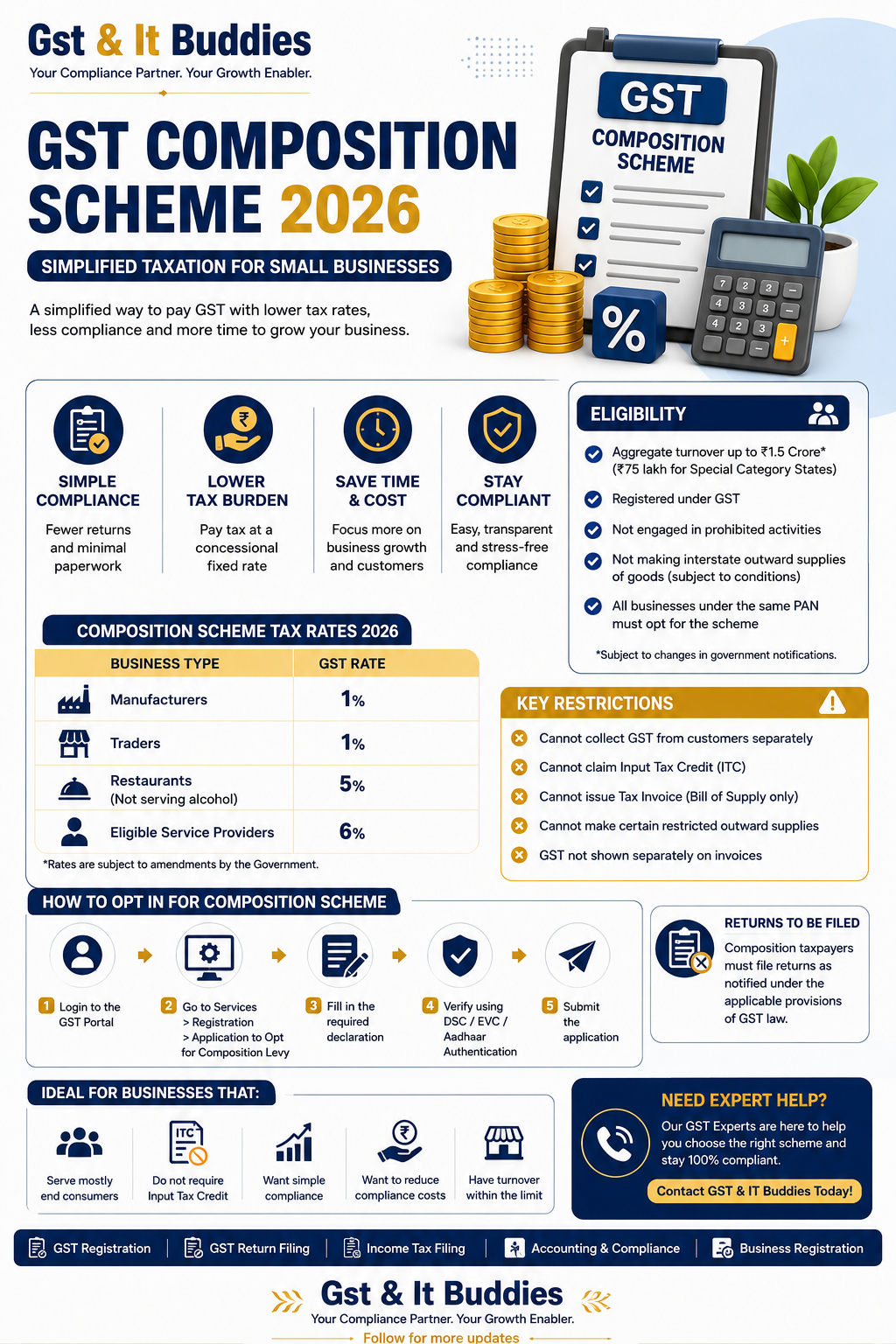
The GST Composition Scheme 2026 is designed to reduce the compliance burden for small businesses in India. Instead of filing multiple GST returns and maintaining extensive records, eligible taxpayers can pay tax at a fixed percentage of their turnover, thereby enjoying a simplified compliance process. If you're a small business owner, retailer, trader, manufacturer, or restaurant owner, understanding the Composition Scheme can help you save time, reduce paperwork, and focus on business growth. In this guide, we'll explain everything you need to know about the GST Composition Scheme in 2026.
What is the GST Composition Scheme?
The GST Composition Scheme is a simplified taxation system introduced under the GST Act for small taxpayers.
Eligible businesses pay GST at a prescribed rate based on their turnover rather than the normal GST rates applicable to goods and services.
The scheme minimizes compliance requirements and makes GST management easier for small businesses.
GST Composition Scheme Turnover Limit 2026
Businesses can opt for the Composition Scheme if their aggregate turnover during the previous financial year does not exceed the prescribed limit under GST law.
Currently, the turnover limit is:
- Up to ₹1.5 crore for most states
- Up to ₹75 lakh for certain Special Category States
Always verify the latest government notifications, as turnover limits may change.
Who is Eligible for GST Composition Scheme?
A taxpayer can opt for the Composition Scheme if:
- Aggregate turnover is within the prescribed limit.
- The business is registered under GST.
- Goods or services supplied comply with Composition Scheme provisions.
- The taxpayer is not engaged in prohibited activities under GST law.
- All businesses operating under the same PAN opt for the scheme.
Who Cannot Opt for the Composition Scheme?
The following taxpayers are generally not eligible:
- Businesses making interstate outward supplies of goods (subject to applicable provisions).
- E-commerce sellers required to collect TCS through specified operators.
- Manufacturers of notified goods restricted under GST law.
- Casual taxable persons.
- Non-resident taxable persons.
GST Composition Scheme Tax Rates 2026
The applicable tax rates generally are:
| Business Type | GST Rate |
|---|---|
| Manufacturers | 1% |
| Traders | 1% |
| Restaurants (Not serving alcohol) | 5% |
| Eligible Service Providers | 6% |
Rates are subject to amendments by the Government.
Benefits of GST Composition Scheme
1. Easy Compliance
Businesses file fewer GST returns compared to regular taxpayers.
2. Lower Tax Burden
Tax is paid at a concessional fixed rate.
3. Less Paperwork
Bookkeeping and GST documentation requirements are significantly reduced.
4. Better Business Focus
Owners spend less time on GST compliance and more time growing their business.
5. Reduced Compliance Costs
Professional compliance expenses are generally lower.
Restrictions Under the Composition Scheme
Businesses registered under the scheme cannot:
- Collect GST from customers separately.
- Claim Input Tax Credit (ITC).
- Issue Tax Invoices (they issue a Bill of Supply instead).
- Make certain restricted outward supplies under GST provisions.
- Display GST separately on invoices.
Documents Required
To opt for the Composition Scheme, businesses typically require:
- GST Registration Certificate
- PAN Card
- Aadhaar Card
- Business Address Proof
- Bank Account Details
- Mobile Number
- Email ID
How to Opt for GST Composition Scheme
Follow these simple steps:
Step 1
Login to the GST Portal.
Step 2
Navigate to:
Services → Registration → Application to Opt for Composition Levy
Step 3
Complete the required declaration.
Step 4
Verify the application using DSC, EVC, or Aadhaar Authentication.
Step 5
Submit the application.
Once approved, your business will be taxed under the Composition Scheme from the applicable date.
GST Returns Under Composition Scheme
Composition taxpayers are generally required to comply with the applicable return filing requirements notified under GST law.
Ensure returns are filed on time to avoid penalties and maintain compliance.
Can You Switch Back to the Regular Scheme?
Yes.
A taxpayer may voluntarily opt out of the Composition Scheme or become ineligible if the prescribed conditions are no longer met.
Once switched to the regular scheme, normal GST provisions—including tax invoices, Input Tax Credit eligibility (subject to law), and regular compliance—apply.
Is GST Composition Scheme Right for Your Business?
The scheme is ideal if:
- You are a small business owner.
- Most customers are end consumers.
- You don't require Input Tax Credit.
- Your compliance budget is limited.
- Your turnover falls within the prescribed limit.
If your customers are primarily businesses that claim ITC, the regular GST scheme may be more suitable.
Common Mistakes to Avoid
- Crossing the turnover limit without timely action.
- Collecting GST while under the Composition Scheme.
- Claiming Input Tax Credit.
- Issuing tax invoices instead of Bills of Supply.
- Missing GST return filing deadlines.
- Ignoring eligibility conditions before opting in.
Frequently Asked Questions (FAQs)
What is the turnover limit for the GST Composition Scheme in 2026?
Generally, up to ₹1.5 crore for most states and ₹75 lakh for certain Special Category States, subject to government notifications.
Can service providers opt for the Composition Scheme?
Our experts ensure your business remains fully compliant while helping you choose the most suitable GST option.
Conclusion
The GST Composition Scheme 2026 offers a simple and cost-effective compliance solution for eligible small businesses. With lower tax rates, fewer filing requirements, and easier record-keeping, it can be a practical choice for businesses that meet the eligibility criteria. Before opting in, review the latest GST rules and evaluate whether the scheme aligns with your business model and customer base.
Need help with GST Registration or the Composition Scheme? Contact GST & IT Buddies today for professional GST compliance and advisory services.