




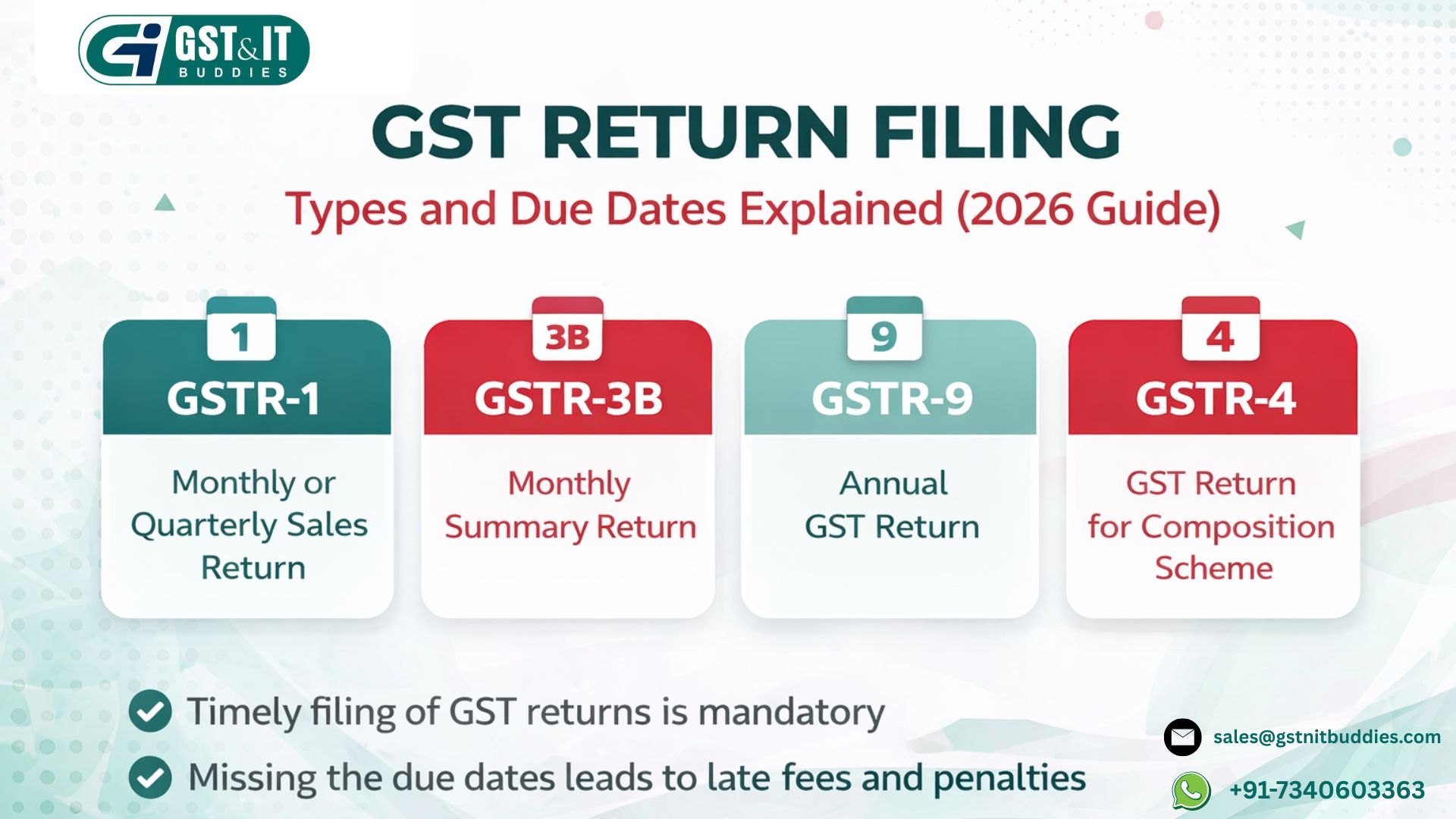
GST Return Filing is an essential compliance requirement for businesses registered under the Goods and Services Tax (GST) system in India. Every registered taxpayer must report details of their sales, purchases, tax collected, and input tax credit (ITC) through GST returns filed on the GST portal. Timely filing of GST returns helps businesses maintain compliance, avoid penalties, and ensure smooth claiming of input tax credit. This guide explains the different types of GST returns and their due dates, which every taxpayer should know. What is GST Return Filing? A GST return is a document filed by a registered taxpayer that contains details of: Outward supplies (sales) Inward supplies (purchases) GST collected from customers Input Tax Credit (ITC) Total tax liability These returns are submitted online through the GST portal. GST return filing allows the government to monitor tax compliance and ensure proper tax collection.
Types of GST Returns in India
There are several types of GST returns depending on the category of taxpayer and the nature of transactions. The most commonly filed GST returns are explained below.
1. GSTR-1 – Return for Outward Supplies
GSTR-1 is a return that contains details of all sales transactions made by a registered taxpayer during a month or quarter.
Details Included in GSTR-1
-
Invoice-wise sales details
-
Export sales
-
Debit notes and credit notes
-
Taxable outward supplies
-
B2B and B2C transactions
Due Date
-
Monthly filing: 11th of the next month
-
Quarterly filing (QRMP scheme): 13th of the month following the quarter
Who Must File
All regular GST-registered taxpayers must file GSTR-1.
2. GSTR-3B – Monthly Summary Return
GSTR-3B is a summary return where taxpayers report their overall tax liability and pay GST.
Information Reported
-
Total sales
-
Total purchases
-
Input Tax Credit claimed
-
GST payable
GSTR-3B is one of the most important GST returns because tax payment is made while filing this return.
Due Date
Generally, the 20th of the next month.
Some states have staggered due dates, such as the 22nd or 24th, depending on turnover.
3. GSTR-2B – Auto-Generated ITC Statement
GSTR-2B is an auto-generated statement that shows the Input Tax Credit available to a taxpayer based on returns filed by suppliers.
Purpose of GSTR-2B
-
Helps taxpayers claim correct ITC
-
Avoids excess or incorrect tax credit claims
-
Improves GST compliance
Generation Date
14th of every month
Taxpayers should verify GSTR-2B before claiming Input Tax Credit in GSTR-3B.
4. GSTR-9 – Annual GST Return
GSTR-9 is an annual return that summarises all GST transactions made during a financial year.
Information Included
-
Total sales and purchases
-
Input tax credit claimed
-
Taxes paid during the year
-
Amendments made during the year
Due Date
31st December of the following financial year
Example:
For FY 2024-25 → Due Date: 31 December 2025
Who Must File
All regular GST taxpayers except certain categories like:
-
Composition scheme taxpayers
-
Input service distributors
-
Casual taxable persons
5. GSTR-4 – Return for Composition Scheme
Businesses registered under the GST Composition Scheme must file GSTR-4 annually.
The composition scheme is designed for small businesses with lower turnover, allowing them to pay tax at a fixed rate with simplified compliance.
Due Date
30 April, following the financial year
Summary of GST Return Due Dates
| GST Return | Purpose | Due Date |
|---|---|---|
| GSTR-1 | Outward supplies (sales) | 11th of next month |
| GSTR-3B | Summary return and tax payment | 20th of next month |
| GSTR-2B | ITC statement | 14th of next month |
| GSTR-9 | Annual return | 31 December |
| GSTR-4 | Composition scheme return | 30 April |
Penalty for Late GST Return Filing
Late filing of GST returns results in late fees and interest.
Late Fee
-
₹50 per day (₹25 CGST + ₹25 SGST)
-
₹20 per day for Nil returns
Interest on Late Tax Payment
18% per annum on unpaid tax.
Continuous delay may also lead to GST notices from tax authorities.
Importance of Filing GST Returns on Time
Timely GST return filing offers several advantages:
-
Avoid penalties and late fees
-
Maintain GST compliance
-
Claim proper input tax credit
-
Improve business credibility
-
Avoid GST departmental notices
Businesses should maintain accurate records and file GST returns regularly to ensure smooth compliance.
Conclusion
Understanding the types of GST returns and their due dates is crucial for every GST-registered business. Proper and timely GST return filing helps businesses remain compliant with tax laws and prevents unnecessary penalties.
Whether you are a small business owner, trader, or service provider, staying up to date with GST return requirements ensures smooth financial and tax management.